


Starting the School Year with Good Habits
With the start of school and the changing of the seasons, the last days of summer are energized in a unique way. We admire our shiny new books (even if they’re only new to us), carefully pick out our notebooks, pencils, and other materials, and plan out how beautifully organized our days are going to be.
But if your family is anything like mine, the organization falls by the wayside as soon as illness or a major Feast (or an out-of-town friend or a big extracurricular activity, etc.) comes knocking.
by Mindi Popovich-Schneider
With the start of school and the changing of the seasons, the last days of summer are energized in a unique way. We admire our shiny new books (even if they’re only new to us), carefully pick out our notebooks, pencils, and other materials, and plan out how beautifully organized our days are going to be.
But if your family is anything like mine, the organization falls by the wayside as soon as illness or a major Feast (or an out-of-town friend or a big extracurricular activity, etc.) comes knocking.
I am decidedly not good at implementing new habits, so I have to work hard at making them stick. Here are a few things that have helped me, and will hopefully help you too.
Think of rhythms, not schedules.
I have noticed that my kids don’t do well without any structure, but at the same time, our days vary far too much for me to even attempt writing down a schedule. Some days we all sleep in, Papa gets to go into work a bit later, we need to spend more time cleaning the house, or we have liturgy for a special feast…and so on.
Instead, on the advice of a friend, I’ve started to think in terms of rhythms. “These are the things we do in the morning: prayers, breakfast, make beds/tidy, school/chores. They might vary in order or length of time spent, but that’s generally what we want to accomplish each day. These are the chores/school tasks we do on Mondays; this is what we do on Tuesdays, etc. Those things may not always happen at the same time each week, but that’s typically what we try to accomplish on that day.” Thinking in general terms helps us go with the flow, while still giving a loose shape to our days.
Start small.
If you struggle to get consistent with a habit, consider breaking it down into smaller components. For example, if you find it hard to fit exercise into your day, don’t go straight to adding trips to the gym or a three-mile walk into your normal routine. Start off with something much smaller that can fit more naturally into the habits you already have. Perhaps when you first go downstairs for the day, you can pause at the bottom of the stairs and do a few reps of stair-steps (i.e., up and down the bottom step a certain number of times). Or maybe you could have your family do some light stretching before everyone sits down to start their schoolwork. Then, once you’ve mastered that small habit, you can think of ways to add onto it, until the habit has become what you originally had in mind.
Another example: if you want to pray more, don’t go straight to trying to do an Akathist each week. Start by praying one or two rounds on your prayer rope. Once you have mastered that, add in one or two shorter prayers, and so on. When you do face some major disruption to your routine, you’ll know how to start over.
Create physical barriers.
Each morning, I feel a lot of pressure to get work done before my kids wake up for the day. That results in prayers–and especially reading my Bible–always getting pushed to the side. Recently, I’ve started putting my prayer rope and Bible on top of my laptop each night–meaning that I have to physically remove them before I can start work…and let me tell you, the guilt makes it very hard to move them aside without engaging with them!
Follow your natural inclinations.
It would be really great if my family (myself included) naturally always put their shoes and socks away in their rooms the moment they took them off. That just doesn’t happen. Instead of fighting it, I made room for a second shoe rack in our coat closet. Our “pop on” shoes can stay by the back door, but anything else goes into the closet, just a few feet away. Socks don’t make it up to the laundry basket? Boom, now there’s a laundry basket in the downstairs closet (yes, I do still constantly have to remind my three year old that’s where they go).
Going back to the goal of exercising more: a friend put a kettlebell in his kitchen so that when he’s between tasks making dinner, he can get in a bit of weightlifting. An added benefit is that if you have toddlers under foot, you can distract them by having them lift weights (or attempt to lift weights) when you have to attend to the food.
The oft-discussed habit stacking falls under this category too. If there’s a habit you already have (e.g., a cup of coffee every morning), add a habit onto it, such as doing squats or rounds on your prayer rope while the coffee brews (you might have to stare at the pot while you exercise/pray to make sure you don’t forget to do it!). My husband and I wanted to start saying prayers at the end of our meals but could never quite make it work, primarily because we and my mother-in-law always linger at the table to chat before we start cleaning up. My oldest kiddo always finishes eating before everyone else and must ask to be excused, so we attached praying to that instead of to when the adults were ready to leave the table.
Don’t try to change the way your household functions; instead, find ways to shape new, good habits to the way your family already naturally works.
Do it together.
I find that I enjoy doing most things ten times more when I’m doing them with my family–plus, getting my kids involved means they’re developing better habits too. Instead of making my kids clean up before bed–or waiting until they’re asleep to just do it myself–we’ve started cleaning up as a family. Sometimes we’ll put on music and blitz-tidy as long as the song plays. (Yes, of course my kids still complain, but I have more fun!)
The same applies to other chores as well. When my son was two, we made up a silly game involving folding socks to occupy him while we put away laundry. It very naturally segued into him folding and putting away his own clothing.
I know none of these concepts are particularly revolutionary, but I do hope that as you prepare for the new liturgical year and school year, they will serve as motivations to grab those habits you’ve been wanting to implement–without feeling pressure to do too much or to be perfect. May God bless you, your family, and all you undertake in the upcoming year!

2026 Retreat Reflection
Clean, coldly sharp mountain air takes away my breath as I walk out of the cabin on an early weekend morning. The sun peeps from behind puffy, white clouds that look like creamy, foamy ocean waves, trying to lend some golden warmth to chase away the chilliness of this glorious morning…
by Sophia, SEM Intern
Clean, coldly sharp mountain air takes away my breath as I walk out of the cabin on an early weekend morning. The sun peeps from behind puffy, white clouds that look like creamy, foamy ocean waves, trying to lend some golden warmth to chase away the chilliness of this glorious morning. The dewy grass kisses my feet which are exposed since I put on sandals without realizing they weren’t appropriate for the morning walk. Mountains all around–the biting air seeping into my skin hurries me on my way to the simply beautiful St. Ignatius Chapel for liturgy, the thought of the homey and grace-filled wooden chapel snug with the sweet scent of incense embracing me; a beautiful liturgy I was invited to chant at, along with wonderful and pious teens.
The East Saint Emmelia Ministries conference was such a blessing to be at and experience. Every morning started with a six thirty liturgy, where the youth chanted the whole service in Byzantine style. Liturgy concluded with a blessing from the priest, then everyone headed to the dining hall for breakfast. A spacious, cabin structure ringing with the conversation of parents talking over morning coffee and children’s happy banter. After Father gave the blessing, we all lined up to partake of bagels and cereal, coffee and warm tea. My favorite part of breakfast was probably sitting at the table with all the teens, debating controversial topics. The raffles we did at each meal were quite an entertainment, though. Miss Mindi had us, the interns, do the raffles with the help of “little friends”--the younger kids. Something was going on in those raffle boxes, for whoever pulled out the name would realize that it was their own name or their parent’s name that they saw, smiling back up at the befuddled individual. Breakfast would conclude with a prayer, then everyone went to their assigned activities.
As teens, we had lots of outdoor activities, both fun and humbling to the youth’s spirit. My personal favorite activities were the talk with Mr. Andrew Kern on technology and the very creative talent show. The talk with Mr. Andrew Kern was especially edifying. He approached us in an unexpected manner, asking us what he was going to tell us about technology. The conversation diverted to AI, where pros and cons were listed (mostly cons). What stuck out to me most was Mr. Kern making us realize that AI is not a toy to be used lightly, nor should we overlook it superficially. The ending message he gave us to remember was this: make yourselves dangerous, in a way that danger won’t turn you over your head. Inform yourself on the wiles of the world so you know how to combat them.
The talent show was a piece of captivating acts of art coming alive right in front of our eyes. From the iconic Anakin vs Obi Wan lightsaber duel, to mesmerizing piano recitals, the famous Sir Lancelot and King Arthur joust, groovy gospel band, and a sentimental solo song “She Used to be Mine”, the evening was surely a success.
Late evening would take us each night to a small but cheery bonfire, with sticky s’mores and hot tea. After our fill of warm treats and newly-acquired knowledge gained from deep discussion around the fire’s crackling flames, everyone trudged to the chapel for a compline service.
Overall, the conference was a beautiful time of prayer, a time spent with inspiring and fun people, a time of revival and joy. It was truly a blessing to be there!
Masculinity, Femininity, and the Search for Meaning
Modern culture often speaks about masculinity and femininity with uncertainty. At times, the differences between men and women are treated as insignificant, while at other times they are reduced to stereotypes, performances, or struggles for power.
by Londyn, SEM Intern
Modern culture often speaks about masculinity and femininity with uncertainty. At times, the differences between men and women are treated as insignificant, while at other times they are reduced to stereotypes, performances, or struggles for power. Many young people grow up surrounded by conflicting messages about relationships, careers, and purpose. Yet beneath this confusion, there often remains a quieter longing that modern culture can never satisfy: the desire for love, stability, family, and a meaningful life shared with others.
Orthodox Christianity approaches masculinity and femininity not as competing identities, but as complementary expressions of the human person. Men and women are created in the image of God and share the same spiritual dignity and calling toward holiness. At the same time, they often express love, sacrifice, responsibility, and care in distinct yet complementary ways. The Church does not see these differences as limitations or social constructions, but as part of the beauty and order of creation itself.
Modern society frequently presents fulfillment as radical independence. Success is often measured through personal achievement, status, wealth, or freedom from obligation. Yet despite these promises, many people still feel deeply lonely, restless, and uncertain about what lasting happiness actually looks like. A longing for marriage, family, rootedness, and faithful community has not disappeared. If anything, it has become more visible precisely because modern life often feels fragmented, temporary, and disconnected.
Growing up in a family with seven children deeply influenced my understanding of these things from an early age. Life is rarely quiet, and our days are filled with constant movement, responsibility, conversation, and shared routines. Yet there is also a warmth and steadiness within it. Family life teaches people to think beyond themselves. It forms patience, forgiveness, sacrifice, humility, and loyalty in ordinary ways that often go unnoticed. Shared meals, laughter, helping care for younger siblings, and simply living closely with others create a sense of belonging that cannot easily be replaced by modern individualistic pursuits.
At the same time, I do not believe masculinity or femininity require rejecting education, ambition, creativity, or experiences beyond the home. This summer, before beginning college, I will be studying abroad in Denmark for a month, and last winter I traveled to Germany with my parents. Traveling changes the way a person sees the world. It teaches humility and attentiveness. Seeing unfamiliar places, hearing different languages, and encountering other cultures broadens the mind and deepens appreciation for beauty. Interestingly, the more people experience the restlessness of modern life, the more many begin to appreciate the goodness of permanence, tradition, and home.
For many women, modern culture often presents two equally unsatisfying extremes. On one side, femininity is reduced to appearance, attention, or performance. On the other, domestic life, marriage, and motherhood are sometimes treated as lesser than professional success or radical independence. Yet many young women still feel drawn toward a quieter and more rooted vision of life: one centered around faithfulness, love, family, and the desire to create a home filled with warmth, peace, and stability.
Orthodoxy understands this desire not as weakness, but as a profound form of vocation. Homemaking, in its deepest sense, is not merely the maintenance of a household. It is the cultivation of an environment where souls are nurtured through patience, discipline, tenderness, forgiveness, and love. Such work may appear ordinary from the outside, yet it quietly shapes future generations and forms the spiritual atmosphere of family life. At the same time, the Church also honors women through many different callings — motherhood, scholarship, service, monasticism, hospitality, teaching, and countless other forms of faithful living.
Masculinity has also become deeply confused within modern culture. Online culture often reduces manhood to status, wealth, physical appearance, domination, or control over others. Yet these images ultimately leave many men isolated and dissatisfied because they mistake strength for aggression and confidence for vanity.
The Orthodox understanding of masculinity is far deeper and more demanding. A good man remains faithful, dependable, disciplined, and willing to sacrifice himself for others. He protects and provides not out of pride or the desire for control, but out of love and responsibility. His strength exists not for self-glorification, but for service. Masculinity requires humility, courage, steadiness, patience, and self-control. It asks a man to remain trustworthy even when life becomes difficult, exhausting, or painful.
Likewise, true femininity is not passive, shallow, or intellectually narrow. It requires deep emotional and spiritual strength. A woman often creates the atmosphere of family and community life through attentiveness, wisdom, compassion, endurance, and steadfast love. Both masculinity and femininity therefore involve sacrifice and self-giving. Neither is centered on self-fulfillment alone. Instead, both find meaning through communion, responsibility, devotion, and love directed toward God and other people.
The Orthodox Church presents Christ as the perfect image of humanity itself. In Him, strength and humility exist together completely. Christ reveals that greatness is found not through domination, but through sacrificial love. The Church also honors the Theotokos as the highest example of human faithfulness and spiritual beauty. Her humility was not weakness, but profound strength rooted in obedience and trust in God. Together, Christ and His mother reveal the fullness of what humanity is meant to become.
Though I am only eighteen and just beginning adulthood, I find myself increasingly drawn toward a life centered around faith, education, friendship, family, and service. I look forward to college, learning, traveling, and experiencing the wider world, yet I also hope to marry, raise children, and build a home of warmth, devotion, stability, and love. That desire does not feel restrictive to me. Rather, it feels deeply meaningful because family life touches something enduring within human nature itself.
Modern society often encourages constant reinvention and independence from all obligation. Yet beneath the noise and movement of contemporary life, many people still long for permanence — for homes filled with laughter, children raised with care, friendships rooted in faithfulness, and lives ordered toward something greater than personal success alone. Perhaps this longing endures because it reflects something fundamental within the human soul. Even in a restless age, the quiet beauty of faithful love, family, sacrifice, and communion continues to endure.
Exodus Lesson Plan: Ten Plagues, Ten Commandments
This month, we are going to look at the ten plagues of Egypt and what they, in their rich symbolism, reveal about God. We will also connect them to the Ten Commandments. Help your students make the connections themselves, giving them just as much information as they need to do so. Begin by reading Exodus 7-11 and Exodus 20:2-17. Then, print off the table on the next page and fold it in half to refer back to throughout the lesson.
by Mindi Popovich-Schneider
This month, we are going to look at the ten plagues of Egypt and what they, in their rich symbolism, reveal about God. We will also connect them to the Ten Commandments. Help your students make the connections themselves, giving them just as much information as they need to do so. Begin by reading Exodus 7-11 and Exodus 20:2-17. Then, print off the table on the next page and fold it in half to refer back to throughout the lesson. Open the discussion by asking these questions:
What aspects of the story are repeated with each plague? Why do you think that is?
Go back and look at verses 7:5, 8:10, 8:22, 9:14, 9:29, 10:2, and 11:7. How do the different plagues show us “who God is”?
The first plague: Blood in the Nile / The First Commandment
The ancient Egyptians greatly revered the Nile River, viewing it as the source of life-giving waters. It was closely associated with the god Hapi, the personification of the annual flooding of the Nile. This event was important to the Egyptians, as it created fertile soil in an otherwise dry and arid land. So why would God, the true Living Water, turn these waters into blood–a symbol of death?
Next, consider the first commandment: Thou shalt have no other gods before me. How is this related to God overcoming the Nile River–what the Egyptians perceived as the source of all life?
The second plague: The Frogs/The Second Commandment
It’s interesting to note that Hapi, in many depictions, was attended by frogs. At the same time, the frog-headed fertility goddess Heqet was also greatly revered: in Egyptian thought, she was not the source of life, like the Nile, but she supervised the last moments of birth–the child’s entrance into the world. She comes from the source of life–an image of it.
The frogs covered the earth, infesting the Egyptians’ beds, pantries, and feeding troughs. It took three days for the frogs to die off, but the land stank of frogs for a long time. As St. Gregory of Nyssa says, “Their breeding in these numbers was not natural, but Moses' command changed the normal density of frogs.” God took a creature, an image of fertility, and made its own fertility the enemy of the Egyptians that worshiped it.
Consider the second commandment: Thou shalt not make unto thee any graven images. How does this commandment overturn the second plague?
The third plague: The Gnats (Lice)/The Third Commandment
Exodus 8:17 says that when Aaron stuck the earth with his staff, “All the dust throughout the land of Egypt became lice.” Imagine how many lice that must have been! There is no known Egyptian god of gnats specifically, but there is a god of earth (or dust): Geb. This god is also closely associated with Hapi–in fact, one of Hapi’s titles, or epithets, is “friend of Geb.” Like Hapi and Heqet, Geb is associated with fertility, as the earth brings forth fruit.
Thus, as the True God made man from dust, Aaron–through the power of the True God–makes destruction from the Egyptians’ idea of life.
Now, consider the third commandment. Thou shalt not take the name of the Lord Thy God in vain. How does this relate to lice? This one’s a little trickier: the Hebrew word for lice (“ כּן” or “kên”) is similar to the another word “ כּנה” or “kânâh,” which means “to call by name.” (While many concordances make a connection between the two words, we do not know if there’s an actual etymological connection, but they certainly sound similar!)
The fourth plague: The Flies/The Fourth Commandment
Unlike the other plagues, this one is not as clearly connected to a specific pagan god, but there are many interesting elements to it. God says this: “But on that day I will set apart the land of Goshen, where my people live, so that no swarms of flies shall be there, that you may know that I the LORD am in this land. Thus I will make a distinction between my people and your people.”
The fourth commandment is: “Remember the Sabbath day to keep it holy.” This day, the Sabbath, is distinguished or set apart from the other days as holy–just as God has set apart his holy people from the Egyptians.
The fifth plague: The Pestilence of Livestock/The Fifth Commandment
Before the fifth plague, God says, “Let my people go, so that they may worship me. If you refuse to let them go and continue to hold them back, the hand of the LORD will bring a terrible plague on your livestock in the field—on your horses and donkeys and camels and on your cattle and sheep and goats.” Of course, Pharoah refuses.
There are many different gods associated with cows in particular, but one stands out as especially important: the apis bull. This bull (or rather, bulls) was sacred, as its continual ritualistic sacrifice and rebirth was a significant part of worship. Do you see any echo–or perhaps fulfillment–of this in our worship as Orthodox Christians? Where do “sacred” cows appear elsewhere in the book of Exodus?
“Honor thy father and mother that thy days may be long upon the land, the Lord thy God giveth thee,” reads the Fifth Commandment. Livestock would have been considered part of a family’s generational wealth–what was passed down from father to son, or given as part of a young woman’s dowry. The destruction of livestock symbolized the destruction of the family’s estate–an inversion of God’s promise in the Fifth Commandment.
The sixth plague: Boils/The Sixth Commandment
God tells Aaron to "Take handfuls of soot from a furnace and have Moses toss it into the air in the presence of Pharaoh. It will become fine dust over the whole land of Egypt, and festering boils will break out on men and animals throughout the land." We have multiple accounts from Ancient Egypt of sacrifice or punishment by immolation. Once again, with this sixth plague, God is showing the Egyptians the weight of their own actions, following it up by directing his own people to avoid the same sin: “Thou shalt not kill.”
This plague also overturns the power of Isis, the goddess of medicine.
The seventh plague: Hail/The Seventh Commandment
Before sending down the hailstorm, God tells Pharaoh: “Let my people go, so that they may worship me, or this time I will send the full force of my plagues against you and against your officials and your people, so you may know that there is no one like me in all the earth. For by now I could have stretched out my hand and struck you and your people with a plague that would have wiped you off the earth. But I have raised you up for this very purpose, that I might show you my power and that my name might be proclaimed in all the earth.”
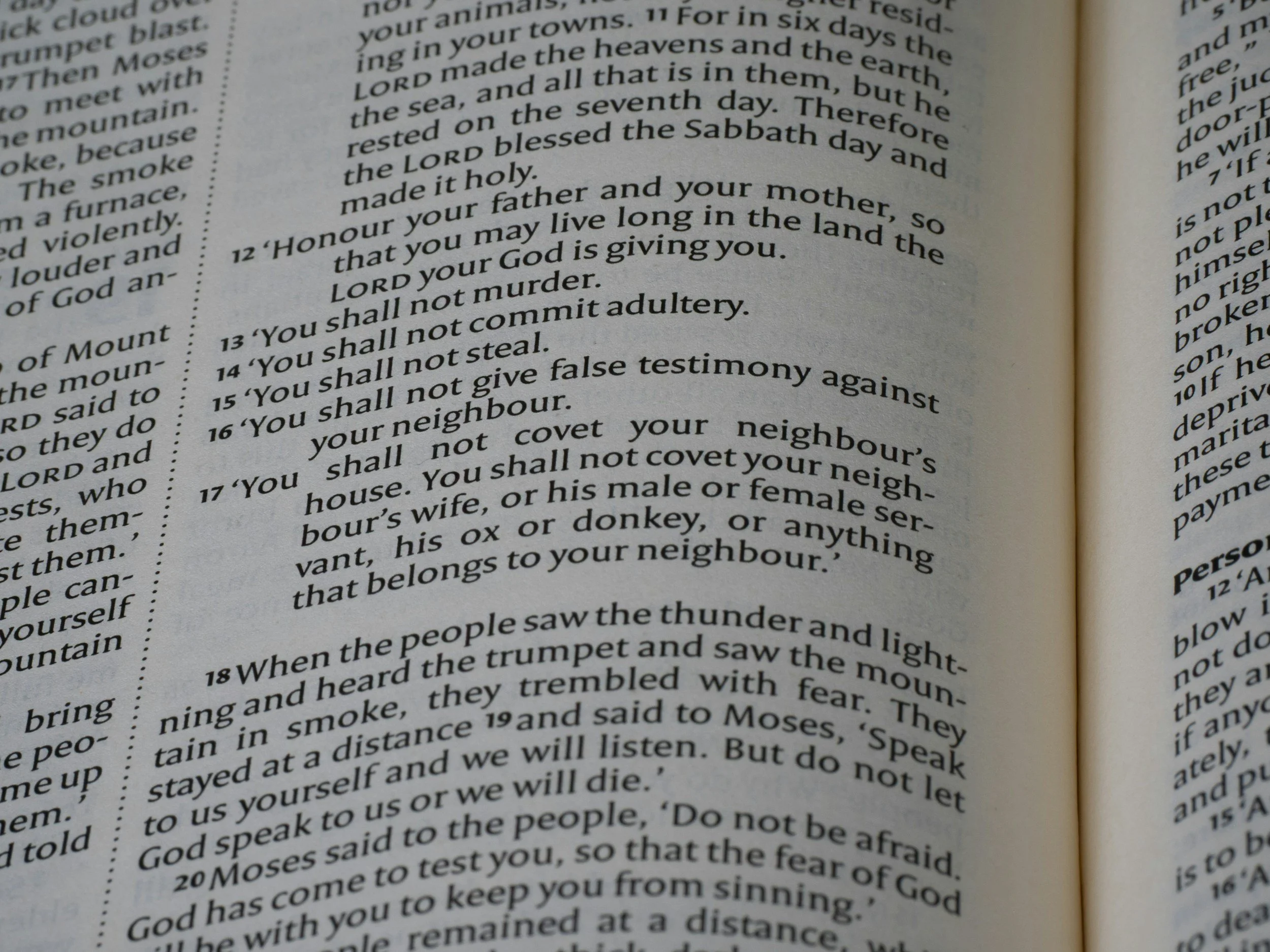
The Seventh Commandment is, “Thou shalt not commit adultery.” In God’s warning, we hear the consequences of what happens when He is forsaken for worship of a false god, as when a spouse forsakes their true spouse for a false one. Additionally, we are told that in this plague, “The LORD sent thunder and hail, and lightning flashed down to the ground,” which calls to mind the destruction of Sodom & Gomorrah: “Then the Lord rained down burning sulfur on Sodom and Gomorrah—from the Lord out of the heavens. [...] [Abraham] looked down toward Sodom and Gomorrah, toward all the land of the plain, and he saw dense smoke rising from the land, like smoke from a furnace.” (Genesis 19). Those wicked cities were destroyed for their debauchery.
The eighth plague: Locusts/The Eighth Commandment
Next, God sends locusts that will “cover the face of the ground so that it cannot be seen. They will devour what little you have left after the hail, including every tree that is growing in your fields.” Just as the Egyptians, in enslaving the Israelites, had stolen everything from them, God takes what little is left of the Egyptians’ prosperity. Later, he reminds the Israelites that now that they are free, they must not do what the Egyptians did to them. In the Eighth Commandment, He says, “Thou shalt not steal.”
The ninth plague: Darkness/The Ninth Commandment
Three days of darkness covers the land of Egypt–God showing that it is He, not the Egyptian god Ra, who gives light. (It is, of course, very significant that the darkness lasts for three days!)
The Ninth Commandment tells us: “Thou shalt not bear false witness against thy neighbor.” When we lie–or bear false witness–we are obscuring the Light of truth, bringing about darkness. According to St. Gregory of Nyssa, the Egyptians “lived in unchanging gloom,” but His people are called to “walk in the Light.” (1 John 1:7).
The tenth plague: The Firstborn/The Tenth Commandment
In Ancient Egypt, the Pharaoh himself was worshiped as a deity–the son of Ra made flesh. In taking the firstborn sons of Egypt, God is sending the Egyptians’ cruelty back on themselves, both as punishment for their murder of the firstborn sons of Israel and as punishment for their jealous enslavement of the Hebrews. More than that, He is also showing that He is the only true God: not even Pharaoh can escape God’s hand.
The Tenth Commandment says, ““Thou shalt not covet thy neighbour’s house, thou shalt not covet thy neighbour’s wife, nor his manservant, nor his maidservant, nor his ox, nor his ass, nor any thing that is thy neighbour’s.” The Egyptians were angry that the Israelites had prospered when they came to Egypt. They also feared that the Israelites would become too great, which is why they killed the firstborn sons. God has righted the evil of the Egyptians, now He calls His people to avoid their grave sins.
Further reading:
http://www.newhumanityinstitute.org/pdf-articles/Gregory-of-Nyssa-The-Life-of-Moses.pdf
https://biblethingsinbibleways.wordpress.com/2022/02/27/the-10-plagues-and-the-10-commandments-are-they-connected/ (Note: not an Orthodox source)
Exodus Lesson Plan: Tabernacle to Church
In our last lesson, we looked at the types that appear in Exodus, and how they prefigure the life of Christ and the Orthodox Church. In this lesson, we will take a closer look at the instructions God gave His people for proper worship and compare them to how we worship the true God today.
by Mindi Popovich-Schneider
In our last lesson, we looked at the types that appear in Exodus, and how they prefigure the life of Christ and the Orthodox Church. In this lesson, we will take a closer look at the instructions God gave His people for proper worship and compare them to how we worship the true God today.
The Sanctuary/Altar:
Exodus chapters 25-27 give instructions for how to build the tabernacle, starting with the innermost part and working outwards. The first section talks about the Ark of the Covenant, then the table, and the lampstand. Read Exodus 25 and 27.
Do we still have these items inside the sanctuary/altar (behind the iconostasis and royal doors)? How are they different now? What is their job in our worship?
How is the table different from the altar?
What materials should be used?
The Tabernacle:
Chapter 26 describes the tabernacle itself. As you read, try to visualize the description.
What images decorate the tabernacle?
What are some of the materials used?
What colors?
Draw a picture of the tabernacle and compare it to the layout of an Orthodox church. How are they similar and different? Why do you think those differences might have come about? What shape is an Orthodox temple usually in?
Vestments:
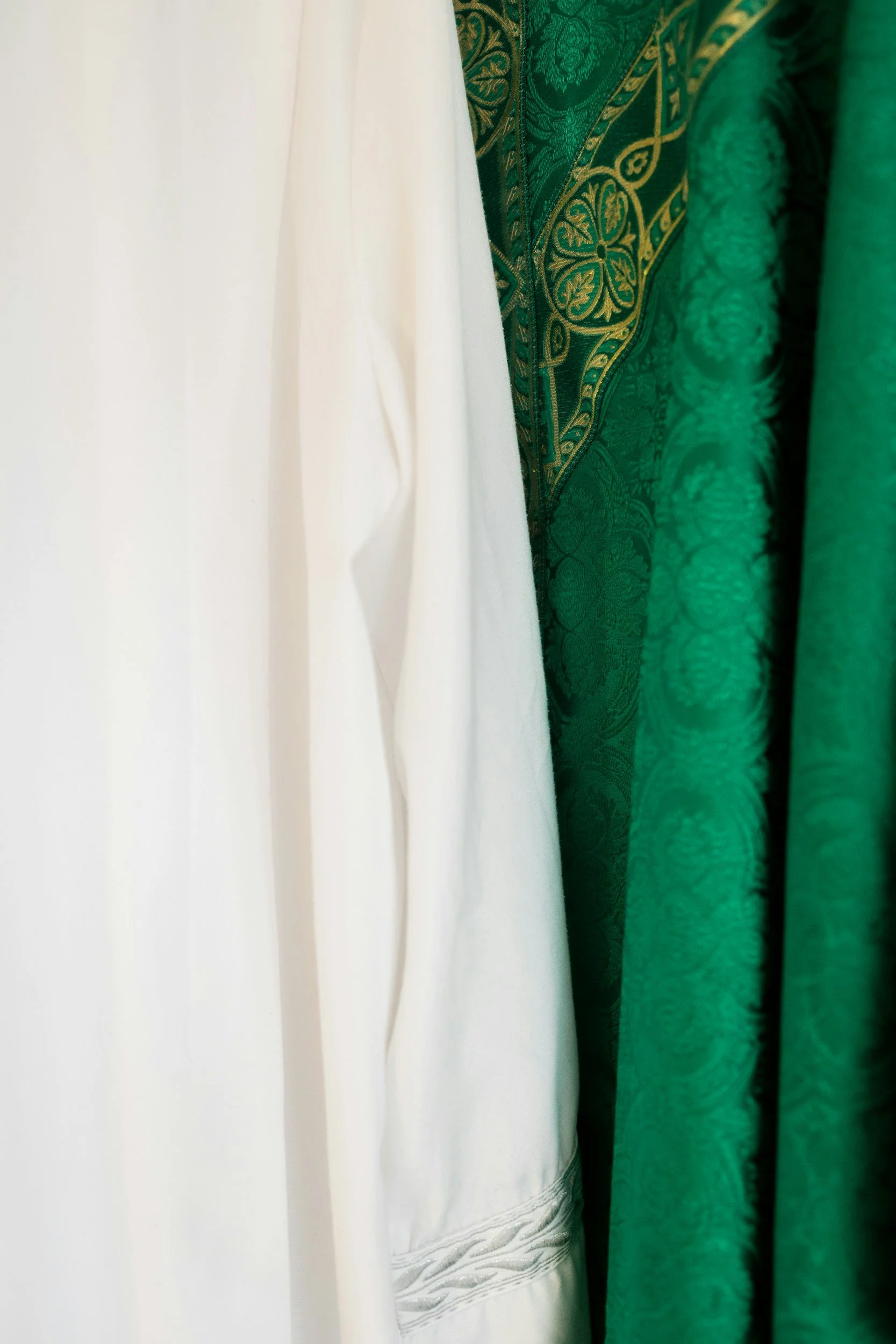
In Exodus 28, God gives Moses instructions for the priestly garments for Aaron “for his consecration, so he may serve me as priest.” The vestments are made up of a breastpiece, an ephod (an “apronlike” garment with shoulder straps), a robe, a woven tunic, a turban and a sash.
Read the chapter and note down the following details:
What colors and fabrics should be used?
What types and colors of stones should be used in each garment…and how many? (You may want to read and compare Genesis 2:10-12 and Revelations 21:10-15)
In what order would a priest put on each garment?
Keeping these details in mind, draw what you think the priestly vestments would look like. Draw a picture of your priest’s vestments. How do the garments compare and contrast? What do you think the purpose of each garment is?
Next, consider the symbolism of the colors, images, and materials used. What does each element remind you of?
Some examples:
Gold: God’s grace
Silver: The goodness in humans, made in the image of God
Bronze: Fallen human nature, refined by God
Blue: Human nature (what the Theotokos contributed to Christ’s incarnation)
Purple: Royalty
Red: Blood of sacrifice/martyrdom
Note: in the Protoevangelium, we learn that the Theotokos was weaving with purple and red, but not blue. Why do you think that might be?
Read the links below for more descriptions of the symbolism of the design of the tabernacle. Then, consider how we have built on or retained these symbols in our beautiful churches!
Further Reading:
https://orthodoxchristiantheology.com/2023/07/20/a-typological-commentary-on-exodus-chapter-25/
https://orthodoxchristiantheology.com/2023/08/14/a-typological-commentary-on-exodus-chapter-26/
https://orthodoxchristiantheology.com/2023/08/20/a-typological-commentary-on-exodus-chapter-27/
https://orthodoxchristiantheology.com/2023/09/06/a-typological-commentary-on-exodus-chapter-28/

Exodus Lesson Plan: Types
When taking up any study of the Bible, it is good to consider the types of God’s plan for our salvation that we see throughout the Old Testament. Typology, the “study of types,” is defined as: “an approach to the interpretation of the Scriptures found in the New Testament itself, and in the writings of the Church Fathers, which sees certain people and events in the Old Testament (Types) as foreshadowing things fulfilled in the New Testament (Antitypes).” You might think of types as a non-verbal, material kind of prophecy!
by Mindi Popovich-Schneider
When taking up any study of the Bible, it is good to consider the types of God’s plan for our salvation that we see throughout the Old Testament. Typology, the “study of types,” is defined as: “an approach to the interpretation of the Scriptures found in the New Testament itself, and in the writings of the Church Fathers, which sees certain people and events in the Old Testament (Types) as foreshadowing things fulfilled in the New Testament (Antitypes).” You might think of types as a non-verbal, material kind of prophecy!
Many types of Christ, the Theotokos, and the Church appear throughout the Book of Exodus. In this lesson, we will explore some of them.
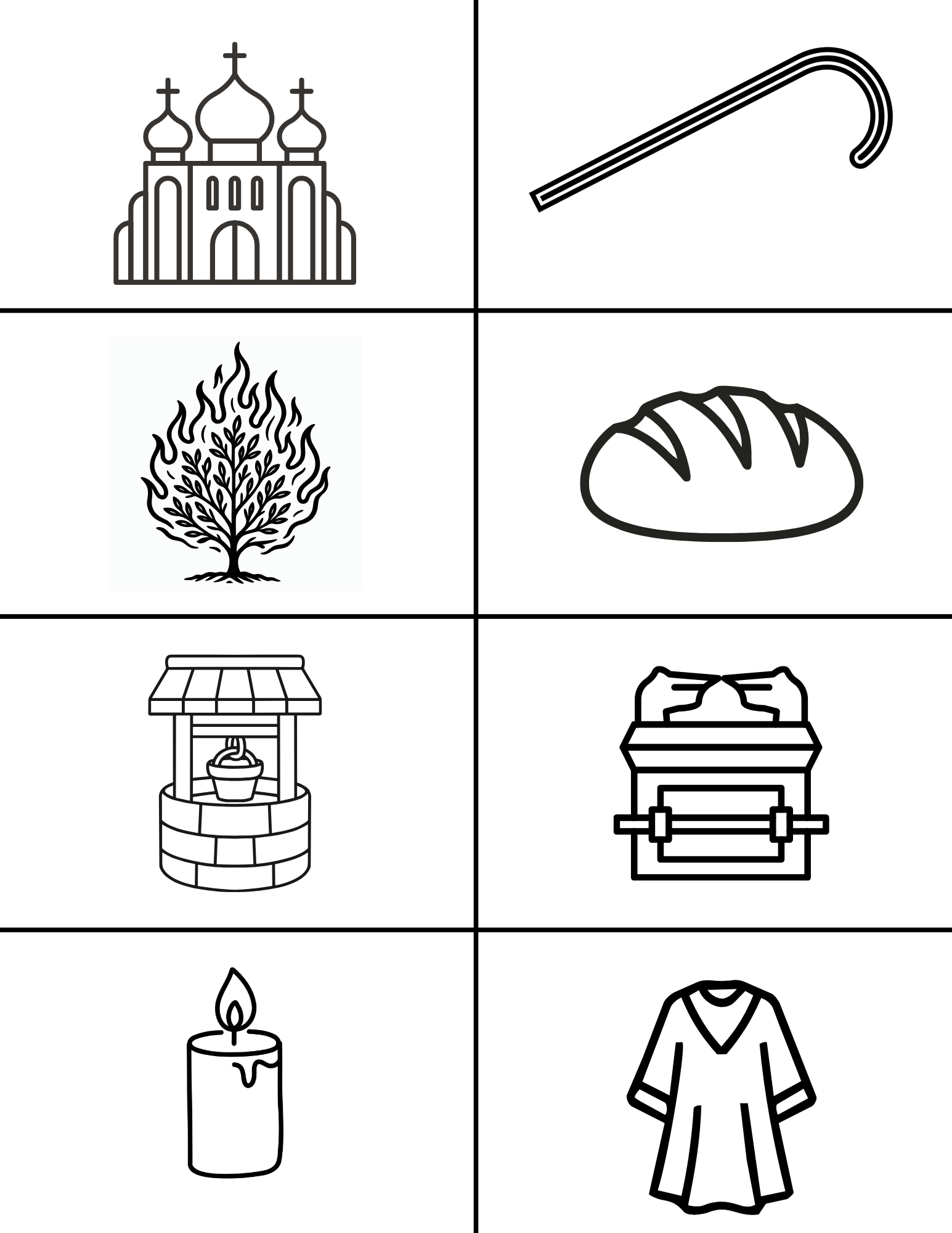
Begin by first reading, then paraphrasing the definition to your students. Offer a few examples from other books of the Old Testament: Jacob’s ladder (Genesis 28:10-12) as a type of the Theotokos, who was the ladder on which Christ descended to earth; the Rod of Aaron (Numbers 17:1-11) as a type of the Holy Cross, which budded with eternal life; etc. Next, make a list of as many types you can think of–specifically ones that appear in the story of Exodus. Finally, read through the following verses and have students identify the types and antitypes in them. For younger children, print off the attached cards and have them choose the one that matches the verses you are reading.
2 – Moses, like Christ, left his position as royalty and became a shepherd
3:1-11 – The Theotokos held Christ in her womb, yet was not burned
16:4 – God fed the Hebrews in the desert with manna; Christ is the bread of life (John 6:31-35)
17:6 – Christ is the living water (John 4:10)
25:10-22 – In the Gospels, the angel Gabriel announces to the Theotokos: “The Holy Spirit will come over you and the power of the Most High will overshadow you” (Luke 1:35). In the same way, the Glory of God sits on the Mercy Seat of the Ark of the Covenant.
25:31-40 – The Theotokos held within herself the Light of the world (John 1:4-5)
27 – These descriptions of the construction of the temple are a type of the Christian life
28 – This chapter details how the priestly garments should be constructed. Christ is the true high priest (Hebrews 4:14), who “clothes Himself in light as in a garment” (Psalm 103:2) and “is clothed in majesty” (Psalm 92:1)
These are just a few examples…how many more can you come up with!? You might also consider where in our liturgy these types are highlighted.
Check out the next section for more information about these and other “types”!
Further reading:
Bible Central. “Moses as a Type & Shadow of Christ.” https://biblecentral.info/library/chapter/moses-type-and-shadow-of-jesus-christ/
Orthodox Christian Theology. “Commentary on Exodus.” https://orthodoxchristiantheology.com/category/commentary-on-exodus/
Orthodox Wiki. “Types.” https://orthodoxwiki.org/Typology

Exodus Lesson Plan: Geography
Goshen, Migdol, Midian, Moab…these names may be familiar to you, but could you find them on a map? This month, as we study the Book of Exodus and its context, we’ll be looking at geography–specifically the Israelites’ route through their desert wanderings.
by Mindi Popovich-Schneider
Goshen, Migdol, Midian, Moab…these names may be familiar to you, but could you find them on a map? This month, as we study the Book of Exodus and its context, we’ll be looking at geography–specifically the Israelites’ route through their desert wanderings.
Read the following verses and make a list of all the places named.
Exodus 13:18-20
Exodus 14:2-3
Exodus 17:1
Exodus 19:1-2
Numbers 33:15-35
Next, look up the locations of those places using an encyclopedia, if possible. If you do not have an encyclopedia available or cannot find the places mentioned, this map from OpenBible might be helpful.
Print off the blank map on the next page and map out each location mentioned in the verses. You might find it helpful to number them as you go. Once you’ve mapped them all out, draw arrows showing their route.
Once you’ve labeled all the places mentioned, try to calculate how many miles they traveled! Keep in mind that the Nile Delta is about 100 miles long.
After you’ve printed the map, use a ruler to find how long the Delta is on your paper (for example, 100 miles = 1 inch).
Measure the arrows you drew to find the approximate length of their journey. For example, if you found a total of 12 inches (including the times they went back and forth), their journey would be 1,200 miles long!
As we journey through Lent, remember the long, tiring journey of the Israelites and run with rejoicing to the promise of our Lord’s glorious Pascha!

Exodus Lesson Plan: Poetry
This month we will be looking at the poetry in the book of Exodus. In Chapter 15, both Moses and his sister Miriam sing hymns of praise after God takes them safely across the Red Sea.
by Mindi Popovich-Schneider
This month we will be looking at the poetry in the book of Exodus. In Chapter 15, both Moses and his sister Miriam sing hymns of praise after God takes them safely across the Red Sea.
Read through Moses’s and Miriam’s hymns.
Make a list of any words you don’t know and look them up in the dictionary.
What do you notice about these songs as you read through them?
Do any particular words or phrases stand out to you?
Do you notice any repetition?
Do you think they used any musical instruments while singing these songs? How do you think they were able to sing such beautiful songs right on the spot?
Where do we find these verses (or “echoes” of them) in the rest of the Bible? For example:
Psalm 77:13-14 echoes Moses’s cry: “Who is so great a God as our God? Thou art the God who workest wonders.” This, of course, became one of our Paschal hymns!
Revelations 15:3 states that St. John hears the angels sing “the song of the servant of God Moses and of the Lamb.”
Where do we find these verses (or similar ideas) in our Liturgy? Some examples:
The whole chapter was once chanted as the first of nine Biblical Odes during Orthros, though St. Andrew of Crete initiated the practice of replacing these with shorter verses. The first verses of our canons still retell this story!
We hear Mose’s introductory line echoed in the first ode of the service of Paraklesis: “Traversing the water as on dry land / and thereby escaping from the toils of Egypt land / the Israelites cried aloud, proclaiming, “To our God and Redeemer, let us now sing!”
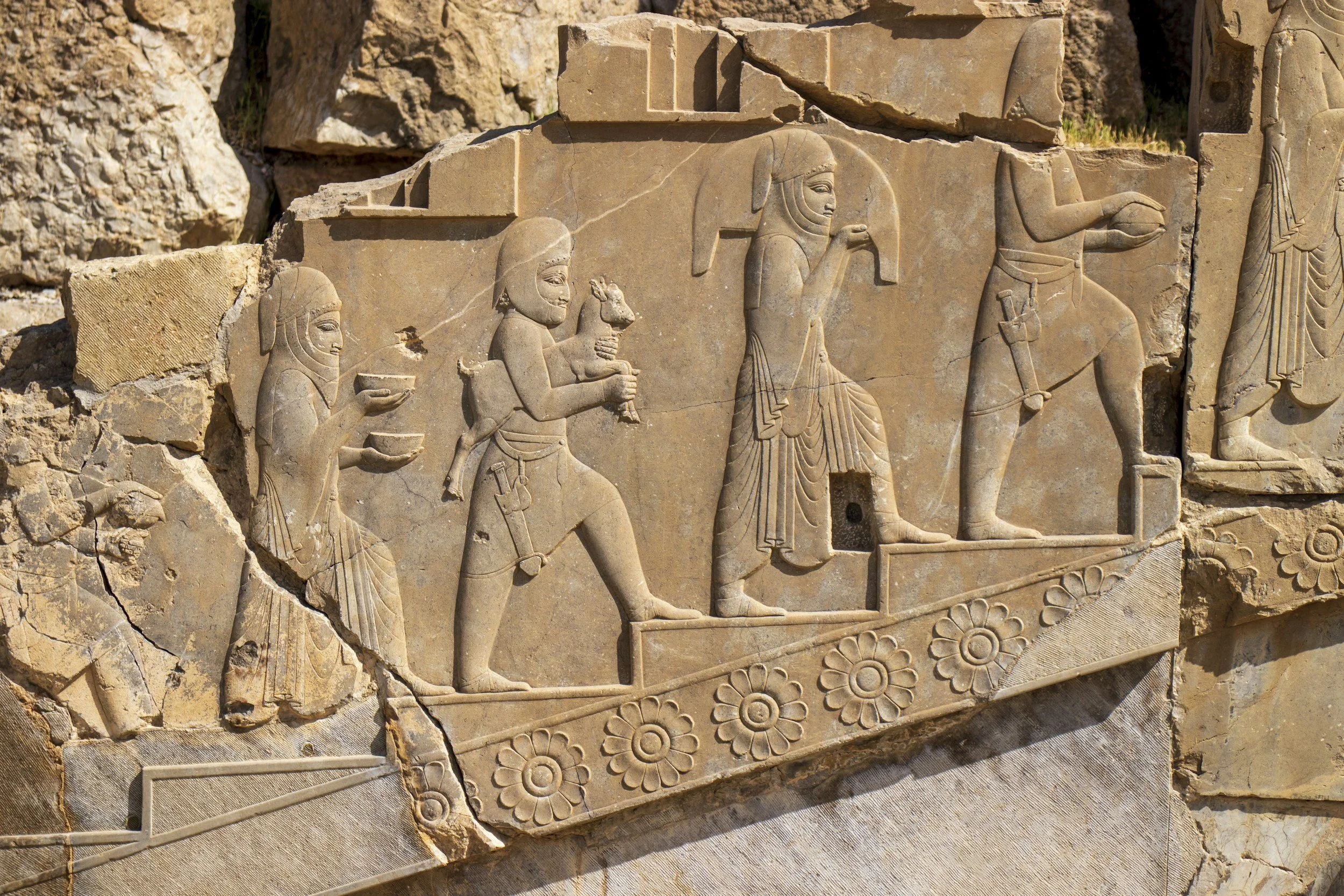
Read “Ozymandias” by Percy Bysshe Shelley (you may even want to memorize it–it’s fun to recite!). Talk through its meaning. How does it relate to the Israelites’ hymns in Chapter 15 of Exodus? (Hint: Ozymandias is the Greek name for Ramses II.)
Ozymandias
Percy Bysshe Shelley
I met a traveller from an antique land,
Who said—“Two vast and trunkless legs of stone
Stand in the desert. . . . Near them, on the sand,
Half sunk a shattered visage lies, whose frown,
And wrinkled lip, and sneer of cold command,
Tell that its sculptor well those passions read
Which yet survive, stamped on these lifeless things,
The hand that mocked them, and the heart that fed;
And on the pedestal, these words appear:
My name is Ozymandias, King of Kings;
Look on my Works, ye Mighty, and despair!"
Nothing beside remains. Round the decay
Of that colossal Wreck, boundless and bare
The lone and level sands stretch far away.
Exodus Lesson Plan: Ancient Civilizations
In this lesson, we will be considering what was happening around the rest of the world at the time when the Israelites fled Egypt and wandered through the desert. Of course, exact dates are not known, but we generally think it was sometime in the early 1200s (13th century) B.C. By simply reading the Bible, we can learn some things about some other civilizations that existed at this point in time: the Canaanites, Hittites, Amorites, Perizzites, Hivites, and Jebusites are all mentioned several times in Exodus!
by Mindi Popovich-Schneider
In this lesson, we will be considering what was happening around the rest of the world at the time when the Israelites fled Egypt and wandered through the desert. Of course, exact dates are not known, but we generally think it was sometime in the early 1200s (13th century) B.C. By simply reading the Bible, we can learn some things about some other civilizations that existed at this point in time: the Canaanites, Hittites, Amorites, Perizzites, Hivites, and Jebusites are all mentioned several times in Exodus!
The Canaanites:
The Canaanites people are, of course, all descendants of Canaan, the grandson of Noah. Many of the other tribes mentioned (such as the Hittites) are the descendants of Canaan’s different children. They inhabited a region that roughly corresponds to modern-day Israel, Palestine, Lebanon, and parts of Jordan and Syria.
The Hittites:
In Genesis, when Abraham goes into Canaan, he meets a people referred to as the “children of Heth.” When Abraham’s wife Sarah died, these people offered a burial place for her, suggesting that they were on friendly terms with Abraham. Later, when Jacob was dying in Egypt, he instructed his sons to take him back to this burial place.
By the time of the Israelite desert wanderings, the Hittites were dwelling in the mountains, according to Moses’s spies. These mountains were probably the Taurus Mountains, which lie to the north of the Indus River Valley, in what is now known as Turkey. But back then, these mountains were a great barrier, making the Hittite people not well known to the other civilizations around them. Even so, the Hittites had an important place in history: they were the first civilization to distribute iron to the ancient world!
The Amorites:
You might recognize this name from the Polyeleos (“many praises”) that we sing during Orthros: “Seon, king of the Amorites…” is mentioned in Psalm 135. This kingdom was mighty, even occupying Babylon at one point in history.
The Perizzites:
Throughout the Old Testament, the Perizzites are consistently mentioned in the context of the Canaanites (that is, “The Canaanites and Perizzites”). It’s possible that the name is referring to “villagers,” and therefore isn’t a distinct people.
The Hivites:
In Joshua, the Hivites are described as being "under Hermon in the land of Mizpeh,” while 2 Samuel mentions them along with the “stronghold of Tyre.” Like the other civilizations mentioned here, the Hivites are listed in Genesis 10 as the descendants of Canaan, himself the son of Ham and grandson of Noah.
The Jebusites:
We do not know much about the Jebusites. Interestingly, when the tribes of Canaan are listed out in the Old Testament, the Jebusites always come last, perhaps indicating their comparatively small size! Like the Hittites, they were a mountain tribe. Their capital was called Jebus, and was later conquered by the tribe of Judah (in the book of Judges) and held until the time of David. That city became known as Jerusalem.
Activity:
Compare a present-day map and a map of the Ancient World (specifically the Fertile Crescent). On the modern day map, try to identify:
The Land of Canaan
The Jordan River
Taurus Mountains
Jebus
Sources:
Mills, Dorothy. The Book of the Ancient World, 2nd Edition. Memoria Press.
International Standard Bible Encyclopedia. Accessed online. https://www.internationalstandardbible.com/
Physical map of the Middle East: https://gisgeography.com/middle-east-map/
Map of the Fertile Crescent: https://www.worldhistory.org/image/13559/fertile-crescent-map/
Exodus Lesson Plan: Art Study
The Antiochian Archdiocese theme for 2025-2026 youth activities is The Book of Exodus. We’ve developed a series of lesson plans that explores that theme through a different discipline. In this lesson, we will be looking at various visual depictions of Moses, both in the setting of a sacred space and outside of the church building.
by Kristin Edwards
The Antiochian Archdiocese theme for 2025-2026 youth activities is The Book of Exodus. We’ve developed a series of lesson plans that explores that theme through a different discipline.
In this lesson, we will be looking at various visual depictions of Moses, both in the setting of a sacred space and outside of the church building. We will begin with one of the earliest extant images and move forward chronologically. Watch as the images change visually and in purpose. This lesson is inspired by the Charlotte Mason picture study method. These images should be sufficient for a month or more, using one at a time that can be repeatedly referred to over the course of several days to several weeks. For each image, use the following steps:
Print off a high quality reproduction.
Give to the student to silently examine for at least two minutes. (Ask the children to be as detailed as possible in their observations. Try to memorize the image, so you’re able to see it in your mind’s eye).
Turn over the reproduction and ask your child to make as many observations as possible without looking at the image. With multiple children, children can take turns making one observation at a time. Adults should participate, too!
Each image has a short informative paragraph (below) that you may want to share with your child as part of your observation discussion. Make sure to ask about what the image might remind your children of. Ask about any connections that they can make to something else they have studied, read, heard, or seen. How does it connect to the biblical story depicted? What details are included and/or excluded? What might be the reasons?
Hang the reproduction up in a visible spot to look at repeatedly for the remainder of the month or quarter or semester. You might notice something new every time you look at it!
Image 1: Moses found in the Nile River. From the Dura Europos synagogue. (ca. 244-255), now reinstalled in Damascus Museum
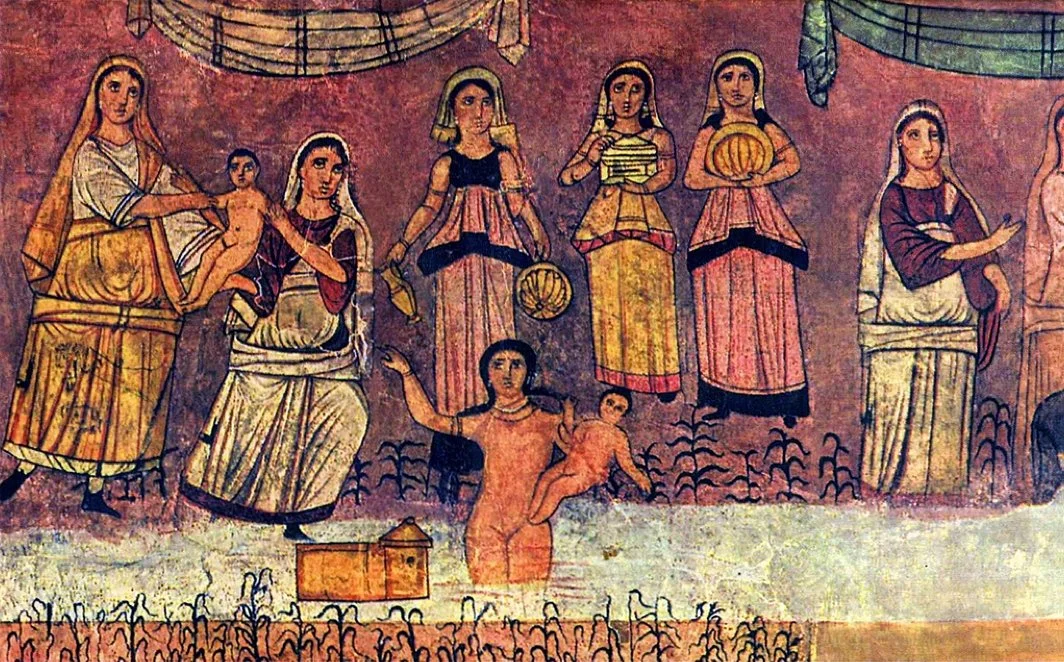
This fresco is part of a series, which covers the interior walls of the Dura Europos Synagogue. The city of Dura Europos (modern-day Syria) was hidden and well-preserved for almost two thousand years under a blanket of sand. Beautiful images cover the walls and make up an entire narrative of the life of Moses. On the lower register at the eye-level of a child, additional frescoes delight the viewer. Dura Europos also was home to an early Christian “house church” baptistry whose walls were covered in images. (These are also worth checking out!) The discovery of this buried city in the 1920s was paramount to the study of sacred images and their use in worship. The narrative scenes demonstrate that visual decoration in sacred spaces was used much earlier than scholars (and iconoclasts) had originally thought. People were to gaze at the images during prayer, as well as learn and memorize the narrative. Notice how the image of Moses shows the movement of Moses from the basket in the water to the bank. There is also a striking resemblance between the traditional imagery of Aphrodite and the form of the Egyptian princess, making a clear statement about the (sacred) nature of these images. The curtains above divided scenes, but also were symbolically significant in the ancient world as delineators of sacred space.
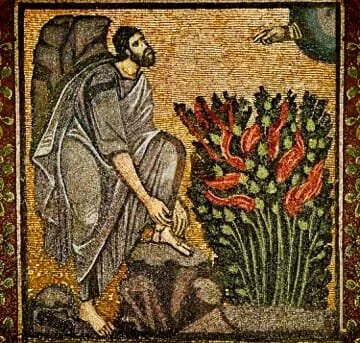
Image 2: Moses and the Burning Bush. St. Catherine’s Monastery Mosaic. (6th Century), Mt. Siani, Egypt.
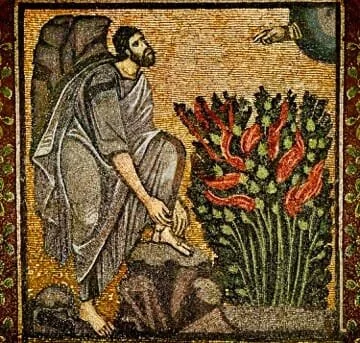
This mosaic of Moses removing his sandals at the burning bush is found at St. Catherine’s Monastery. It is above the eastern apse of the monastery’s Great Basilica. Moses and the burning bush is a prominent theme of the monastery’s visual program for obvious reasons – the monastery is located on the holy ground at the base of Mt. Sinai itself. This image is also an early one, meant to be a part of liturgical life. Like many of the other icons and mosaics at the monastery, the Muslim occupation of the region during iconoclasm preserved it from destruction. Its survival left an example of early Christian iconography for later generations. Notice the thousands of tesserae of many colors that were used to create the image. The folds of Moses’s garments are magnificently executed. The tongues of fire in the burning bush are, indeed, strikingly similar to tongues of fire that we see in images of Pentecost. Why? What are you reminded of when you see this image? How is this similar to the sacred images / icons in our own churches?
Image 3: Moses Parting the Red Sea. Illumination in the Paris Psalter. (ca. 950-970), in the Bibliothèque Nationale de France, Paris.
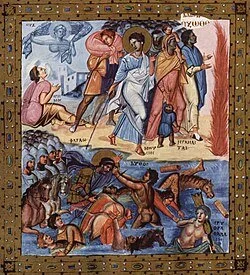
Versus a large-scale church decoration, this image is part of an illuminated manuscript called the Paris Psalter. It takes sacred images outside the church building and puts them in private hands. This psalter was made during the Macedonian Renaissance after iconoclasm had ended and is considered one of the most lavish examples of Byzantine illumination. The psalter does not have an inscription to indicate the exact circumstances of its commissioning, giving it an air of mystery. However, because of some visual clues (like King David depicted in emperor’s clothes in one of the illuminations) and the sumptuous materials used in its making (calf-skin parchment, expensive minerals, and abundant gold leaf), it is widely accepted that it was a psalter commissioned by a Byzantine emperor. There are 14 miniatures in the psalter, two of which are images of Moses illustrating the Old Testament Canticles. Instead of the decorations being for “public consumption” as in the previous two images, these were for the private devotions of the reader. Still sacred in nature, the illuminated manuscript decoration brought images to a more personal level, albeit in this case for imperial private use. In image 3, the pillar of fire stands on the right side as Moses leads the Israelites out from personifications of night and the desert. In the bottom register, there is a personification of the deep, who pulls Pharaoh down into the water. If you and your children enjoy this image, look up the other miniature of Moses receiving the tablets of the law! In fact, all 14 miniatures are fabulous.
Image 4: Giotto di Bondone. Moses Brings Forth Water out of a Rock. (ca. 1304-1306) Fresco embedded in a decorative band as part of a large scale church decoration, Scrovegni Chapel, Italy.
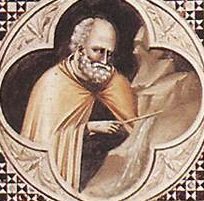
This small border fresco was painted by Giotto in the 14th century as part of a large-scale decoration cycle. It is nestled inside a border image that delineates much larger frescoes with the story of Christ’s life. The chapel decoration overall is a particularly striking example of Giotto’s revolutionary style that was a (oftentimes shocking) departure from Byzantine painting tradition. You can look at the other images from the chapel with your child if desired. Here Moses brings water from a rock, a sacred act. However, notice the more realistic expression and the softer lines that Giotto was known for. Moses is given a more “lifelike” appearance, drawing attention to his humanity. He has soft hair and wrinkles and an emotional expression on his face. And yet, the mountain still has something of an unrealistic appearance, reminding the viewer of otherworldliness or sacred space. Though inside a sacred space again, the image is less a window to the divine and more an artistic expression of the humanity of his subject. Giotto’s style and methods of painting only become more and more popular in the Renaissance, Catholic West in following years. Though not for prayer in the Orthodox sense, its beauty is still reflective of God’s beauty in the world, possibly bringing some nuance to an understanding of what it is to be human.
Image 5: Rembrandt van Rijn. Moses Smashing the Tablets of the Law (ca. 1659), in the Gemäldegalerie, Berlin.

This Rembrandt painting of Moses’s descent from the mountain is a stark contrast to earlier, sacred images for use during prayer. After the Protestant Reformation, churches did not typically commission artwork, and art moved even more into the sphere of personal use. Most of Rembrant’s paintings were commissioned by individuals. By Rembrandt’s time at the height of the Dutch Baroque period painting’s purpose had shifted from sacred devotional use or use in worship to a focus on an artistic evocation of emotion and feeling. This painting illustrates that fact by its mere size. It is large: five feet tall and four feet wide. Moses is positioned directly in front of the viewer where one can quite intensely feel movement downward. He is angry or in pain, likely about to smash the tablets of the law. Everything is realistically portrayed, including the Hebrew lettering on the tablets of the law. What else can you and your children notice about this painting? What else might Moses be feeling and how might this be represented?
Check back soon for more lesson plans!

Meet the Matushkas: Presb. Christine Slaughter Doty
Saint Emmelia Ministries is blessed to have a board of wise, loving Spiritual Advisors who help run our regional conferences and online events, provide guidance to local homeschoolers, and guide the vision & work of the ministry. Alongside them are their wives, who work tirelessly to support their husbands’ work, on top of educating their children. In this series, we are honored to introduce you to these exceptional women.
Saint Emmelia Ministries is blessed to have a board of wise, loving Spiritual Advisors who help run our regional conferences and online events, provide guidance to local homeschoolers, and guide the vision & work of the ministry. Alongside them are their wives, who work tirelessly to support their husbands’ work, on top of educating their children. In this series, we are honored to introduce you to these exceptional women.
by Pres. Christine Slaughter Doty
1. Please introduce yourself briefly.
I’m Presbytera Christine Slaughter Doty, and I’ve been married to Fr. Justin Slaughter Doty for nearly nine years. We currently live in the Midcoast town of Rockland, Maine, where we’ve been for almost four years now. Before coming to Maine, we served the Church in Washington State, Connecticut, and Lincolnshire, England.
Fr. Justin and I met before either of us was Orthodox, while working in EMS. I had been an EMT for a few years when a new paramedic joined our company—and he happened to be wearing a very lovely British cap, which I made sure to let him know! At the time, I was working about 90 hours a week, so the only way he could take me on a date was to sign up for the same shift and ambulance as myself. Not long after that, we became paramedic partners… and three months later, we were engaged.
When we became engaged, he was preparing to study at an Anglican seminary in New York City. My husband has always been very academically inclined, whereas I came from a non-traditional upbringing that lacked many educational opportunities. Still, I had a strong interest in linguistics, ancient studies, and Egyptology. At the time, I was just having a blast with my own independent research, which involved the conception of the soul in ancient Egyptian thought and some translation work in Middle Egyptian. He found it very amusing that I was doing “thesis style work” as he said, without being enrolled in any program whatsoever. So he spent the next few months encouraging me to apply to college and helping me through that whole process. I was eventually accepted into the very same college that he had just graduated from, and together we designed an independent major that involved studies between my home college and Brown University, along with summer coursework in linguistics at Harvard and Yale. My professors were incredibly supportive of my rather unique pursuits and ambitions. My husband and I are extremely self-aware that we tend to be very ambitious people, but that ambition has seen us through many, many necessary steps in life to bring us to where we are now.
About four months after our engagement, we were married—and five days later, I left for college in Massachusetts while he went to seminary in New York City. The original plan was for him to take the train up on the weekends, but that quickly changed. Within two weeks, he found us an apartment in my town and got permission to transfer his studies to the Greek seminary, Holy Cross, in MA. An Anglican… at an Orthodox seminary. His former professors warned him, “Be careful—don’t convert!” …well.
Today, we have three children: Heloise Thekla (almost six), Alphage (Alfie) Æthelwine (almost four), and Odilia Leofgyth (almost three). We’ve been lightly homeschooling for about two years. Right now, our focus is on the basics—reading, writing, math, and languages (Greek and French)—along with starting music, sewing, and painting. The last three are not only hobbies for us; they’re connected to the life of the Church: music in preparation for Byzantine chant, sewing for vestments, and painting as a foundation for iconography. We’ve also been very blessed with a very kind, retired schoolteacher in our parish, who has been such an incredible resource and help to my children and I.
2. What did the discernment process for the priesthood look like for your family?
Our path was probably a bit different than most. When we met, my husband was already on track for the Anglican priesthood, and I was, what I say, too scared of God to call myself an “atheist,” so I shamefully claimed to be “Agnostic.” I had grown up in quite a unique Catholic household, and by the time I left home at seventeen, I had stepped away from the church and was no longer interested in Christianity.
He encouraged me to return to the Faith, and later, when I was in college and he had transferred to the Greek seminary, we both began searching more deeply for the truth—but in different ways. My academic work began to shift. What started as a study of the soul in ancient Egyptian religion gradually transformed into a comparison between ancient Egyptian beliefs and early Christian thought. Through that, I encountered the Church Fathers—and I found myself drawn to Orthodoxy. At the same time, I felt a real tension. My husband was still pursuing the Anglican priesthood, so I wanted to be supportive of him, but I wasn’t sure how to reconcile that with what I was discovering. So I waited.
His time at Holy Cross, surrounded by Orthodox seminarians, professors, and clergy, was great for him—my husband has never been one to shy away from debates. He has always been a truth-seeker, and it didn’t take him much longer than myself to accept Orthodoxy. When he finally came to me to share his thoughts, he discovered that I had already arrived at the same place!
We were received into the Orthodox Church later that year, and from there he began meeting with His Grace, Bishop John, to discuss his presence at the seminary and the Orthodox priesthood. In many ways, the discernment unfolded over a few years of shared searching and gradual clarity—but I had always known that his life was oriented toward the priesthood.
3. How did you decide to homeschool? How did you decide what methods/curriculum/ pedagogical approaches to use?
We chose homeschooling largely because it aligns best with how we want to raise our children. We’re not particularly drawn to public schools for a number of reasons, and while some private schools can be good, it would always be on a case-by-case basis. Right now, there are no private school systems near us that are of any interest.
For us, keeping the children close to home—and close to us—is important. Homeschooling allows for that, while also giving us the flexibility to shape their education around the life of the Church.
We try to incorporate elements that will serve them later within the Church: music, sewing, art, and a general familiarity with the rhythm of liturgical life. At the same time, we also have a long-standing interest in classical education. We once began developing an Orthodox classical school system in England before returning to the United States, and that vision has never entirely left us. It’s something that we think of from time to time, and God-willing, we still hope to revisit it one day.
4. What are some practical ways that you balance ministry, homeschooling, homemaking, etc.?
This is probably the hardest question to answer, because it’s always in flux.
One of the most important things we’ve done is to intentionally keep two days off each week—usually Mondays and Tuesdays. We treat them as our “weekend,” and our parishioners understand that we’re only available during that time for emergencies. I think this is essential for clergy families; otherwise, the boundaries between parish life and home life quickly disappear.
For homeschooling, I try to set aside consistent time blocks—usually one to three hours every other day. Without that structure, it’s very easy for the weeks to slip by.
When we first arrived in Maine, our mission was very small—only about seven people. Over the last three years, it has grown into a parish of over 100, and last July we purchased our own building! Over the course of six weeks, we managed to convert an old medical office into a fully functioning, beautiful church. All of the work was done by my husband, myself, and our very dedicated and skilled parishioners. We all worked about 16-hours a day for the entirety of that six weeks. The grandmas had to come in to assist my husband and I with the children… Despite the very frantic process of it all, the church was completed the day before our patronal feast, decorated and all! His Grace, Bishop John arrived to open the doors, and the first liturgy in the new building was celebrated.
Experiences like that make it very clear: if we don’t intentionally structure our time, everything can easily be consumed by the work of the Church. So we try to be deliberate about protecting time for family life. I was warned once a long time ago by my spiritual father: Do not let the parish be built upon the backs my children. There is a longer tale that goes with that phrase, and I've never forgotten it. The parish, God-willing, will always remain once my husband and I are long gone, but the time of childhood is short in comparison, fragile, and cannot be regained once it passes.
5. How do you recharge yourself to be a better person for those around you? How much time do you spend?
We tend to be early risers—everyone is up around 6:00am—and that rhythm works well for us. By the evening, the children are usually in bed by 6:45 or 7:00pm.
From about 7:00 to 11:00pm, my husband and I share a mix of work and personal time. I’ll use that time for writing, homeschooling preparation, or administrative work for the parish, while he may focus on counseling calls, sermon preparation, or research. We also make sure to set aside time for hobbies and movies. It’s a balance of productivity and rest, which helps us both recharge.
We also try to take one or two short family trips each year—usually Monday through Friday so we’re still home for weekend services. And living on the coast of Maine has its own blessing: we’re only about eight minutes from the beach, which becomes a regular part of our summer life. Winters are quieter—there’s not quite as much to do outdoors for us...not exactly the outdoorsy type — but as a house full of bookworms, it has its own charm.
6. Not counting the Bible, what book has impacted you the most as a mother/teacher?
This is a difficult question, because there isn’t just one.
Over the years, I’ve been especially drawn to the writings of spiritual mothers—nuns, abbesses, and priest-wives. While, of course, I deeply value the writings of the Church Fathers and elders, there is something uniquely accessible about the voices of women in the Church. Their words often speak more directly to the lived experience of women, wives, and mothers.
A few of my particular favorites include the biography of Abbess Thaisia of Leushino, as well as the works of Mother Siluana—particularly God, Where is the Wound? and Theology of the Ordinary. I really could list many others.
Much of my own work now is devoted to building resources for Orthodox women—especially those who are just beginning to explore the Faith. Over the years, I’ve seen a common pattern in many inquirers: It’s usually a husband that first attends the services by himself for a long time, completely committed to Orthodoxy, however, his wife remains hesitant—not out of resistance per say, but mostly it’s because she doesn’t yet understand what the life of the Church really looks like.
Men and women are very different. Often, and I don’t say completely because it’s never 100% the same, but often men are brought in by the academics, the theology, the patristics, all of the historical background to Christ and Orthodoxy. Women, especially mothers, often connect to the Faith through the life of the home: the rhythms of fasting and feasting, the liturgical calendar, the traditions that shape daily life, theology and catechetical books that she can easily devour and then utilize in the educational curriculum of the children, even the music that we often play in the background of the home has an impact.
I am the co-head of a bookstore and library attached to our parish, and I keep a dedicated section for women for this very reason—a section filled with the very books that have helped so many wives take their first steps into Orthodoxy: Marriage as a Path to Holiness, A Sacred Beginning (any pregnancy and post-partum resources), Close to Home, Blueprints for the Little Church, and many others. In a way, it’s a holistic approach to the Faith for women—one that begins not only in study, but in the lived reality of the Christian home.
Make sure to check out Pres. Christine’s wonderful website: https://www.orthomotherhood.com/

Meet the Matushkas: Matushka Zoë Kavanaugh
Saint Emmelia Ministries is blessed to have a board of wise, loving Spiritual Advisors who help run our regional conferences and online events, provide guidance to local homeschoolers, and guide the vision & work of the ministry. Alongside them are their wives, who work tirelessly to support their husbands’ work, on top of educating their children. In this series, we are honored to introduce you to these exceptional women.
Saint Emmelia Ministries is blessed to have a board of wise, loving Spiritual Advisors who help run our regional conferences and online events, provide guidance to local homeschoolers, and guide the vision & work of the ministry. Alongside them are their wives, who work tirelessly to support their husbands’ work, on top of educating their children. In this series, we are honored to introduce you to these exceptional women.
by Mat. Zoë Kavanaugh
Hi! I’m Matushka Dr. Zoë Kavanaugh. I grew up with the Russians, so the title Matushka is dear to my heart. My husband and I met through an act of God at seminary in the last minutes of my visiting the area for an unrelated work conference. I always tell young people that it is when you have given up, and given your heart’s desire to Christ and the Theotokos, that miracles happen, and meeting my husband is one of my biggest miracles. We have been happily married for over a decade and have four vivacious children. While my husband attended public schools growing up, I was homeschooled, so it was a natural, mutual choice to homeschool our children. My favorite part about homeschooling is devouring great literature together all snuggled up on the couch, and being able to follow rabbit trails of knowledge to uncover fascinating and memorable knowledge nuggets. I also love how Fr. and I can encourage each child to realize much of the potential of who they already were when we got to hold them for the very first time.
There are so many wonderful books out there. One recent one that has had a profound influence on Fr.’s and my vision for our homeschooling, our ministry, and our family farm is called “The Family Economy”. It is a Protestant book, and is limited to the nuclear family, but it becomes even more poignant when this book is taken in conjunction with the spirit of the book “The Benedict Option,” and interpreted through the lens of Orthodoxy, to include Christian community. These two books have inspired Fr. and me in our community building and farm work at Ave Maria Farm in Wichita Falls, TX, where we have a ministry to help young people escape from the machine and return to clean, simple living, with the time-tested Orthodox rhythms of work and prayer. There is nothing like sharing food that you have raised and prepared together as a community.
Our homeschooling focuses on helping each child delve deeply into their interests with a goal of future monetization of those interests. We also are blessed with lots of guests joining us for farm to table family meals at our huge table. Many of these guests share priceless insights with the whole family. For example, one of our guests completely changed the way we see weeds in the garden. Weeds are now fun tools to prevent soil erosion here or add minerals there, or perhaps another one is good for an herbal remedy or skincare. Community life is so rich and rewarding, and I love how people in community are free to be friends with people of any age, rather than only with people within their birth year. This organic socialization is a beautiful way to prepare children for the real world.
There are so many fabulous curriculae out there. We have found that Ambleside Online, Scriptorium Writing (fabulous new curriculum written by Subdeacon Callum Lyda), and Math You See have met our needs well. However, I contend that the fun of homeschooling is that you don’t have to do things like public school. I feel that the largest part of my children’s education is liturgy, reading The Prologues from Ochrid at the breakfast table, devouring the countless totes full of picture books from the library, and taking trips inspired by those stories to bring the stories alive. The free association and cross-disciplinary possibilities available from going on rabbit trails is so much more memorable and poignant than stressing while checking off the boxes of a curriculum. The best advice we got for selecting curriculum is to find your mission statement, put it in a sentence or two, and weigh out any activity or class against that mission statement, outlining where/who you want your children to be as the end goal. Of course, anything worth doing is difficult: being an Orthodox Christian, being married, having children, and homeschooling. One thing that has helped me find joy is to rip out my microwave, and in its place, make a lovely little shrine with a statue of St. Elizabeth of Hungary, and icons of Saint Ita and Saint Morwenna, all of whom inspire me in the many areas I’m lacking, while I spend time cooking with them.
If I were to share any wisdom from our homeschooling journey, it would be the advice my dear husband constantly encourages me with: to teach the children from a place of joy and Christ’s peace, and when you’re not there, in the words of St. Sophrony, “Stand on the edge of the abyss and when you feel that it is beyond your strength, step back and have a cup of tea.” May His peace and joy be with you on your journey!

Meet the Matushkas: Mat. Melissa Naasko
Saint Emmelia Ministries is blessed to have a board of wise, loving Spiritual Advisors who help run our regional conferences and online events, provide guidance to local homeschoolers, and guide the vision & work of the ministry. Alongside them are their wives, who work tirelessly to support their husbands’ work, on top of educating their children. In this series, we are honored to introduce you to these exceptional women.
Saint Emmelia Ministries is blessed to have a board of wise, loving Spiritual Advisors who help run our regional conferences and online events, provide guidance to local homeschoolers, and guide the vision & work of the ministry. Alongside them are their wives, who work tirelessly to support their husbands’ work, on top of educating their children. In this series, we are honored to introduce you to these exceptional women.
by Mat. Melissa Naasko
1. Please introduce yourself briefly.
Father and I have eleven children, six girls and five boys. It has been an interesting journey since we met in at the University of Colorado. We met in the student government office and had friends who just happened to be cousins. We hit it off immediately and here we are!
2. What did the discernment process for the priesthood look like for your family?
My husband was a philosophy instructor and worked with Catholic seminarians. One day, while the bishop was visiting, he asked my husband to come into the altar after liturgy. He asked him to consider the diaconate. We decided together that this would be a way for him to help serve our community. Later, when we lost our priest, the bishop called and asked him to consider the priesthood. At first, he was hesitant. He loved being a deacon. I am so glad that he decided to say yes because he loves being a priest even more.
3. How did you decide to homeschool? How did you decide what methods/curriculum/pedagogical approaches to use?
Our oldest was fascinated by reading and was reading early chapter books at four. I had started teaching him phonics in a haphazard way but it worked for him. There was an article on why some people were homeschooling in Parents Magazine and we started considering it. My mother bought us the books "What Your (blank) Grader Needs to Know" and we dove in. A mother in my local support group was graduating her youngest and gave me her well loved set of Charlotte Mason books and just started.
4. What are some practical ways that you balance ministry, homeschooling, homemaking, etc.?
We really believe that we are a tag-team. We have the same goals and we tag each other in and out to get everything done. There have been times when we had to divide and conquer and some of us will miss some services to be able to deliver lambs or calves or study for an exam and other times when we set everything aside so we can all be at Church. The best way for us to decide how to manage all the various demands is to consider what has the most consequences if not met and do this first down in importance to the thing of the least consequence. Sometimes we do it well and sometimes we don't but we try to do it together.
5. How do you recharge yourself to be a better person for those around you? How much time do you spend?
Now that my kids are older and not early risers, I get up before them and I knit with some coffee. I just enjoy the morning this way so much. When they were little, everyone had "Afternoon Nap". I did not care if they slept but they had to be quiet. I played the same classical music CD (it was about 50 minutes long) and when it was over, they could get up. I sometimes napped and sometimes read and often knitted but it was a critical time for me.
6. Not counting the Bible, what book has impacted you the most as a mother/teacher?
There are lots of parts of me and each has their own book. I would say that for my homeschooling journey, it would be "Designing Your Own Classical Curriculum" by Laura Berquest. I still use it. For my spiritual journey, it would be my Jordanville Prayer Book. It is so well used and looks like it is barely holding together but the worse it looks, the better I do. I could replace it but I have no plans to. Then there is Robert Louis Stevensen's "A Child's Garden of Verses" which I memorized, on my own, when I was little. I started reading every poetry book I could and collected them from thrift stores and just memorized enormous swaths of poetry. All my children started out in this book.
7. If there’s one thing you could tell your just-starting-out-homeschooling-self, what would it be?
Firstly, you don't have to be perfect but you do have to be consistent. Stick at it every day. Just keep going. Secondly, cultivate a culture of reading by always reading. Carry a book with you. Let your children see you read. Read aloud every day. If they can read and comprehend, they can learn anything they want.
8. What would is the most crucial subject homeschool beginners should focus on?
The three Rs, in fact, get Ruth Beechick's "The Three Rs" and just do that. You can make your own curriculum for young children. Just start and be consistent. You really don't have to be perfect or have the most fun curriculum. What you need to is to be consistent.

Meet the Matushkas: Kh. Kelleylynn Barberg
Saint Emmelia Ministries is blessed to have a board of wise, loving Spiritual Advisors who help run our regional conferences and online events, provide guidance to local homeschoolers, and guide the vision & work of the ministry. Alongside them are their wives, who work tirelessly to support their husbands’ work, on top of educating their children. In this series, we are honored to introduce you to these exceptional women.
Saint Emmelia Ministries is blessed to have a board of wise, loving Spiritual Advisors who help run our regional conferences and online events, provide guidance to local homeschoolers, and guide the vision & work of the ministry. Alongside them are their wives, who work tirelessly to support their husbands’ work, on top of educating their children. In this series, we are honored to introduce you to these exceptional women.
by Kh. Kelleylynn Barberg
1. Please introduce yourself briefly.
Christ is in our midst!
I’m Khouria Kelleylynn Barberg; married for nearly 31 years to Fr. Raphael Barberg; we live in the Greater Buffalo (GO BILLS!) Niagara area in Youngstown NY. A little geography for you: we live in the farthest western northern town in NY state by Lake Ontario along the lower Niagara River that borders Canada. It’s a little Mayberry town. We love living here.
We have 5 children: Colin (28), Hannah (27), Mary Katherine (23), Luke (21), and Nathanael (15). This school year, Nathanael entered a private Catholic High school, and has straight A’s. We have (2) college graduates: Colin, from Hellenic College (2019), and Mary Katherine, from St. John’s College in Santa Fe, NM (2025). Hannah finished high school in 3 years (it can be done), and works full-time in the hospitality industry; Luke is a Corporal with the United States Marine Corps. We are realizing that we are now spectators in our children’s lives than guides; in all honesty, they have and continue to teach us. It is an incredible full life filled with all the ingredients of a beautiful chaos. I wouldn’t change a thing—well, maybe go back in time once in awhile to hold my little babies again.
This year, the long decades of homeschooling has come to a bitter-sweet end. I would do a few things differently; maybe we’ll touch on that later. However, I’m not quite moving away from homeschooling, just pivoting my attention as I carry on in my job as the Administrator with St. Athanasius (on-line homeschool) Academy (since 2021) and a board member with SAAOT. This gives me more time to share my love of home education; yes, also to help families make the best connections and educational decisions that fit their needs. Our SAA teachers and admin-team are a melting pot of talent for Orthodox Christian homeschooling families who may need help in navigating the early years to transitioning middle school and high school; to college or career goals. It is encouraging to be among such faithful and dedicated human beings. And our students and families are wonderful! I only wish we could be in person so I can hug on them all! I have learned so much by their example. It’s been a rewarding journey, and I never thought I’d help run an on-line teaching academy for homeschooling families within the Orthodox Christian Faith, yet by the grace of God, here I am, and I love it! It is so very good to see how far homeschooling has made strides in our Orthodox Christian church communities. Glory to God for all things!
Fr. Raphael and I have a long history together as we met when I was just 11; he was 18. We did not date until I was 20. We attended a large Protestant church together. He was a youth leader; I was a fitful tween. He saw me grow up and and I watched him transition into a young man. We both come from divorced homes, and our mothers were instrumental in our Christian rearing—overcoming unbearable obstacles as single mothers. We started dating in Spring of 1994, and within 2 months we were engaged; married in June of 1995.
“Perhaps I had a wicked childhood / Perhaps I had a miserable youth / But somewhere in my wicked, miserable past / There must have been a moment of truth / For here you are, standing there, loving me / Whether or not you should / So somewhere in my youth or childhood / I must have done something good”
He was already a catechumen in the Orthodox church and had a chrismation date set that ended up being postponed. It was postponed because Fr. George, of blessed memory, told Fr. Raphael (a.k.a. Kevin) “Marry her first; then we will figure out Orthodoxy together...the church will be here, we will be here; Orthodoxy is not going anywhere, but she might; it is good for you to have a wife.”
I was blown away by this response, and decided I needed to meet this priest and see the church for myself. Long story short, on June 3, 1995, we were married in the Protestant church where we met, and by that time my heart and mind was looking toward the East. We were eventually brought into the Holy Faith together in 1996 on St. Mary of Egypt Sunday at St. George Niagara Falls, NY, where we now have been serving the faithful for the past 8 years. We were parishioners at St. George’s for 15 years, had 4 children there, baptized the children; their God parents still attend (one is now a priest!), and Fr. Raphael was ordained to the Holy Priesthood there, and we came back in 2014 to lay my mother for eternal rest. St. George was and is always our home. We returned to serve the faithful after 10 years of being away in 2018.
In 2008, we moved to St. Vladimir’s Seminary near NYC to attend seminary for the next 3 years. While at seminary, we finally were among other Orthodox Christian families to homeschool with —although we had homeschooled before attending seminary and said goodbye to a healthy co-op group of homeschoolers in Western NY—we were always the only Orthodox Christians. This was a first, and it encouraged our homeschooling journey immeasurably. After graduation (2011), we were assigned to a small parish in Maryland, and with our 5th child just 9 months old, homeschooling become the greatest challenge.
With no supportive co-op, friends and family nearby, these years were filled with loneliness and too many doubts. “Did we do the right thing by us and for our children?” I was unmotivated without a homeschool community, doubting that I could do this all on my own. It was extremely difficult. I no longer had Fr’s help, he was busy with the new parish and a full-time job too! We also recognized our Luke was struggling to read, and after testing, he was diagnosed with Dyslexia. I had no idea how to help him. We enrolled him into 2nd grade at the local elementary school. The teacher was amazing, and he made leaps and bounds — we eventually brought him back home because he asked to be back with us. Today, at 21 and a Corporal with the US Marines, he is thriving and is one smart young man. He is a gift to me. Dyslexia is a gift—another way of learning — like going in the back door than the front door. Dyslexic children can and will learn! They need lots of patience, but don’t we all?!
When I look back, it is here where we grew closer as a family in deeper understanding and patience. We just didn’t see it then. During the 5 years in MD, we enrolled our eldest into a private Catholic high school, and the following year, our eldest daughter went to the local high school (her choice). We gave our children the option to choose when entering the high school years; that they also could return home at any time. Transitioning from homeschool to high school was different for each one; presented multiple challenges and triumphs. During that time away from the home, they were able to exercise their voice in another environment, to practice advocacy for others and themselves, they navigated being proactive, organized priorities that aligned in their faith with the academic knowledge they gathered, and gave kindness and grace to their neighbor/fellow classmate. Sometimes, it was not easy for them. It took a ton of prayer and patience. They developed listening skills while taking instruction from another adult—who generally did have their best interests for their students— was an invaluable learning opportunity for them. We ended up enrolling all the children into high schools when their time came. We moved after 5 years in MD to OKC, and during those 2 years there, we once again were blessed like our seminary days with a vibrant and loving homeschool co-op. We were a small group of 4 moms and 16 children, and we liked it that way. In OKC, our third child, entered a private Catholic high school; she faced so many challenges of belonging and fitting in—more than the first two experienced. But she wanted to stay, and finished the year and persevered. We moved after her freshman year; this time back to our hometown where she was enrolled into an all girls Catholic school, and she soared there. Thank God! It was a huge leap of faith to make this all work financially and loads of courage to endure between 4 moves in 10 years. That was difficult on all the children. Two more into high school, and ups and downs along the way—those were lessons as valuable as ABC and 1-2-3. Our children became adaptable young people, and steadfast in their faith in God even in the struggles. I am not advocating other families do as we did, just that itended up a good fit for our children and their life decisions ahead. They are still in progress, we cannot carefully curate perfect children — there is that thing called “free will”. We can, however, love and teach them without our forced intentions, as Christ loves us all.
What did the discernment process for the priesthood look like for your family?
Oh, discernment! We were not on the same page, at first. Much like our conversion story. God’s ways are not our ways. I truly believe, discernment is not possible without patience. Most who know Fr. Raphael, knew he was a Buffalo NY Police Lieutenant for 20 years before pursuing the priesthood. That was a good job for us as a growing family: steady hours, paid well with lots of flexible vacation and personal time. One day, after we had our third baby (fall of 2002), he came to me while I was doing laundry, and pleaded with me to attend seminary that summer! He wanted to make a plan to take an early retirement, and we could go. I flat out said, “no, now is not the time.” That was a hard time for us-as we were not in agreement. I wasn’t trying to be a disobedient wife, disrespect his ambitions, or be a stubborn wife (although I am that - Lord, have mercy on me), I just *knew* we ought to wait. I sensed my husband was anxious to begin—even though he did not want to pursue the priesthood, he desired to attend seminary; that was not how I wanted to begin this. I liked where we were. I loved my home, and I had never lived away from family and friends. We prayed; we talked it over; talked it over with our priest. In a short time, Fr. knew we needed to wait as well. He was already the parish deacon for one year, ordained just before 9/11 in September of 2001; he was not up for retirement until 2008! In late December of 2003, we lost a baby; within 2 months we were expecting again. My mother was living with us and was not well. Life was heavy and very full. It all felt a foolish endeavor, so discernment, to me—it was obvious! I thought if we waited, this desire of his will pass. Our fourth baby arrived in early fall of 2004; still four more years until retirement. He focused on serving the parish as best as he could as the deacon; his work with IOCC. He was a dedicated and faithful deacon to the parish priest and community while still working as a police officer. Why would anyone want to leave that comfort? The summer before his retirement year, we decided to travel to Kodiak, Alaska to experience the pilgrimage to St. Herman of Alaska on Spruce Island. We were there for 2 weeks: one week to help around the seminary and the other for the pilgrimage. One evening during a Akathist service for St. Herman, the faithful were able to venerate his uncorrupt body and heavy iron cross St. Herman was known for keeping around his neck and body. After venerating, I needed to step outside to get some fresh cooler air. The church was packed, and with the heavy incense permeating the church; the August summer air was warmer than usual inside the small cathedral. I remember the native people making comments how hot it was to them! There were still so many more people filing in to the church to venerate their beloved St. Herman. My husband stood over St. Herman’s coffin holding up the cover and helping people in and around the holy relics. I quietly slipped outside with the church doors still open and could hear the troparion to St. Herman sung in English, Russian, and Yupik...it was glorious! I had been an Orthodox Christian for 11 years, and this was my first encounter with a holy saint’s relics! It was amazing; ethereal! In the moments sitting on the Cathedral steps, gazing at the snow capped mountains, it was as St. Elijah experienced: a calm and still voice-nothing rushed or filled with anxiety. The wind went around me, “It is time.” I cried. There were so many logistics to manage: sell a house, secure my mom a new safe living situation, settle retirement funds, apply to seminary and scholarship with the Antiochian Archdiocese, and tell the children! We talked a great deal during the pilgrimage, and we prayed at St. Herman’s well on Spruce Island. We brought some water home. We prayed more in the cathedral by his relics; we talked to priests who had wisdom to give us. One year later, we stepped out of our moving van, unto the parking lot of Lakeside 1 at St. Vladimir’s Theological Seminary in Crestwood, NY— on the very feast day of St. Herman of Alaska to begin this endeavor. It all came together—yes, there is synergy to make something like this happen, and there was lots of work that went into it but it was all by the grace of God! At SVS there is an icon of Jesus Christ on the iconostasis that reads: "You did not choose me, but I chose you” John 15:16. The three years at seminary were filled with many beautiful days and painful-heart wrenching growing moments. Our faith was tested. We departed SVS with Fr. Raphael just one year as an ordained priest, his first parish assignment in MD ahead of us; our fifth child just 9 months old. The rest of the kids in tow, trusting us, and in God for all things that would come our way. God’s ways are not our ways. Patience gathers discernment. I see that now.
How did you decide to homeschool? How did you decide what methods/curriculum/ pedagogical approaches to use?
Ha, I have to laugh at this. Forgive me. When we started out homeschooling (2000!) there wasn’t much to choose from that aligned with the Orthodox Faith, and we rag-bagged curriculum on a minimal income. I borrowed textbooks and we went to the libraryall the time! It definitely was not shiny and new. Honestly, if you just read to your children, allow time for them to play and explore, to make a mess, and teach them to clean up; read more to them; read aloud the psalms and poetry. Give them structure: brush your teeth and wash your face. Provide opportunities and places to explore, teach them to hold a pencil, a paint brush; write a well thought out sentence, and narrate a book back to you; play ball, read a book in quiet, sit quietly; knit, sew, look at art, create art; fix and repair a broken chair or radio; help with the cooking and housework; laundry, and allow them to play in the snow and rain, get dirty; climb and jump. Eek! They might break a leg (we had two boys with femur breaks), teach them to feel the grass in bare feet and taste fruits and veggies at the farmers market (or homegrown)—you are 90% homeschooling your children. Of course, yes, there is more to it than all that; when they’re older, balancing and time management comes in. Foster interdependence over codependence as they grow into young men and women. But, I digress. We started out with this massive curriculum “Tapestry of Grace” and it was all my husband’s pushing to homeschool. I had no incline to homeschool, it was overwhelming and unknown to me; I was scared. I could not stay with TOG (sorry creators) and took a slower, easier and steadier approach. I had beenintroduced to the Trivium approach: Grammar, Logic, Rhetoric. Eventually, we read moreabout "Charlotte Mason” and devoured her words and methods. I needed life to be simpler. There were 4 children under the age of 8 needing constant attention. Charlotte Mason’s teaching resonated with me; it was exactly the kind of education I had wished I received. So, we visited museums: history, art, science; we listened to music-all the music; the girls took ballet lessons and we went to the theatre. For a time, I taught them basic French (my heritage) words. Some played the piano, the violin, and then the guitar, and fiddled with a camera; helped me in the kitchen, the garden, and everywhere else. We took long walks, vacationed at the beach, and went camping. In time, we chose curriculum from Saxon Math to First Language Lessons and Story of the World by Susan Wise Bauer to many more; a plethora of Science textbooks. Spent money on art classes, voice lessons, and I bought curriculum we never used! They learned to read the scripture texts during family prayers and the 8 tones of Byzantine chant. Later on, our children have been invaluable at the kleros. Looking back, my favorite times was just reading to them and sharing that close time together. My favorite memories are when Fr. Raphael taught them all how to read from a textbook: “Teach Your Children to Read in 100 Easy Lessons”. That book fell apart by the time it was Nathanael’s turn. And, MK skipped right past the last 50 lessons—too smart for all of us put together. They loved that time with their father. I loved that time they had with him. They also loved the voices he made when reading out loud from “The Hobbit” or “The Chronicles of Narnia”. I’d give anything to go back to those simple days. They memorized poetry during bath time. Ask one of my children to recite “The Gingham Dog and the Calico Cat” by Eugene Field. Back then, we didn’t feel we were doing anything extra special for our children— it was simply that we desired as much time with them as we could. Many balked at what we were doing, and questioned our ability to teach them. We were the only homeschoolers in our parish! We were tired parents doing the best we knew how with what we had. Co-ops were a challenge for us lonely Orthodox in our area. It took a long time to find the right fit. It’s different today for many, and I’m grateful to hear that.
What are some practical ways that you balance ministry, homeschooling, homemaking, etc.?
We follow the church calendar, observing the feasts and fasts. It was easy to navigate when they were young and all at home. It really was! We kept it simple too. I didn’t raise our children around social media—rushed or pressured to post a perfect picture of what we did—but stayed attuned to them and the moment. Do the next best things for you and your family. Others will have to do the same. We’d say evening prayers. We’d pray before meals. And, we had group hugs. Please eat together, at the table; as often as you can. Sometimes, in my earlier years with the children; pulled into this weird online world, I felt like I should be “the one” to show the virtual-world how to; quickly with conviction came to terms that was not healthy. When they were little, we spent many breaks with the nuns at a monastery. They have fond memories of that time, and our one daughter will visit occasionally. Today, with the youngest attending high school and his extra activities it is more challenging to pace ourselves. Our college graduate daughter is living back home and has a job schedule that will conflict with the church calendar, and the other 3 are living on their own — one in Okinawa. Our lives are vastly different than while we were all home, homeschooling all of them, and it is definitely more challenging to balance time with one another. But, life is not static; we adjust with the inevitable changes. There is joy in both missing the days that were and the newness of another day offers. We certainly do our best; I’m grateful that time and time again, our “party of 5” long to be “home” and to be together. They are a very close group-best of friends- and if that is all they learned during our years as homeschoolers, then Glory be to God!
So, parents to young ones, relish the days when you all are at home, even the monotony- there is a blessedness in that quotidian that quickly changes. Our only hope, as God allows, is that we have instilled these practices for when they have a family of their own.
How do you recharge yourself to be a better person for those around you? How much time do you spend?
This has been a work in progress for me, and I am still learning. I’ve learned the hard way too. Time with others outside my home is helpful. I think because I spend more time at home working, I like the change of scenery. It wasn’t always like that, we would entertain quite often in our home with the children always present. I like coffee dates; lunch dates; breakfast dates because I don’t have to cook and I am able to have long conversations with a friend or my husband; now with my older children individually. I get monthly massages now that I make my own money. I wake early, I did not do that when the kids were little. I stand in the front at church, keeping my distractions at a minimum. Limit social media. I ought to read more. I do take a yearly vacation with just me and my twin sister, no kids, no husbands, and no agendas or timelines. And, I do visit a monastery twice a year...we have one about 3 hours away. I will be going in February with my husband, and we have not done that in so long together. It’s usually just me on my own. However, we do take time for vacations. Simple ones where we can rest and explore. If I am tired, I rest. I used to push myself to exhaustion. Somedays, I do stay in my pajamas if there is nothing on the calendar. And, I am really okay with that! Now that the house is quieted, I miss the comings and goings but also like the silence. It’s all changed for us this past year, and I am finding new things to do. I did recently join a small gym just minutes from our home. My daughter encouraged me to do so. I look forward to spring so I can take walks along the river once again.
If there’s one thing you could tell your just-starting-out-homeschooling-self, what would it be?
I have so much to say to my just-starting-out-homeschooling-self: Be gentle with yourself. Begin the day with patience and prayer. Let the day unfold as it should. Play more and clean up later. There is so much they imitate and learn by watching you. I know, that wasn’t one thing.

Meet the Matushkas: Mother Lara Oliver
Saint Emmelia Ministries is blessed to have a board of wise, loving Spiritual Advisors who help run our regional conferences and online events, provide guidance to local homeschoolers, and guide the vision & work of the ministry. Alongside them are their wives, who work tirelessly to support their husbands’ work, on top of educating their children. In this series, we are honored to introduce you to these exceptional women.
Saint Emmelia Ministries is blessed to have a board of wise, loving Spiritual Advisors who help run our regional conferences and online events, provide guidance to local homeschoolers, and guide the vision & work of the ministry. Alongside them are their wives, who work tirelessly to support their husbands’ work, on top of educating their children. In this series, we are honored to introduce you to these exceptional women.
by Mother Lara Oliver
I'm Mother Lara Oliver~ my husband is an Antiochian priest in Tennessee; the Arabic title "Khouriya" doesn't fly very well in the south, so we settled on "mother." Fr John and I met in 1996 at a microbrewery in Nashville where I was waiting tables while trying to figure out what to do with my life after having graduated from the Johns Hopkins University with two degrees I had no interest in pursuing vocationally. He asked me about the cross around my neck; we talked about our grandmothers and Jesus, and we became really good friends until one day we found ourselves in love. Oops! Of course, it was a lot more complicated and messy than that, but 30 years later, we're the parents of 5 children, ages 26-16. I have homeschooled all of them from preschool to college. Our nearly 17 year old son is still homeschooling while also dual enrolling at the local university. I look forward to taking a breather for a couple of years and then beginning again with our grandson, who is currently 8 months old, and hopefully other grandchildren and children in our church community (where I have directed a homeschooling cooperative for 19 years.).
When Fr John and I were getting to know one another, he shared that he had been told by his priest that he should someday consider the priesthood. Assuming that "someday" would be in about 20 years, I shrugged it off. 4 years later, while we were living happily ever after in our little cottage in the woods, within a week's time, three different priests independently approached him about going to seminary/pursuing the priesthood. We were shocked at first but it was hard to ignore the three priests who knew us best. There wasn't much of a discernment process; there wasn't even a question. It was more like a revelation: Oh, THIS is what's next for our life. It was hard to leave our little home, our friends, our beloved church community, and the sweet life we had just built for our family, but there was no doubt that this was what God was calling us to do. I was 8 months pregnant with our second child when we headed to St Tikhon's and Fr John was ordained to the priesthood two and a half years later, a few days after our third child was baptized.
Fr and I both grew up in families that highly valued academics and education. I assumed that our children would get the same top-notch college-preparatory education that I had received, but then I realized that we had chosen a life of simplicity and a measure of, not poverty, but, shall we say, modest income. I had leapt off the academic/career train I had been on to be a stay at home mother, and my husband had left his job to become a priest. Then we voluntarily left a thriving stable parish for a tiny mission in rural Tennessee. Expensive prep schools would be out of the question. Besides, by this time, I was an Orthodox Christian, and my goals for my children had evolved... from "Harvard bound" to "Heaven bound." I wanted our children to be well-educated, literate, articulate, intelligent, and capable, but I REALLY wanted them to love Jesus, to seek first His kingdom, to be humble and loving and self-controlled, to consider others above themselves.... I wanted them to be Christians. But we couldn't afford a private Christian school, either. Having devoured The Well-Trained Mind and balancing it out with a hefty dose of Charlotte Mason, I decided to delve into this crazy homeschooling thing so I could give our children the "best" education possible.
At first I thought, well, if I do this homeschooling thing right, our children can be both heaven- AND Harvard-bound. But two things happened as I grew into mothering and being an Orthodox Christian. First, I realized we could only have ONE first thing in our life, and that had to be unequivocally Christ and His church. Education was good and important, but it must NOT be the first thing in our life. Second, the more time I spent with our children, despite the stress and exhaustion and depression and irritability, the less I could imagine parting with them several hours a day for the rest of their childhood. So my goal in homeschooling and my reason for homeschooling shifted. Why would I put our children on the train that I had leapt off? Why not, instead, try to equip them to live as faithful, pious Orthodox Christians spreading light in a world full of darkness?
I'm the worst person to talk to about methods and curricula. I have opinions, and I'm not known for being shy about sharing them, but I don't really think it matters as much what you use or how you teach them as creating an atmosphere of learning in your home and making the Church the axis around which your family life revolves. Teach them to read and do math; fill the home with beautiful, meaningful books. Keep them off of devices as long as you possibly can (I lament ever having caved on these issues) and give them opportunities to explore nature and art and music and cultures and everything this beautiful world has to offer. Orient them toward the Lord and toward thinking of others. Live your faith shamelessly. Who cares what math curriculum you use or how many languages your child can speak or instruments he masters if he loses his soul?
Balance? Hmmmm.... I am decidedly unqualified to speak on balance. :) Have you heard that quote from Hopko's grandmother? "Go to Church, say your prayers, remember God..". Well, school isn't on that list. Neither is housekeeping. Educate your children; keep your house as tidy and orderly as you reasonably can, which will be different during different seasons of family life. But don't get your priorities confused.
Do I sound like a terrible homeschooler? While I was doing it, I thought I was the worst. And I guess it's possible that I am! We rarely followed a schedule, fell years behind in math, kept a very messy house, and never really mastered anything~ instruments or languages or impressive skills. But by the grace of God, our children are adults who love Jesus and His church, love others, care for creation, and are also intelligent, articulate, literate, and pretty well-rounded. (Please don't ask about Math, though. They managed to earn merit-based scholarships to college, but it wasn't for their math scores!) I am not qualified to tell anyone what to do or how to do it; I am just here to encourage you to put first things first, and the rest will fall into place. Hmmmm... that sounds familiar, doesn't it? "Seek ye first the Kingdom of God, and His righteousness, and all these things shall be added unto you..."

Meet the Matushkas: Kh. Anna Phelps
Saint Emmelia Ministries is blessed to have a board of wise, loving Spiritual Advisors who help run our regional conferences and online events, provide guidance to local homeschoolers, and guide the vision & work of the ministry. Alongside them are their wives, who work tirelessly to support their husbands’ work, on top of educating their children. In this series, we are honored to introduce you to these exceptional women. Today, we’d like to introduce you to Kh. Anna Phelps.
Saint Emmelia Ministries is blessed to have a board of wise, loving Spiritual Advisors who help run our regional conferences and online events, provide guidance to local homeschoolers, and guide the vision & work of the ministry. Alongside them are their wives, who work tirelessly to support their husbands’ work, on top of educating their children. In this series, we are honored to introduce you to these exceptional women.
by Kh. Anna Phelps
Please introduce yourself and give a little of your family’s background.
My name is Kh. Anna Phelps, and I've been married to Fr. John Phelps for 29 years. We have eight children and are from Alaska and moved to Goldendale, WA ten years ago. We moved specifically to work on growing the Antiochian mission here in town, just twelve miles from the Greek Orthodox Monastery of St. John the Forerunner, started by Elder Ephriam up in the mountains near here. Many of our friends from Alaska and California have become nuns at this monastery, and we are blessed to call Goldendale our home. We just married off our fifth child, and we have six grandkids, with two on the way. We don't "encourage" our kids to get married young, but we also don't discourage it either. We (along with their priest or spiritual father) have counseled our kids on a case-by-case basis when it came to getting married and at what age, depending on who they were marrying.
Father and I met in Alaska when I was 15 at the church that I grew up in Eagle River, AK. He was converting from his Presbyterian church while he was in college in Anchorage, AK after moving back from attending Hillsdale College for two years. Once he converted, we were friends for a few years and eventually both joined the Holy Cross house (like a discipleship house) in Eagle River, where we met and housed with Fr. Noah Bushelli and Fr. Peter Gilquist (Jr) and many other legendary humans.
We started courting and then he wanted to have a serious talk. So we went on our talk where he hit me with some hard questions. He wanted to be sure of a few things before we progressed any further. He wanted me to be a stay-at-home-mom, he wanted me to be a homeschool mom (he was homeschooled, and I was public schooled), and he wanted to be a priest some day and wanted me to be ok with that. These are all very big life decisions at a young age, but ultimately I agreed that I was ok with them all. Thus began our homeschool journey and journey to the priesthood. He was 24 and I was 19.
Hochooling was NOT my idea. Because of this I have a very different approach than most other homeschooling moms out there, who pour over the curriculum catalogs and jump at the chance to take their kids to the library. I do not like books, or even like the smell of books. Thus, we do things VERY differently at our house. Homeschool came WAY before the priesthood. My husband didn't become a priest until eith years ago, and we had our first baby 27 years ago. So I have been a homeschool mom for about 25 years and a priest wife for only 8 years.
What is your pedagogical approach/how do you choose curricula?
Homeschooling was difficult to wrap my head around mainly because I don't like to sit still for very long; I'd rather be outside building a fence, canning beans, buying goats, or sewing a quilt... sitting and teaching my kids lessons is almost like torture, unless it's very short and sweet. I used "Teach Your Kids to Read in 100 Easy Lessons" because my mom (who's a school teacher by trade) recommended it. I used Saxon Math because the school I went to when I was a kid was selling all of their old math books, so I bought them at a good price. I used them when I was a kid, and I always liked math. Finding a "good" English curriculum was more tedious and grueling because I don't love English and I can't spell worth a darn and I finally figured out that I don't like reading because I read at a 7th grade level (SUPER SLOW). So after 10 years or so of beating my head against a wall and watching my kids easily learn to read and love reading, I realized the kids are smart and they'll be fine, I just need to find a curriculum that works for ME, the lame mom who has no patience for curriculum catalogs.
In theory we were going to follow the Classical model of teaching but in reality we followed the "bare bones" and semi-unschooling methodology. I insisted they learn how to read first, then they would do their math religiously every day, then they'd be reading everything they could get their hands on, so that was never an "assignment," except when they got older I'd try to get them to read a bit of the Bible and saint stories every day, as well as history, and email me a summary. They would sing Byzantine chant in the choir; they would all do some sort of instrument or three (their choice and never forced); they would beg me to do art, so I sent them to my mom's for that. If they need science, I beg my sister to let them go to her house, and I'll pay her good money to teach them. They would do animal chores daily (except one daughter ,who would much rather clean the whole house and hold babies all day), and eventually in high school, they'd choose their classes: science, a foreign language (definitely key to helping them understand the English language), literature, math, history…and then graduate!
We never geared their school towards academics in particular, but never made them think they couldn't go to college. If they went to college, we were very clear on exactly what they'd be going for: college is too expensive and soul sucking to go for fun! The kids who could read well, I'd make them read Plato, Herodotus, St. John Chrysostym, classics, and dystopian novels that made them think. Or they'd do college classes and get an Associates degree in business admin. If they weren't at that level, they'd stick to the basics: daily lives of the saints, the Bible, and some sort of saint/historical book.
I don't have a name for my "pedagogical" approach. I'm embarrassed about it most of the time, but my kids have turned out so amazingly that I feel like it's important to tell people about this haphazard approach I have taken to teaching my kids, just so they know it is possible to be a really bad homeschool mom and have your kids learn despite you! My kids do school five days a week, and we take breaks in the summer and for Christmas, so if I just didn't make them do anything and if every day was a holiday, that would not work, but we always "do schoo,l" even if it's them doing their school in the other room while I work and me checking in while I'm making dinner, making sure they do their pesky English dictation and spelling words. My kids just have to tell me what parts to read to them, and I can do it. My kids know I don't like school either, so knowing that we're in it together maybe makes it ok.
If I had to go back in time I'd tell myself to not sweat it. The kids love learning; they just don't necessarily want to learn in the order in which you tell them to. They will continue learning after they graduate, as long as the learning process is enjoyable. My oldest is 27 and still learning new languages as her hobby. She's now taking high-level math courses, determined to become an aerospace engineer because she can do anything if she goes for it. I think me telling her that 1000 times finally sunk in.
Also, the saint stories are the base. You can build entire curriculums off the saints timeline and the maps of the countries in which they lived, you can learn about ancient emperors, good and evil, all in those great and tiny stores every day. Don't underestimate the saint stories, if that's all you can do for history, you're doing great!
I have graduated five kids so far, three to go.
How do you balance being a homemaker and homeschooler with your ministry (and, in your case, a homestead!)?
Balancing is a funny question. I also work and homeschool and we have a small homestead. Balance is for the birds... During fasting periods I cook more food, during the summer I cook less and garden more, during the school year I glance at the kids’ math to be sure they're doing it and attending some of their online classes. The 5 year old gets reading lessons from me from time to time and from her 11 year old brother from time to time. When I'm working, I ask my 17 year old to be sure to feed the kids and protect me from the 5 year old. Morning coffee with my husband is great if we can manage it before we start our days, and we end the day connecting again after the kids go to bed. That time is important, especially to him, but when he's gone I miss it, so it's grown to be important to me as well. Everyone has their "lists" for the day. Nobody is allowed to ask me for screen time unless EVERYTHING is done— chores AND school—and also it has to be dark out first (at least in the winter). If they ask about screen time but I discover they didn't do their English or animal chores, they're either grounded completely that day or their time gets cut in half. This way there's no drama, just natural consequences and I know they're getting done. My oldest is currently doing college courses before graduation, so she's on her own. I don't micromanage teenagers (ok, not anymore…as much) because they need the freedom to mess up their own education and I need the brain space to work and not worry about her school.
How do you recharge/keep going?
Recharging, what is that? It's hard to get away but we do occasionally. I really just like some good quiet time so I can cross stitch and listen to a book, and in the summer, spring and fall I escape outside to do yard work, bonfires, and rest my brain. When we moved here, I was desperate for human interaction so I'd go up to the monastery coffee shop and hang out with the sisters for a couple of hours. But now we have teens and young adult children and many people in our church, and I work doing real estate now, so that can be very stressful and mentally draining. Sometimes all I want to do is hide when I can hide and not listen to people's problems or help anyone. I should do my prayers more faithfully because that ACTUALLY recharges me like nobody's business, but having quiet time is golden. Having an empty house is a luxury item, but that never happens in a homeschooling home where both parents work at home.
What book has impacted you the most (besides the Bible)?
When I sold my Alaska business it was around the time my husband was becoming a priest. I had all this extra time on my hands and my sewing machine was not working. I started reading books with St. Paisios in them (The Guru, the Young Man, and Elder Paisios & Mountain of Silence). In both of these books the authors rubbed me the wrong way, and I didn't respect them, but I was loving the parts where St Paisios was teaching them. I then discovered that we had the book Athonite Fathers and Athonite Matters on our bookshelf. Who was that author? None other than St. Paisios. I read that amazing, humorous, down to earth, heartwarming little book and was completely head over heels in love with this man. I ran to the monastery and bought the Spiritual Councils set of five books (now there are six). The sisters that St. Paisios taught in Greece published these about what he taught them. Every day I looked forward to meeting with him while drinking my coffee. Some days I could only read a small bit because what he'd hit me with was so huge I needed to chew on it for a while. But usually it was so down to earth simple, like he was saying, "Anna, today I'm going to teach you how to be kind." Or how to trick yourself into thinking the correct way, etc. It was truly life changing for me, but I was also in a state of needing exactly that. I had been looking for something to help me shift my way of thinking towards good and stop thinking of bad, but I needed help to know how to do that. St Paisios is still my favorite and I am so thankful for those books and that time that I had to put my hobbies down and pick some truly good and life changing books. And those are the books that you want to take your time reading, so it helped that I'm such a slow reader. I also learned how to make the prayer ropes during this time and I'm really thankful for that as well.
Ideally homeschool moms would sit with their kids, let their kids make messes with art projects and be a much better mother than I have been. But I have to give myself grace for who God made me to be. I like to stay busy renovating a bathroom, writing recipes, being on the parish council as the cemetery sexton, joining in the building committee for our new church building project, organizing coffee hour groups, planning the Pascha feast, helping people buy houses, loving business and teaching my kids about business and helping my friends start businesses. I love working outside, specifically building my compost pile and making a good bonfire, I love organizing the goat milk, having enough milk for my husband to make cheese, making lasagna for five single guys out of ground lamb and rabbit sausage from our friends, tomato sauce from my garden, cheese that was gleaned from Azure—and feeding the young guys and my family with almost no cost and good ingredients! I do a little bit of everything ,but I'm no expert at anything, and now that I'm nearly 50 I am finally comfortable in my own skin. I know that as a priest wife, there are unlimited expectations, but I can't worry about everyone's expectations, and I just have to do what I can do to get everything done and hope that at the end of the day I can be somewhat supportive to my husband and be nice enough to my kids so they'll want to come home and visit me when they're adults. So far, it's mostly working.

Hiding in the Library: 2025 in Books
Each year, the interns and I compile our favorite books of the year. Here are our books of 2025.
By Mindi Popovich-Schneider and the Interns
Each year, the interns and I compile our favorite books of the year. Here are our books of 2025.
Adult/Teen:
The Secrets of Ormsdale series by Christina Baehr
When I finished this series in early March, one of my first thoughts was, “I can’t wait to write about this in our annual book round-up!” I flew through the whole series in a week, and the only reason it took me that long was because of Hoopla’s limitations on checking out books!
Set in Victorian England, this series follows Edith Worms, a clergyman’s daughter, who travels to her estranged family’s estate after the death of her uncle. Edith finds herself pulled into the secrets of Wormwood Abbey and its mythical creatures (who aren’t so mythical after all).
Edith is a delightful, charming main character, and her reliance on Christ to help her through every challenge is one of the loveliest parts of the book. (There are a few unnecessary digs at Catholicism throughout, but that is the only criticism I have!)
The Professor by Charlotte Bronte
This story is about a young man named William Crimsworth who is looking for a job that suits him and a soulmate. Throughout this book, one can see how the process of choosing a spouse is not only based on physical beauty, but a beauty of character, intelligence, and depth.
The False Prince by Jennifer Nielsen
In this low fantasy novel, an orphan teen is “adopted,” – or rather, selected to train along with other teen boys for a special task. The assignment? Pretend to be the long-lost prince in order to help the rebellion take the throne. The catch? The boys who are not chosen will be disposed of to protect the rebellion’s secrets.
Children’s Books:
Watership Down by Richard Adams
This book tells the story of a group of rabbits who must evacuate their old warren. Tag along on the adventures these fuzzy bunnies have as they face the difficulties of finding a new location and does to help populate it.
Early/Leveled Readers
Mr. Putter & Tabby series by Cynthia Rylant
When I was a little girl, Mr. Putter & Tabby was one of my favorite books. For the first time this year, I read the rest of the series, and the follow-up entries are almost as wonderful as the original. I especially like Mr. Putter & Tabby Walk the Dog.
Picture books:
Farmhouse by Sophie Blackall
This beautiful book tells the story of a farmhouse and the family that once lived in it. It is illustrated with beautiful collages, the components of which were taken from the farmhouse that the book is about.
Miss Bridie Chose a Shovel by Leslie Connor
This historical fiction tells the story of Miss Bridie, and how her choice to bring her shovel with her to America affected her life.
Michael Bird Boy by Tomie de Paola
I love pretty much anything written by Tomie de Paola, but this surprising little book is especially charming and whimsical.
What were your best books of the year? Which ones should we add to our lists!?

Discernment in Music
Everyone has standards and beliefs. These influence their judgment on what they will accept from the culture. An example is the music one decides to listen to. In seventh grade, the popular music culture began to peak my interest, and I was captivated by the various tunes. Though I was skeptical of some lyrics, I unfortunately placed my concerns aside to enjoy the catchy tunes. I came to realize the themes in many popular songs contradict the Christian ideal. I learned I must use discernment in choosing the music I listen to.
Christina, Intern
Everyone has standards and beliefs. These influence their judgment on what they will accept from the culture. An example is the music one decides to listen to. In seventh grade, the popular music culture began to peak my interest, and I was captivated by the various tunes. Though I was skeptical of some lyrics, I unfortunately placed my concerns aside to enjoy the catchy tunes. I came to realize the themes in many popular songs contradict the Christian ideal. I learned I must use discernment in choosing the music I listen to.
In Matthew 6:22-23, Christ says “The lamp of your body is the eye. If therefore your eye is good, your whole body will be full of light. But if your eye is bad, your whole body will be full of darkness.” This also should be applied to our ears. The experiences we have through our five senses (taste, hearing, sight, smell, and touch) affect the purity of our souls. Have you ever heard the phrase “scarred for life”? It is typically used if someone experiences something terrifying or inappropriate. Though this is a casual, throw-away phrase, when one thinks about it literally, it means that we have left a mark on our souls that is difficult to remove. One of the ways we can aim to be like Christ is having a pure soul, heart, and mind. We can do this by guarding what we hear, especially in music, so that we are not “scarred for life”.
It is important to make sure the songs we listen to are uplifting for us because, while our vast human memory capacity is a blessing, we can memorize songs quickly – good or bad. After hearing a song over and over, such as a beloved church hymn, we eventually memorize and internalize it. We can also internalize the bad songs. To internalize something means to make it a part of us; what we have internalized is inseparable from us. Many of the popular, “cool” songs want us to answer to every call of our hearts, giving us unfulfilling, dark solutions to the trials and problems we face. Moreover, after our brain hears something too many times; sometimes, it just might accidentally come out of our mouths.
The process of discerning a song’s impact should be based on the lyrics, not by the tune or by what other people like. When considering the lyrics, keeping the purity of the soul in mind is most important; thus, avoiding the impact of songs that bring you down. In the end, music is a beautiful gift given by God. We can preserve its beauty by opening our ears to songs that lead us towards Him and not away.
Note: Our interns curate Spotify playlists of music worth listening to. Check them out here, though we strongly recommend that if you use the free version of Spotify, you set your age to under 15 to avoid inappropriate advertisements.

Motherhood is not a Job
Lately, I’ve noticed a trend that I find a little troubling–what I can really only call “the commodification of parenthood.” As far as I can tell, this trend started with very good intentions, springing from the idea that stay-at-home moms in particular are undervalued, as evidenced when comparing their workload to a full-time job. Over the past year or so, however, I think this discourse has gotten out of hand. I can’t count the number of posts that are recommended to me across social media channels that feature comments about dads “solo parenting” while mom is running errands, moms calling themselves “HR manager,” or parents “clocking in for the closing shift” before putting kids to bed.
by Mindi Popovich-Schneider, Saint Emmelia Ministries Assistant Director
Lately, I’ve noticed a trend that I find a little troubling–what I can really only call “the commodification of parenthood.” As far as I can tell, this trend started with very good intentions, springing from the idea that stay-at-home moms in particular are undervalued, as evidenced when comparing their workload to a full-time job. Over the past year or so, however, I think this discourse has gotten out of hand. I can’t count the number of posts that are recommended to me across social media channels that feature comments about dads “solo parenting” while mom is running errands, moms calling themselves “HR manager,” or parents “clocking in for the closing shift” before putting kids to bed.
If I had to guess, I would say that there are two sources of this language trend. The first is that, thanks to social media, everything is commodified. If something can be described in corporate language, it almost certainly will be—probably because of the way that the minutiae of everyday life has become an income stream for content creators. Of course that would trickle down into the parenting corners of the internet: these influencers are making money off of documenting their “work” as parents. Second, I think this trend indicates a general lack of purpose in parenthood. Without clear goals, of course the natural end is to commodify parenting: there is nothing that sets it apart from any other use of our time, and our time is most valuable in the language of money.
To be clear, I think there can be positive applications of this type of language: as moms (especially stay-at-home and homeschooling moms), there can be a lot of guilt around feeling tired or burnt out. Comparing homemaking and parenting to a 40 hour job might help with that guilt. Or it might help ease tensions around mismatched expectations between spouses or in-laws. I’m not saying we need to totally do away with this language. I do think, however, that it might be doing some damage to our relationship with the concept of motherhood–and indeed, parenthood more broadly.
The reality is that motherhood is not a job. It’s something deeper. It’s biological. Despite the cute TikToks or Instagram Reels that suggest otherwise, you can’t clock out to go do a Target run. You don’t work shifts. You can change your profession, but you cannot change that you are a parent. You are a mother (or father) all the time. Your responsibilities don’t disappear because your kids are not with you in a given moment.
Our goal is to raise children who love and serve Christ and therefore those around them. That means that even when we are not doing the direct work of parenting, like feeding, cleaning, or disciplining children, we still have work to do. In the times that we are not with our children physically, we still have a spiritual responsibility–a responsibility to direct every moment of our lives towards service to God so that we are better-equipped to teach our children to do the same. Then, we should be praying for our children in every moment possible.
Household chores can feel like a mundane, neverending task, especially for someone like me, who is not very domestic or naturally maternal. But they are all in service of the job that we can never clock out from: helping point our children to heaven and trusting Christ to get them–and us–there.
So, what’s the point of saying all this? It is, I hope, to encourage you in the same way that I myself often need to be encouraged. Even when motherhood feels like a slog, even when it feels like you’re “clocking in” to clean the kitchen or wash the same clothes that you washed two days ago, remember that this is not your job. This is your holy work. This is your gift of sanctification.

The Holy Silence of a Monastery
“‘We have one sword–the Jesus Prayer.’ (St. Barsanuphius of Optina) Spending a month at one of Elder Ephraim’s women’s monastery, I saw St. Barsanuphius’ quote taken quite seriously. In the busy bakery, amidst the whirring of baking and cooking machinery; in the cafe, serving curious tourists and eager customers; walking up to their cells on a sunny afternoon: these valiant warriors of Christ always were wielding this sword…”
by Sophia, SEM Intern
‘We have one sword–the Jesus Prayer.’ (St. Barsanuphius of Optina) Spending a month at one of Elder Ephraim’s women’s monastery, I saw St. Barsanuphius’ quote taken quite seriously. In the busy bakery, amidst the whirring of baking and cooking machinery; in the cafe, serving curious tourists and eager customers; walking up to their cells on a sunny afternoon: these valiant warriors of Christ always were wielding this sword. Sometimes I would hear a nun before seeing her. Yes, they would murmur it under their breath, sometimes saying it out loud, “Lord Jesus Christ, have mercy on me.” Gerondissa Makrina, the “grandmother” of the monastery, encourages her nuns to say the Prayer out loud, so that any sister whose mind had wandered off would remember to resume the Prayer when she hears her sister saying it.
A monastic spends the whole day in prayer. Visiting the monastery for such a lengthy time, I got to experience almost their whole schedule and–I have to admit– it was hard. I didn’t have to wake up at one in the morning to do my short rule, but I did go to the two am Paraklesis services that were held four days a week, and the four-thirty am liturgy on Thursdays. The services were beautiful with the simple, sweet nuns’ chanting, but it was very hard not letting my heavy eyelids close for a bit. I will tell the truth and say that I have fallen asleep more than once during services, but my guardian angel always nudged me awake whenever a sister passed by to cense with the incense burner.
For Dormition, during my stay, a long vigil was held in honor of the Panagia’s special feast. It was beautiful–and lengthy. Vespers, orthros with lamentations, and liturgy. It started at eight the evening before, and ended at three in the morning. The chanting, the polycandelon swaying from side to side during specific moments, representing the angels, and the prayerful atmosphere of the packed church made the service seem to fly by. It was such a blessing to be there.
During the normal week days, everyone kept busy. There was the cafe/bookstore to run, food orders to be made, bakery sweets and spanakopitas to be baked, the meals to be cooked, flowers to be watered–to name a few. The list could go on and on and on. And no matter what they were doing, the sisters always kept the prayer-filled atmosphere. Because of that, everyone was at peace despite the evil one’s attacks.
My trip was such a wonderful blessing, and I strongly encourage everyone– but especially, young adults– to experience not only a pilgrim's point of view, but to be invested and part of the monastery for a little while. I’ve been told many times that the monastic life can be tried out, unlike marriage. So, if you are able to visit, do it!
Glory be to God for all things!!