

Exodus Lesson Plan: Tabernacle to Church
In our last lesson, we looked at the types that appear in Exodus, and how they prefigure the life of Christ and the Orthodox Church. In this lesson, we will take a closer look at the instructions God gave His people for proper worship and compare them to how we worship the true God today.
by Mindi Popovich-Schneider
In our last lesson, we looked at the types that appear in Exodus, and how they prefigure the life of Christ and the Orthodox Church. In this lesson, we will take a closer look at the instructions God gave His people for proper worship and compare them to how we worship the true God today.
The Sanctuary/Altar:
Exodus chapters 25-27 give instructions for how to build the tabernacle, starting with the innermost part and working outwards. The first section talks about the Ark of the Covenant, then the table, and the lampstand. Read Exodus 25 and 27.
Do we still have these items inside the sanctuary/altar (behind the iconostasis and royal doors)? How are they different now? What is their job in our worship?
How is the table different from the altar?
What materials should be used?
The Tabernacle:
Chapter 26 describes the tabernacle itself. As you read, try to visualize the description.
What images decorate the tabernacle?
What are some of the materials used?
What colors?
Draw a picture of the tabernacle and compare it to the layout of an Orthodox church. How are they similar and different? Why do you think those differences might have come about? What shape is an Orthodox temple usually in?
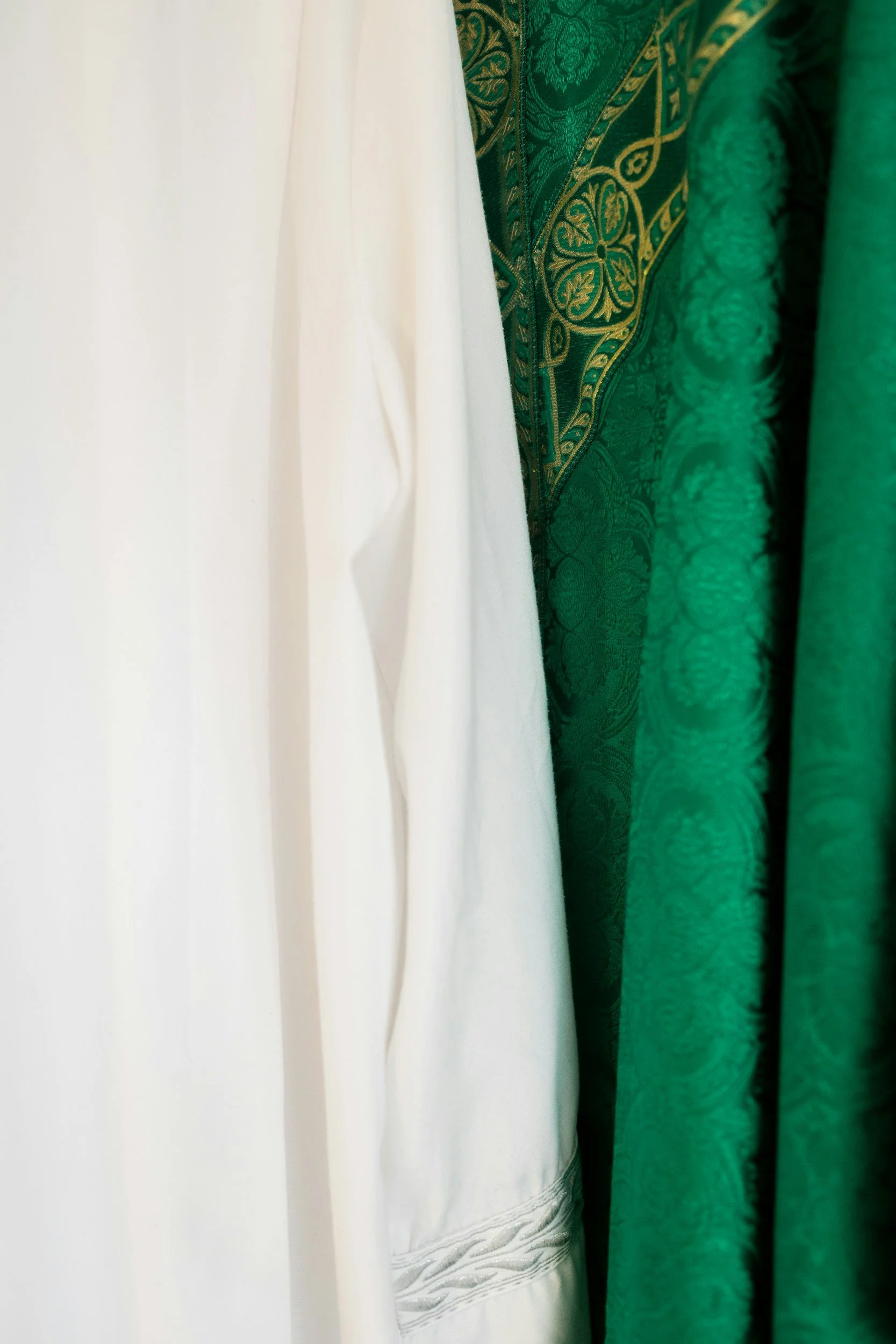
Vestments:
In Exodus 28, God gives Moses instructions for the priestly garments for Aaron “for his consecration, so he may serve me as priest.” The vestments are made up of a breastpiece, an ephod (an “apronlike” garment with shoulder straps), a robe, a woven tunic, a turban and a sash.
Read the chapter and note down the following details:
What colors and fabrics should be used?
What types and colors of stones should be used in each garment…and how many? (You may want to read and compare Genesis 2:10-12 and Revelations 21:10-15)
In what order would a priest put on each garment?
Keeping these details in mind, draw what you think the priestly vestments would look like. Draw a picture of your priest’s vestments. How do the garments compare and contrast? What do you think the purpose of each garment is?
Next, consider the symbolism of the colors, images, and materials used. What does each element remind you of?
Some examples:
Gold: God’s grace
Silver: The goodness in humans, made in the image of God
Bronze: Fallen human nature, refined by God
Blue: Human nature (what the Theotokos contributed to Christ’s incarnation)
Purple: Royalty
Red: Blood of sacrifice/martyrdom
Note: in the Protoevangelium, we learn that the Theotokos was weaving with purple and red, but not blue. Why do you think that might be?
Read the links below for more descriptions of the symbolism of the design of the tabernacle. Then, consider how we have built on or retained these symbols in our beautiful churches!
Further Reading:
https://orthodoxchristiantheology.com/2023/07/20/a-typological-commentary-on-exodus-chapter-25/
https://orthodoxchristiantheology.com/2023/08/14/a-typological-commentary-on-exodus-chapter-26/
https://orthodoxchristiantheology.com/2023/08/20/a-typological-commentary-on-exodus-chapter-27/
https://orthodoxchristiantheology.com/2023/09/06/a-typological-commentary-on-exodus-chapter-28/

Motherhood is not a Job
Lately, I’ve noticed a trend that I find a little troubling–what I can really only call “the commodification of parenthood.” As far as I can tell, this trend started with very good intentions, springing from the idea that stay-at-home moms in particular are undervalued, as evidenced when comparing their workload to a full-time job. Over the past year or so, however, I think this discourse has gotten out of hand. I can’t count the number of posts that are recommended to me across social media channels that feature comments about dads “solo parenting” while mom is running errands, moms calling themselves “HR manager,” or parents “clocking in for the closing shift” before putting kids to bed.
by Mindi Popovich-Schneider, Saint Emmelia Ministries Assistant Director
Lately, I’ve noticed a trend that I find a little troubling–what I can really only call “the commodification of parenthood.” As far as I can tell, this trend started with very good intentions, springing from the idea that stay-at-home moms in particular are undervalued, as evidenced when comparing their workload to a full-time job. Over the past year or so, however, I think this discourse has gotten out of hand. I can’t count the number of posts that are recommended to me across social media channels that feature comments about dads “solo parenting” while mom is running errands, moms calling themselves “HR manager,” or parents “clocking in for the closing shift” before putting kids to bed.
If I had to guess, I would say that there are two sources of this language trend. The first is that, thanks to social media, everything is commodified. If something can be described in corporate language, it almost certainly will be—probably because of the way that the minutiae of everyday life has become an income stream for content creators. Of course that would trickle down into the parenting corners of the internet: these influencers are making money off of documenting their “work” as parents. Second, I think this trend indicates a general lack of purpose in parenthood. Without clear goals, of course the natural end is to commodify parenting: there is nothing that sets it apart from any other use of our time, and our time is most valuable in the language of money.
To be clear, I think there can be positive applications of this type of language: as moms (especially stay-at-home and homeschooling moms), there can be a lot of guilt around feeling tired or burnt out. Comparing homemaking and parenting to a 40 hour job might help with that guilt. Or it might help ease tensions around mismatched expectations between spouses or in-laws. I’m not saying we need to totally do away with this language. I do think, however, that it might be doing some damage to our relationship with the concept of motherhood–and indeed, parenthood more broadly.
The reality is that motherhood is not a job. It’s something deeper. It’s biological. Despite the cute TikToks or Instagram Reels that suggest otherwise, you can’t clock out to go do a Target run. You don’t work shifts. You can change your profession, but you cannot change that you are a parent. You are a mother (or father) all the time. Your responsibilities don’t disappear because your kids are not with you in a given moment.
Our goal is to raise children who love and serve Christ and therefore those around them. That means that even when we are not doing the direct work of parenting, like feeding, cleaning, or disciplining children, we still have work to do. In the times that we are not with our children physically, we still have a spiritual responsibility–a responsibility to direct every moment of our lives towards service to God so that we are better-equipped to teach our children to do the same. Then, we should be praying for our children in every moment possible.
Household chores can feel like a mundane, neverending task, especially for someone like me, who is not very domestic or naturally maternal. But they are all in service of the job that we can never clock out from: helping point our children to heaven and trusting Christ to get them–and us–there.
So, what’s the point of saying all this? It is, I hope, to encourage you in the same way that I myself often need to be encouraged. Even when motherhood feels like a slog, even when it feels like you’re “clocking in” to clean the kitchen or wash the same clothes that you washed two days ago, remember that this is not your job. This is your holy work. This is your gift of sanctification.

Being Christian in Difficult Environments
In elementary and middle school I attended private Catholic and public school. I was the only practicing Orthodox Christian besides my brother at both schools. At times, it was quite difficult being the only one who wasn’t either a Catholic, Protestant, or atheist. There were many times that I was asked to explain things, such as icons and certain Saints, to a crowd who wasn’t interested in learning.
by Caroline, SEM Intern
“So in every test, let us say, ‘Thank you, my God, because this was needed for my salvation.’” -St. Paisios the Athonite
In elementary and middle school I attended private Catholic and public school. I was the only practicing Orthodox Christian besides my brother at both schools. At times, it was quite difficult being the only one who wasn’t either a Catholic, Protestant, or atheist. There were many times that I was asked to explain things, such as icons and certain Saints, to a crowd who wasn’t interested in learning.
My time at the public school was a challenging time for my faith. There were a few moments that confronted my beliefs. I vividly remember having a substitute teacher one day for my computer science class in eighth grade. We didn’t have a substantial assignment so there was more free time to catch up on other homework and talk. Out of twentyish kids in my class, there were about four to five practicing and believing Christians. One classmate, who was a firm atheist, loved to debate. She began to talk about how she didn’t believe in God and that Jesus was not the Son of God. A few other students joined in, and it became a heated discussion. Rather than calm down the conversation, the teacher encouraged it and subtly agreed with my classmates. I remember being completely silent and uncomfortable. The other Christians in the classroom were also silent and unsure of what to say.
On my first day in eighth grade, I was quite lonely. While no one was mean to me, I didn’t make many friends. One group of kids noticed and invited me to sit with them. The first thing they asked me was “Are you a Christian?” While I answered yes, I felt like I had to justify why. There was a Catholic church right beside the lunch hall, and as we walked to class, they began to make fun of the church. Rather than calling them out, I laughed along with them. I compromised my beliefs in order to please people. It’s very easy to say that you wouldn’t do that until you’re in a difficult situation. Standing up to my classmates and friends who made fun of Christianity would have jeopardized those friendships. In retrospect, it may seem like that wouldn’t have been a huge deal, but it was a really huge worry for me in middle school. I desperately wanted someone to like me, and I based my worth around how many friends I had.
So, how do we respond to situations like these in a Christian-like manner? I think the book of Titus offers wonderful guidance: “Likewise, exhort the young men to be sober-minded, in all things showing yourself to be a pattern of good works; in doctrine showing integrity, reverence, incorruptibility, sound speech that cannot be condemned, that one who is an opponent may be ashamed, having nothing evil to say of you” (Titus 2:6-8). Mark 13:11 also reminds us that we should not worry beforehand about what we should say. “ But when they arrest you and deliver you up, do not worry beforehand, or premeditate what you will speak. But whatever is given you in that hour, speak that; for it is not you who speak, but the Holy Spirit.”
We need to speak with humility and gentleness to our “opponents.” You might possibly be one of their first encounters with a Christian. Unkind speech can make someone not want to step foot in a church. We should strive to speak in a way that cannot be condemned or spoken ill of. It is crucial to not talk poorly about others. I always try to remember that the other party is still someone created in the image and likeness of God. It’s very important to humanize them and extend grace. Just because someone treats us unfavorably doesn’t mean we should do the same. How would we be different if we sneered back at them? Everybody’s situation is different, and you never know what they may be going through.
It is key to determine if the other party genuinely wants to understand your point or simply wants to argue with you. Typically, if they are just interested in being right, it’s not fruitful to debate with them. Some people do not deserve nor need an explanation from you. As St. Paul states in Titus 3:9, “But avoid foolish disputes, genealogies, contentions, and strivings about the law, for they are unprofitable and useless.” We should find an appropriate time to speak while being wise and careful about our words. It is also crucial to ensure that we are not motivated by the desire to “be right.” If we want to speak out of hatred or anger for the other party, perhaps it is not the right time to engage.
It is also important to weigh whether speaking up would ruin your relationship with the other person. I find that most true friends would not be angry with you for disagreeing with them. If you are truly afraid of losing them, maybe it’s time to reflect on your relationship with them. You’re not going to lose a real friend; rather you’ll lose someone who wants others to reaffirm their opinions and beliefs. Everyone is at a different place, and it’s okay to walk away from someone who drags you down. We can love and pray for others from a distance. I often remind myself that we are who we surround ourselves with.
We should use these difficult times to grow in virtue. As St. Theophan the Recluse says in Unseen Warfare, “If you wish always to press forward on the path of virtue without stopping, you should pay great attention to things, which may serve as chances for acquiring virtue, and never let them slip out of your hands.” God allows us to be put in these situations as opportunities for us to grow in virtue and faith!
As we reach closer to Holy week and Pascha, let us remember the words of the Gospel of John: "In Him was life, and the life was the light of men, and the light shines in the darkness, and the darkness could not overcome it." (John 1:4-5). We should think of being “the light” like how we light each other’s candles during the Paschal rush service. Instead of keeping the light to ourselves, we should spread it around! Whenever someone’s candle goes out, we should relight it. If our candle goes out, we should ask for someone’s help to relight it. From up close, we can see each candle and person individually. However, from afar, the candles are all one large and bright light. You'll meet so many people whose “candles” are out, and it is our job to spread the light. Sometimes, we’ll have to face dark environments and remind ourselves that it’s hard to adjust from the dark to light. Those who have been in darkness for a while may be uncomfortable with a new-found light. Rather than forcing light upon those who may not be ready, let us gradually glow and be radiant, striving to be examples of Christ’s love for mankind.