


2026 Retreat Reflection
Clean, coldly sharp mountain air takes away my breath as I walk out of the cabin on an early weekend morning. The sun peeps from behind puffy, white clouds that look like creamy, foamy ocean waves, trying to lend some golden warmth to chase away the chilliness of this glorious morning…
by Sophia, SEM Intern
Clean, coldly sharp mountain air takes away my breath as I walk out of the cabin on an early weekend morning. The sun peeps from behind puffy, white clouds that look like creamy, foamy ocean waves, trying to lend some golden warmth to chase away the chilliness of this glorious morning. The dewy grass kisses my feet which are exposed since I put on sandals without realizing they weren’t appropriate for the morning walk. Mountains all around–the biting air seeping into my skin hurries me on my way to the simply beautiful St. Ignatius Chapel for liturgy, the thought of the homey and grace-filled wooden chapel snug with the sweet scent of incense embracing me; a beautiful liturgy I was invited to chant at, along with wonderful and pious teens.
The East Saint Emmelia Ministries conference was such a blessing to be at and experience. Every morning started with a six thirty liturgy, where the youth chanted the whole service in Byzantine style. Liturgy concluded with a blessing from the priest, then everyone headed to the dining hall for breakfast. A spacious, cabin structure ringing with the conversation of parents talking over morning coffee and children’s happy banter. After Father gave the blessing, we all lined up to partake of bagels and cereal, coffee and warm tea. My favorite part of breakfast was probably sitting at the table with all the teens, debating controversial topics. The raffles we did at each meal were quite an entertainment, though. Miss Mindi had us, the interns, do the raffles with the help of “little friends”--the younger kids. Something was going on in those raffle boxes, for whoever pulled out the name would realize that it was their own name or their parent’s name that they saw, smiling back up at the befuddled individual. Breakfast would conclude with a prayer, then everyone went to their assigned activities.
As teens, we had lots of outdoor activities, both fun and humbling to the youth’s spirit. My personal favorite activities were the talk with Mr. Andrew Kern on technology and the very creative talent show. The talk with Mr. Andrew Kern was especially edifying. He approached us in an unexpected manner, asking us what he was going to tell us about technology. The conversation diverted to AI, where pros and cons were listed (mostly cons). What stuck out to me most was Mr. Kern making us realize that AI is not a toy to be used lightly, nor should we overlook it superficially. The ending message he gave us to remember was this: make yourselves dangerous, in a way that danger won’t turn you over your head. Inform yourself on the wiles of the world so you know how to combat them.
The talent show was a piece of captivating acts of art coming alive right in front of our eyes. From the iconic Anakin vs Obi Wan lightsaber duel, to mesmerizing piano recitals, the famous Sir Lancelot and King Arthur joust, groovy gospel band, and a sentimental solo song “She Used to be Mine”, the evening was surely a success.
Late evening would take us each night to a small but cheery bonfire, with sticky s’mores and hot tea. After our fill of warm treats and newly-acquired knowledge gained from deep discussion around the fire’s crackling flames, everyone trudged to the chapel for a compline service.
Overall, the conference was a beautiful time of prayer, a time spent with inspiring and fun people, a time of revival and joy. It was truly a blessing to be there!
Masculinity, Femininity, and the Search for Meaning
Modern culture often speaks about masculinity and femininity with uncertainty. At times, the differences between men and women are treated as insignificant, while at other times they are reduced to stereotypes, performances, or struggles for power.
by Londyn, SEM Intern
Modern culture often speaks about masculinity and femininity with uncertainty. At times, the differences between men and women are treated as insignificant, while at other times they are reduced to stereotypes, performances, or struggles for power. Many young people grow up surrounded by conflicting messages about relationships, careers, and purpose. Yet beneath this confusion, there often remains a quieter longing that modern culture can never satisfy: the desire for love, stability, family, and a meaningful life shared with others.
Orthodox Christianity approaches masculinity and femininity not as competing identities, but as complementary expressions of the human person. Men and women are created in the image of God and share the same spiritual dignity and calling toward holiness. At the same time, they often express love, sacrifice, responsibility, and care in distinct yet complementary ways. The Church does not see these differences as limitations or social constructions, but as part of the beauty and order of creation itself.
Modern society frequently presents fulfillment as radical independence. Success is often measured through personal achievement, status, wealth, or freedom from obligation. Yet despite these promises, many people still feel deeply lonely, restless, and uncertain about what lasting happiness actually looks like. A longing for marriage, family, rootedness, and faithful community has not disappeared. If anything, it has become more visible precisely because modern life often feels fragmented, temporary, and disconnected.
Growing up in a family with seven children deeply influenced my understanding of these things from an early age. Life is rarely quiet, and our days are filled with constant movement, responsibility, conversation, and shared routines. Yet there is also a warmth and steadiness within it. Family life teaches people to think beyond themselves. It forms patience, forgiveness, sacrifice, humility, and loyalty in ordinary ways that often go unnoticed. Shared meals, laughter, helping care for younger siblings, and simply living closely with others create a sense of belonging that cannot easily be replaced by modern individualistic pursuits.
At the same time, I do not believe masculinity or femininity require rejecting education, ambition, creativity, or experiences beyond the home. This summer, before beginning college, I will be studying abroad in Denmark for a month, and last winter I traveled to Germany with my parents. Traveling changes the way a person sees the world. It teaches humility and attentiveness. Seeing unfamiliar places, hearing different languages, and encountering other cultures broadens the mind and deepens appreciation for beauty. Interestingly, the more people experience the restlessness of modern life, the more many begin to appreciate the goodness of permanence, tradition, and home.
For many women, modern culture often presents two equally unsatisfying extremes. On one side, femininity is reduced to appearance, attention, or performance. On the other, domestic life, marriage, and motherhood are sometimes treated as lesser than professional success or radical independence. Yet many young women still feel drawn toward a quieter and more rooted vision of life: one centered around faithfulness, love, family, and the desire to create a home filled with warmth, peace, and stability.
Orthodoxy understands this desire not as weakness, but as a profound form of vocation. Homemaking, in its deepest sense, is not merely the maintenance of a household. It is the cultivation of an environment where souls are nurtured through patience, discipline, tenderness, forgiveness, and love. Such work may appear ordinary from the outside, yet it quietly shapes future generations and forms the spiritual atmosphere of family life. At the same time, the Church also honors women through many different callings — motherhood, scholarship, service, monasticism, hospitality, teaching, and countless other forms of faithful living.
Masculinity has also become deeply confused within modern culture. Online culture often reduces manhood to status, wealth, physical appearance, domination, or control over others. Yet these images ultimately leave many men isolated and dissatisfied because they mistake strength for aggression and confidence for vanity.
The Orthodox understanding of masculinity is far deeper and more demanding. A good man remains faithful, dependable, disciplined, and willing to sacrifice himself for others. He protects and provides not out of pride or the desire for control, but out of love and responsibility. His strength exists not for self-glorification, but for service. Masculinity requires humility, courage, steadiness, patience, and self-control. It asks a man to remain trustworthy even when life becomes difficult, exhausting, or painful.
Likewise, true femininity is not passive, shallow, or intellectually narrow. It requires deep emotional and spiritual strength. A woman often creates the atmosphere of family and community life through attentiveness, wisdom, compassion, endurance, and steadfast love. Both masculinity and femininity therefore involve sacrifice and self-giving. Neither is centered on self-fulfillment alone. Instead, both find meaning through communion, responsibility, devotion, and love directed toward God and other people.
The Orthodox Church presents Christ as the perfect image of humanity itself. In Him, strength and humility exist together completely. Christ reveals that greatness is found not through domination, but through sacrificial love. The Church also honors the Theotokos as the highest example of human faithfulness and spiritual beauty. Her humility was not weakness, but profound strength rooted in obedience and trust in God. Together, Christ and His mother reveal the fullness of what humanity is meant to become.
Though I am only eighteen and just beginning adulthood, I find myself increasingly drawn toward a life centered around faith, education, friendship, family, and service. I look forward to college, learning, traveling, and experiencing the wider world, yet I also hope to marry, raise children, and build a home of warmth, devotion, stability, and love. That desire does not feel restrictive to me. Rather, it feels deeply meaningful because family life touches something enduring within human nature itself.
Modern society often encourages constant reinvention and independence from all obligation. Yet beneath the noise and movement of contemporary life, many people still long for permanence — for homes filled with laughter, children raised with care, friendships rooted in faithfulness, and lives ordered toward something greater than personal success alone. Perhaps this longing endures because it reflects something fundamental within the human soul. Even in a restless age, the quiet beauty of faithful love, family, sacrifice, and communion continues to endure.

Discernment in Music
Everyone has standards and beliefs. These influence their judgment on what they will accept from the culture. An example is the music one decides to listen to. In seventh grade, the popular music culture began to peak my interest, and I was captivated by the various tunes. Though I was skeptical of some lyrics, I unfortunately placed my concerns aside to enjoy the catchy tunes. I came to realize the themes in many popular songs contradict the Christian ideal. I learned I must use discernment in choosing the music I listen to.
Christina, Intern
Everyone has standards and beliefs. These influence their judgment on what they will accept from the culture. An example is the music one decides to listen to. In seventh grade, the popular music culture began to peak my interest, and I was captivated by the various tunes. Though I was skeptical of some lyrics, I unfortunately placed my concerns aside to enjoy the catchy tunes. I came to realize the themes in many popular songs contradict the Christian ideal. I learned I must use discernment in choosing the music I listen to.
In Matthew 6:22-23, Christ says “The lamp of your body is the eye. If therefore your eye is good, your whole body will be full of light. But if your eye is bad, your whole body will be full of darkness.” This also should be applied to our ears. The experiences we have through our five senses (taste, hearing, sight, smell, and touch) affect the purity of our souls. Have you ever heard the phrase “scarred for life”? It is typically used if someone experiences something terrifying or inappropriate. Though this is a casual, throw-away phrase, when one thinks about it literally, it means that we have left a mark on our souls that is difficult to remove. One of the ways we can aim to be like Christ is having a pure soul, heart, and mind. We can do this by guarding what we hear, especially in music, so that we are not “scarred for life”.
It is important to make sure the songs we listen to are uplifting for us because, while our vast human memory capacity is a blessing, we can memorize songs quickly – good or bad. After hearing a song over and over, such as a beloved church hymn, we eventually memorize and internalize it. We can also internalize the bad songs. To internalize something means to make it a part of us; what we have internalized is inseparable from us. Many of the popular, “cool” songs want us to answer to every call of our hearts, giving us unfulfilling, dark solutions to the trials and problems we face. Moreover, after our brain hears something too many times; sometimes, it just might accidentally come out of our mouths.
The process of discerning a song’s impact should be based on the lyrics, not by the tune or by what other people like. When considering the lyrics, keeping the purity of the soul in mind is most important; thus, avoiding the impact of songs that bring you down. In the end, music is a beautiful gift given by God. We can preserve its beauty by opening our ears to songs that lead us towards Him and not away.
Note: Our interns curate Spotify playlists of music worth listening to. Check them out here, though we strongly recommend that if you use the free version of Spotify, you set your age to under 15 to avoid inappropriate advertisements.

Motherhood is not a Job
Lately, I’ve noticed a trend that I find a little troubling–what I can really only call “the commodification of parenthood.” As far as I can tell, this trend started with very good intentions, springing from the idea that stay-at-home moms in particular are undervalued, as evidenced when comparing their workload to a full-time job. Over the past year or so, however, I think this discourse has gotten out of hand. I can’t count the number of posts that are recommended to me across social media channels that feature comments about dads “solo parenting” while mom is running errands, moms calling themselves “HR manager,” or parents “clocking in for the closing shift” before putting kids to bed.
by Mindi Popovich-Schneider, Saint Emmelia Ministries Assistant Director
Lately, I’ve noticed a trend that I find a little troubling–what I can really only call “the commodification of parenthood.” As far as I can tell, this trend started with very good intentions, springing from the idea that stay-at-home moms in particular are undervalued, as evidenced when comparing their workload to a full-time job. Over the past year or so, however, I think this discourse has gotten out of hand. I can’t count the number of posts that are recommended to me across social media channels that feature comments about dads “solo parenting” while mom is running errands, moms calling themselves “HR manager,” or parents “clocking in for the closing shift” before putting kids to bed.
If I had to guess, I would say that there are two sources of this language trend. The first is that, thanks to social media, everything is commodified. If something can be described in corporate language, it almost certainly will be—probably because of the way that the minutiae of everyday life has become an income stream for content creators. Of course that would trickle down into the parenting corners of the internet: these influencers are making money off of documenting their “work” as parents. Second, I think this trend indicates a general lack of purpose in parenthood. Without clear goals, of course the natural end is to commodify parenting: there is nothing that sets it apart from any other use of our time, and our time is most valuable in the language of money.
To be clear, I think there can be positive applications of this type of language: as moms (especially stay-at-home and homeschooling moms), there can be a lot of guilt around feeling tired or burnt out. Comparing homemaking and parenting to a 40 hour job might help with that guilt. Or it might help ease tensions around mismatched expectations between spouses or in-laws. I’m not saying we need to totally do away with this language. I do think, however, that it might be doing some damage to our relationship with the concept of motherhood–and indeed, parenthood more broadly.
The reality is that motherhood is not a job. It’s something deeper. It’s biological. Despite the cute TikToks or Instagram Reels that suggest otherwise, you can’t clock out to go do a Target run. You don’t work shifts. You can change your profession, but you cannot change that you are a parent. You are a mother (or father) all the time. Your responsibilities don’t disappear because your kids are not with you in a given moment.
Our goal is to raise children who love and serve Christ and therefore those around them. That means that even when we are not doing the direct work of parenting, like feeding, cleaning, or disciplining children, we still have work to do. In the times that we are not with our children physically, we still have a spiritual responsibility–a responsibility to direct every moment of our lives towards service to God so that we are better-equipped to teach our children to do the same. Then, we should be praying for our children in every moment possible.
Household chores can feel like a mundane, neverending task, especially for someone like me, who is not very domestic or naturally maternal. But they are all in service of the job that we can never clock out from: helping point our children to heaven and trusting Christ to get them–and us–there.
So, what’s the point of saying all this? It is, I hope, to encourage you in the same way that I myself often need to be encouraged. Even when motherhood feels like a slog, even when it feels like you’re “clocking in” to clean the kitchen or wash the same clothes that you washed two days ago, remember that this is not your job. This is your holy work. This is your gift of sanctification.

The Holy Silence of a Monastery
“‘We have one sword–the Jesus Prayer.’ (St. Barsanuphius of Optina) Spending a month at one of Elder Ephraim’s women’s monastery, I saw St. Barsanuphius’ quote taken quite seriously. In the busy bakery, amidst the whirring of baking and cooking machinery; in the cafe, serving curious tourists and eager customers; walking up to their cells on a sunny afternoon: these valiant warriors of Christ always were wielding this sword…”
by Sophia, SEM Intern
‘We have one sword–the Jesus Prayer.’ (St. Barsanuphius of Optina) Spending a month at one of Elder Ephraim’s women’s monastery, I saw St. Barsanuphius’ quote taken quite seriously. In the busy bakery, amidst the whirring of baking and cooking machinery; in the cafe, serving curious tourists and eager customers; walking up to their cells on a sunny afternoon: these valiant warriors of Christ always were wielding this sword. Sometimes I would hear a nun before seeing her. Yes, they would murmur it under their breath, sometimes saying it out loud, “Lord Jesus Christ, have mercy on me.” Gerondissa Makrina, the “grandmother” of the monastery, encourages her nuns to say the Prayer out loud, so that any sister whose mind had wandered off would remember to resume the Prayer when she hears her sister saying it.
A monastic spends the whole day in prayer. Visiting the monastery for such a lengthy time, I got to experience almost their whole schedule and–I have to admit– it was hard. I didn’t have to wake up at one in the morning to do my short rule, but I did go to the two am Paraklesis services that were held four days a week, and the four-thirty am liturgy on Thursdays. The services were beautiful with the simple, sweet nuns’ chanting, but it was very hard not letting my heavy eyelids close for a bit. I will tell the truth and say that I have fallen asleep more than once during services, but my guardian angel always nudged me awake whenever a sister passed by to cense with the incense burner.
For Dormition, during my stay, a long vigil was held in honor of the Panagia’s special feast. It was beautiful–and lengthy. Vespers, orthros with lamentations, and liturgy. It started at eight the evening before, and ended at three in the morning. The chanting, the polycandelon swaying from side to side during specific moments, representing the angels, and the prayerful atmosphere of the packed church made the service seem to fly by. It was such a blessing to be there.
During the normal week days, everyone kept busy. There was the cafe/bookstore to run, food orders to be made, bakery sweets and spanakopitas to be baked, the meals to be cooked, flowers to be watered–to name a few. The list could go on and on and on. And no matter what they were doing, the sisters always kept the prayer-filled atmosphere. Because of that, everyone was at peace despite the evil one’s attacks.
My trip was such a wonderful blessing, and I strongly encourage everyone– but especially, young adults– to experience not only a pilgrim's point of view, but to be invested and part of the monastery for a little while. I’ve been told many times that the monastic life can be tried out, unlike marriage. So, if you are able to visit, do it!
Glory be to God for all things!!

Listening Well
I used to feel insecure about my quiet nature. I would watch others lead, speak, shine—commanding rooms with their charisma, weaving words into influence—and I would wonder if my presence was enough. I would sit in conversations, not always knowing what to say, but deeply feeling the weight of someone else’s words. And I would ask myself: is this a gift, or just passivity dressed up as virtue? Is my silence meaningful, or merely a void?
by Londyn, SEM Intern
I used to feel insecure about my quiet nature. I would watch others lead, speak, shine—commanding rooms with their charisma, weaving words into influence—and I would wonder if my presence was enough. I would sit in conversations, not always knowing what to say, but deeply feeling the weight of someone else’s words. And I would ask myself: is this a gift, or just passivity dressed up as virtue? Is my silence meaningful, or merely a void?
In a world that prizes visibility, volume, and velocity, quietness can feel like a flaw. We are taught to equate worth with productivity, impact with noise, and leadership with dominance. But Orthodoxy has a way of answering questions we did not know how to ask. It does not rush to fill silence with sound. It does not confuse stillness with stagnation. It teaches us that love is not always loud and that healing often comes through stillness.
Throughout the life of the Church, there have been saints whose holiness was revealed not through eloquence, but through silence. St. Silouan the Athonite, for example, lived in quiet prayer and deep humility, offering his heart to God in stillness and tears. St. Mary of Egypt, after her dramatic conversion, spent decades in the desert in complete solitude, her repentance echoing loud. St. Seraphim of Sarov greeted visitors with radiant peace, often saying little but emanating divine love. These saint’s lives are icons of the truth that stillness can be the most powerful witness of grace.
When we listen, we echo Christ’s descent into our brokenness. We say, “I’m here. I see you, and I won’t run away.” And that presence can be more healing than any advice or solution. Listening is not passive, it is active love. It is spiritual labor and the work of mercy. And yes, it is quiet! And yet, so is the heart that prays in secret. If you have ever felt like your gift is too small, too quiet, too invisible—remember this: Christ was born in a cave. He came in silence. He healed with a touch. He listened to the woman at the well, to the thief on the cross, to the cries of the blind and the broken. And He listens to you. So go ahead, be the listener. Be the quiet one. Be the heart that holds space. You are doing holy work!
Here are some ideas for growing as a listener:
Put away distractions: Silence your phone, close your tabs, and give your full attention. Presence is the first gift.
Don’t interrupt: Let their words unfold. Silence does not have to be empty.
Pray before, during, and after: Ask God to help you listen with love, and to bless the person you’ve heard.
Allow pauses: Don’t rush to fill silence–let it breathe!
See Christ in the other: Every person is an icon. Listening becomes an act of reverence.

Consistency
During my freshman year of high school, I was diagnosed with an autoimmune disease that turned my whole world upside down. I got diagnosed with Multiple Sclerosis (MS), which can affect my ability to walk, see, balance, and feel things through my body due to nerve damage. During this season of my life, I was in and out of the hospital for months on end, I struggled with my home prayer-life, I felt isolated and alone, and it seemed that I had truly hit rock-bottom. I am very much a rhythmic/routine kind of person, and this entire situation threw my life completely off balance. I had no routine, no rhythm, what felt like no community, and no end in sight. The only thing that was semi-consistent in my life was church. While I did feel isolated and shut out at times, my family made a point to take me to Liturgy every Sunday during this struggle, even when I was in a wheelchair. Yes, it was a struggle; yes, I felt invisible; but that consistency was all I had.
by Gabriella, SEM Intern
During my freshman year of high school, I was diagnosed with an autoimmune disease that turned my whole world upside down. I got diagnosed with Multiple Sclerosis (MS), which can affect my ability to walk, see, balance, and feel things through my body due to nerve damage. During this season of my life, I was in and out of the hospital for months on end, I struggled with my home prayer-life, I felt isolated and alone, and it seemed that I had truly hit rock-bottom. I am very much a rhythmic/routine kind of person, and this entire situation threw my life completely off balance. I had no routine, no rhythm, what felt like no community, and no end in sight. The only thing that was semi-consistent in my life was church. While I did feel isolated and shut out at times, my family made a point to take me to Liturgy every Sunday during this struggle, even when I was in a wheelchair. Yes, it was a struggle; yes, I felt invisible; but that consistency was all I had.
My parents had given me my first ever prayer book and copy of the Orthodox Study Bible a year or two before my health complications started, but I hadn’t really gotten into the habit of using them daily, or even weekly. During this struggle with my health, when all I could do was lay or sit in bed for days on end, I finally found it in me to start using the tools my parents had gifted me. One thing I would often find myself doing was listening to a podcast or audiobook on Ancient Faith Radio and coloring in a coloring book for hours. It passed the time and gave me something to do. It gave me peace.
The more I listened to these online resources, the more I wanted to try reading or doing (praying) the things I was hearing. I had to fight a lot of temptations when I started this. “I’m too tired right now,” “I am hurting a lot and won’t be able to pay attention,” “Resting would be better for me,” “Do I have to?” and so on. I’m sure most people have struggled with some version of these thoughts before. They are so appealing in the moment, and yet… I always seemed to feel worse if/when I listened to the thoughts.
That next year, during Great Lent, my struggles increased. I could barely make it out of the house and struggled with anxiety and depression often. My family lived about an hour away from our parish at the time, and I hadn’t made it to almost any Lenten services. I wanted to push myself and go to as many Holy Week services as I could. This was for selfish reasons at first (I wanted to “check all the boxes”), but I grew to truly appreciate the services for what they are. My family took me to about half of the Holy Week services that year, and it was exhausting in the absolute best way. Then Pascha rolled around. I struggled through the service and had to go outside a few times, but once I Communed, something changed. That next week, right as I was going to see some specialists for my health problems, I was starting to heal. I was able to start using my legs for the first time in almost 9 months!
The next year was a new kind of challenge. Now that I could walk again, I had to gain my strength back. I went to various different doctors and physical therapy offices, and I had to do different types of desensitization at home (my siblings loved to help with that!). Through the Grace of God, and everyone’s prayers and support, by the end of the year I was back to a regular state of health, whatever that means!
Now, four years later, I still struggle with the same things from time to time. I knew my life would never be the same, but I knew one thing for sure, I had to keep the Church in my life. From this experience with my health I have grown to appreciate the services, prayers, and resources the Church gives us. Yes, I still struggle with those same thoughts and feelings I had when I was really sick, but they are less now. There are days I don’t want to get out of my cozy bed and go to my icons. There are days when I would much rather get lost in a good fiction book than read my Bible. But I have learned that if I listen to those thoughts, if I let myself get dragged away from the consistent help the Church gives me, I will always feel worse than when I started.
I now make it a point to pray, read Scripture, and exercise daily. No matter how little or much I can do. I might just say “Lord, have mercy on me” and walk around my backyard listening to Scripture readings on my phone, or maybe just staring at my Bible. I often feel guilty when I do this, thinking it’s “not enough” and I’m a “terrible Christian”, but some days that is all I can give to God. I know He helps me where I fail on those days and loves me regardless. And if I didn’t keep up with these things, if I weren’t consistently trying to try, I would just fall back into all the complications I struggled with before and have even less motivation to get out. No matter the amount, the effort, the consistent effort, is always what shines through. And thank God for that!

Starting the School Year With Your Right Foot Forward
Ah yes, fall. Us students’ favorite time of year. Right around August/September, we are all starting up school again (or maybe you’re taking a gap year, or you’ve graduated. If so, congrats!). If you’ve had a busy summer like me, then you might feel as if the months flew by way too quickly, and school can’t possibly be starting again so soon. Yet here we are, about to jump into a world of books, lectures, homework, and more! It can seem pretty daunting, I know. However, with the right mindset and God’s Grace, it can be accomplished fairly easily!
by Gabriella, SEM Intern
Ah yes, fall. Us students’ favorite time of year. Right around August/September, we are all starting up school again (or maybe you’re taking a gap year, or you’ve graduated. If so, congrats!). If you’ve had a busy summer like me, then you might feel as if the months flew by way too quickly, and school can’t possibly be starting again so soon. Yet here we are, about to jump into a world of books, lectures, homework, and more! It can seem pretty daunting, I know. However, with the right mindset and God’s Grace, it can be accomplished fairly easily!
I just graduated this past May (2025) and am currently taking a gap year. I was homeschooled all the way through my K-12 years of education. My mom was my main teacher for the majority of the years, but then around 7th/8th grade, I began doing most of my work independently, and by 8th/9th grade I was doing all online classes through Saint Athanasius Academy (SAA). There were a lot of bumps and hiccups throughout the years I was in high school, and it was often hard to find the motivation to sit down and just get it done. I’d often find myself lost in a good book, spending time with my siblings, doing chores, or just sitting around procrastinating! Fall was especially challenging. I had gotten used to a new routine over the summer, and then it all had to change in a few days. I had to get used to attending classes again, keeping up with assignments, making sure to take notes properly, and balancing all that with my spiritual and family lives. It was never fun.
Even though the first few weeks (sometimes months, or maybe the entire year) of school feel draining, stressful, and sometimes lonely, I always felt so rewarded after pushing through and getting into a new rhythm. During the last few years of high school, I learned about and grew close to a few saints who are known for their help to students. Some of my favorites are Saint John of Kronstadt (commemorated December 20th/January 2nd), Saint Sergius of Radonezh (commemorated September 25th/October 8th), and the Three Holy Hierarchs (St. John Chrysostom, St. Basil the Great, and St. Gregory the Theologian [commemorated January 30th/February 12th]). I have icons of St. John of Kronstadt and the Holy Hierarchs by my desk and I would always ask for their intercessions before starting any of my school work or classes.
Along with these saints, there are several prayers for before classes/studying which can be found here (you’ll have to scroll down a little bit, fyi!). These are wonderful ways to incorporate the Faith into your daily lessons and are extremely helpful.
I know it sounds cliche, but another thing that is always helpful is the 30/5 rule. You work for 30 minutes, you take a break for 5. And no, scrolling on your phone or computer does not count as a break. Go outside, walk around, do some squats or stretches, read about the saints of the day, etc. Just get up and away from your work for a few minutes to recharge and come back to it with a clear mind! Especially if you are starting to feel groggy/unmotivated. You can also listen to some music to get your mind out of a fog. The SEM playlists have some great songs!
Along with taking the core classes, I found that taking electives or classes about topics I am really interested in helps me be much more engaged in the topic. If you’re interested in history, take a class on a period you really want to learn more about; if you like books, do a book club; if you’re into theater and acting, find a local theater (preferably a Christian one), or do something online (maybe try writing a play for English class); if you like space, astronomy; etc, etc…Y’all are smart, I think you get the idea!
The point is, if you enjoy something, learning about it will help you to both retain the information better and deepen your appreciation for that topic. During high school I took at least one or two Orthodox Studies classes each year. I took classes about the Old Testament, one about Early African Christianity/Saints, one about the Cappadocian Fathers, and many more. They were all so much fun and I feel like I was truly able to deepen my appreciation for our Faith. All of the classes I listed I took from SAA if anyone wants to check them out!
One last thing to remember in this season of Marian feasts, is the example the Panagia gave us as young adults. As we enter this school year, wherever we are, whatever is happening or going to happen, we need to remember to be meek, humble, and contemplative in all the work we do. Yes, you are going to mess up that essay. Yes, you are going to ask a dumb question in class or answer one way wrong. No, you are not going to make it through the year completely perfectly. In all of these challenges that the school year brings, it is important to remember that Christ is giving us these beautiful opportunities to learn about Him through the subjects we are studying. We don’t need to get mad about the bad grammar on our assignment, we don’t need to get annoyed with our teachers/parents, we don’t need to isolate ourselves to get school done. Will all of these things happen? Yes, they will. Even if you try to avoid getting mad, annoyed, or distant, it is bound to happen. That’s life. And school is a stressful thing that EVERYONE struggles with. What really matters is how we approach it and grow from it. Will we follow Christ and His Mother as examples of our attitudes? Or will we lean toward the Disciples of Jesus on the boat and freak out about the waves of schoolwork around us? It’s up to you, and I wish you all the best as you enter this school year! May God give us all strength.

Stillness, Part II
It seems a bit silly for me, of all people, to be writing this blog post. After all, I am not, by nature, a particularly “still” person. I struggle with fairly severe anxiety, and my mind tends to wander towards current or potential projects whenever I’m faced with a task that seems mundane. On the other hand, that means that I have had to think a lot about ways to achieve even the tiniest bit of stillness.
by Mindi Popovich-Schneider, Saint Emmlia Ministries Assistant
It seems a bit silly for me, of all people, to be writing this blog post. After all, I am not, by nature, a particularly “still” person. I struggle with fairly severe anxiety, and my mind tends to wander towards current or potential projects whenever I’m faced with a task that seems mundane. On the other hand, that means that I have had to think a lot about ways to achieve even the tiniest bit of stillness. Here are some habits and techniques that have helped me.
Remember your goals. Yes, there’s curriculum to teach, laundry to fold, dishes to wash, errands to run…a never-ending list of chores and responsibilities. And those things are important, but they are not the goal. Our main goal is to be sanctified, thereby being united with Christ. Our second goal is to raise our children to pursue the same. Our third goal is to love and serve others. Completing housework, teaching a set amount of curriculum, and so on—these are much farther down the list. When you approach each moment as a possibility for achieving our goals, essentially giving each moment to Christ, the rest of the world has a way of melting away. You’ll still be folding the same shirt you folded yesterday or washing the 800th fork of the day, but you’ll be doing it with the knowledge that it is for your sanctification, not for marking off a to-do list item.
Lead with prayer. One of the biggest disruptors in my peace is arguing and negotiating allllllllll day with tiny humans who don’t know how to tie their shoes but are convinced they should be in charge of…well, everything. One of the–if not THE–sweetest balms for that struggle is prayer. When it feels like I’m disciplining my children every 5 minutes, I stop and pray. Not silently, not a memorized prayer. I take my child onto my lap, and I ask God to give me His love and peace. And then I ask my child to take a turn praying. I cannot think of a single instance in which this has not opened my child’s and my hearts to reconciling with each other, working together, and loving each other more.
Pray for others. Something I really struggle with is replaying interactions on loop, dissecting them and fretting about them. And if I’m not analyzing specific interactions, I’m probably worrying about entire relationships. Recently, I have begun focusing on praying for people the moment they come to mind. If I am able to do a full circuit on my prayer rope (Lord Jesus Christ, have mercy on my mother/my friend/this sick person at church/a political leader who said something troublesome), that’s a massive blessing! But five “Lord have mercies” as I’m going about chores works wonders on their own.
Practice gratitude. It’s hard to be anxious when you’re focused on how many gifts you have and how many good things you are surrounded by in the current moment (no matter how stressful that moment is!). When my child does something well (like obeying quickly or completing a task efficiently), we thank God and our guardian angels. I (try to) give thanks for my children throughout the day, appreciating every smile, funny expression, precocious or goofy comment, etc. At dinner each night, we take turns thinking back on the day and choosing one thing that we’re grateful for. These three things have made our home so much more peaceful.
Live in the moment. If I had to sum up my other tips, it would be this! When you give up the things of tomorrow, or next week, or 10 years ago, and you focus on what is in front of you in this moment, there is so much more room for peace and stillness. This is a very hard thing to do! It’s a bit like doing a plank while working out, and I myself can only hold this mental “plank” for a few seconds at a time, and with great effort. But just like with learning to do a plank, you get a little stronger each time you do it! One thing that has helped me when my thoughts start to wander away from whatever is in front of me in a given moment is to picture–or more accurately, feel–myself actually handing my thoughts over to Christ.
In Part I, Londyn shared a beautiful piece of wisdom from Saint Isaac the Syrian: “Establish your heart in peace, and a multitude around you will be saved.” But along with that exquisite articulation of the importance of stillness, I want to share this reminder from St. Paul in his letter to the Hebrews: Therefore we also, since we are surrounded by so great a cloud of witnesses, let us lay aside every weight, and the sin which so easily ensnares us, and let us run with endurance the race that is set before us, looking unto Jesus, the author and finisher of our faith, who for the joy that was set before Him endured the cross, despising the shame, and has sat down at the right hand of the throne of God.
Remember that stillness is one of the destinations on our way to our ultimate goal of being united with Christ…but it is also a race—more accurately, a marathon—in and of itself! Take courage, and each time you fall, letting the noise of the world crowd in, get back up with God’s strength, and begin to run again!
God be with you in this difficult, but incredibly rewarding, race!

Stillness
The world we live in is loud. Nearly everywhere we go, there’s motion and sound– conversations rise and fall, and the chatter of plans and problems and priorities is ever going. While none of this is inherently wrong, I’ve come to notice how easily all this noise piles up in my heart. After a while, it starts to feel like clutter. And in the middle of it all, I find myself longing—not just for rest, but for something deeper. I long for stillness. Not just the absence of sound, but the kind of stillness that lets the soul breathe. That sacred quiet that lets me see clearly again and remember what matters most. The Church has a word for this: hesychia—holy silence. A silence not of emptiness, but of fullness. A silence in which we can finally hear God.
by Londyn, SEM Intern
The world we live in is loud. Nearly everywhere we go, there’s motion and sound– conversations rise and fall, and the chatter of plans and problems and priorities is ever going. While none of this is inherently wrong, I’ve come to notice how easily all this noise piles up in my heart. After a while, it starts to feel like clutter. And in the middle of it all, I find myself longing—not just for rest, but for something deeper. I long for stillness. Not just the absence of sound, but the kind of stillness that lets the soul breathe. That sacred quiet that lets me see clearly again and remember what matters most. The Church has a word for this: hesychia—holy silence. A silence not of emptiness, but of fullness. A silence in which we can finally hear God.
Psalm 45:11 says, “Be still and know that I am God.”
Over time and prayer, I’ve learned that silence can begin in the smallest places: closing my eyes before a meal and remembering that every breath is a miracle. Walking under the stars and letting wonder rise. Sitting beside a loved one without needing to speak.
Stillness isn’t always easy. Sometimes it feels uncomfortable, especially at first. I’ve had moments where I sit down to pray in silence and suddenly everything I’ve ignored comes rushing in—worries, regrets, distractions. But even that is part of the healing. Stillness makes us honest. It clears out space so that something better can grow.
The desert fathers didn’t choose solitude because they hated people—they longed for the presence of God in a pure and undistracted way. In their words and lives, I see a deep truth: that the quieter our hearts become, the more clearly we hear the One who made them.
“Establish your heart in peace,” wrote Saint Isaac the Syrian, “and a multitude around you will be saved.” What a thought—that my personal stillness, my quiet love for Christ, can ripple outward and bring peace to others. Isn’t that the kind of person we all long to become? The kind whose very presence brings calm? The kind who listens without hurrying, who sees without judging, who loves without noise?
Life won’t always give us silence. But stillness can live even within sound. It’s an attitude of the heart—a way of being. I’ve felt it even while walking in a crowd or washing dishes or watching leaves fall. I think that’s the grace of it: once you start to make space for stillness, it follows you. It becomes part of you. Because beneath it all—beneath the schedules and worries and distractions—there is a God who waits to be known. And His voice is not in the earthquake or the fire or the whirlwind. His voice is in silence and He’s already speaking.
Check back for part II, Practical Tips for Fostering Stillness!

Focusing on Fasting
In the quiet moments of our busy lives, fasting invites us into a deeper communion with God. As Orthodox Christians, the sacred tradition of fasting is a journey of the soul, a practice that transforms daily routines into opportunities for spiritual growth. Through the act of fasting, we learn to find beauty in simplicity, strength in discipline, and a profound connection with our faith. Join our interns as we share some of our favorite fasting recipes, from breakfast, lunch, dinner, and snacks!
by the SEM Interns
In the quiet moments of our busy lives, fasting invites us into a deeper communion with God. As Orthodox Christians, the sacred tradition of fasting is a journey of the soul, a practice that transforms daily routines into opportunities for spiritual growth. Through the act of fasting, we learn to find beauty in simplicity, strength in discipline, and a profound connection with our faith. Join our interns as we share some of our favorite fasting recipes, from breakfast, lunch, dinner, and snacks!
Londyn: As a convert for just over two years, adjusting our usual meal plans to be fast-friendly was especially challenging for my family. It was easy to become overwhelmed and think about food even more than before fasting! However, with time and prayer, I realized that my fasting efforts could improve—I needed to focus less on meals. So, I did some quick thinking and came up with a tried-and-true list. I hope these are helpful to you in some way!
Protein bowl: beans (pinto or black are my favorite), corn, and rice. I usually add some salsa and avocado/guacamole, too!
Hummus and veggie platter (I also like to put the hummus on top of naan or pita bread!) I love cucumbers, bell peppers, and carrots
Avocado toast (seed bread has extra protein)
Peanut butter, honey, and flax seed sandwiches/toast
Granola and almond milk
Caroline: Fasting has always been a struggle for me. It can be easy to focus on the food part and neglect the prayer part. As my mother always says, fasting without prayer is just being hungry! Instead of worrying about the food, I lean on my staple recipes.
Couscous with beans (I love using black beans)
Roasted chickpeas
Black bean burgers
Smoothie w/ vegan protein powder (I like PEscience)
Vegan cookies (Tasty has an AMAZING recipe)
Cecilia: Fasting helps us regain balance and perspective in our lives. Abstaining from certain food products is medicine that the Church prescribes us to aid us on our spiritual journeys. It’s easy, however, to become so caught up in the dos and don’ts of fasting that we completely miss the spirit of the fast! We frantically check labels or use substitutes that taste almost like the real thing, but are just more expensive and take more time to prepare. If we try to eat more simply, we can use our extra time and money (which was not spent on food) to share with our hungry, poor, and suffering brothers and sisters. Here are some simple fasting meals you can try:
Chili with fasting cornbread
A simple stir fry (with tofu)
Baked oatmeal bars:
Mix:
2 c flour
1 c brown sugar
½ tsp baking soda
1 tsp cinnamon
1 tsp vanilla
2 c oats
Add:
¾ c oil (or could try applesauce?)
¾ c water
½ to 1 c cranberries or chocolate chips
Optional: nuts, coconut, other grains
Put in greased 9x13 pan
Bake at 350F for 30 min
Peanut butter and jelly, avocado, or hummus on whole wheat bread
Smoothie bowl: Blend a thick berry smoothie. Add granola, coconut flakes, honey, peanut butter, and fruit on top.
Nachos: Lay tortilla chips out on a tin foil-covered baking sheet. Put black and refried beans (and corn, if you wish!) on top of the chips. Bake at 400F for about five minutes. Top the nachos with guacamole, salsa, etc. when out of the oven.
Nora: It’s always been difficult for my family to find good fasting recipes that we will actually enjoy, especially with us being newer to the church and my younger siblings being quite picky with certain foods. We have tried many different fasting recipes trying to figure out which ones are best for our family, so here are some recipes that we love!
Cowboy Caviar: black beans, corn, bell peppers, tomatoes, avocado, cilantro, jalapenos, avocado oil, vinegar and lime. Chop ingredients, put in a bowl and mix in oil, vinegar and lime (add seasonings of your choice; garlic, salt, pepper, etc.)
Rice Soup: veggie broth, rice, veggies of your choice (we use peas, carrots and celery), garlic and onion
Breaded Cauliflower w/ dipping sauce of your choice (use plant milk to bread them instead of eggs)
Fruit Salsa w/ cinnamon pita chips: dice up fruit very small (we use strawberries, kiwi, green apples, raspberries), combine in bowl then add some lime juice, mix and pair with cinnamon pita chips
Lemon Garlic Pasta: pasta of your choice (we use bowties), vegan butter, garlic, lemon juice, lemon zest, spinach, salt and pepper
As we each walk this path, sharing our experiences and recipes can help make the journey a little easier and a lot more meaningful. We hope these recipes inspire you to find joy in simplicity, strength in discipline, and a deeper connection with your faith. Let’s continue to support and uplift each other through the fasting season. May our efforts bring us closer to God and to one another. Praise the Lord!
What are your favorite fasting recipes?

Easy Ways to Serve as a Young Person
The Bible tells us to serve each other and to treat our neighbors as ourselves. If you want to do something that will benefit other people, there are so many things that can be done. It can feel overwhelming to consider taking on a big project, but helping others doesn’t have to involve taking on something big. There are so many little ways you can help.
by Sevastiane, Summer ‘24 Intern
“Be devoted to one another in love. Honor one another above yourselves.”- Romans 12:10.
The Bible tells us to serve each other and to treat our neighbors as ourselves. If you want to do something that will benefit other people, there are so many things that can be done. It can feel overwhelming to consider taking on a big project, but helping others doesn’t have to involve taking on something big. There are so many little ways you can help.
If you are crafty, something simple and fun is to make icons. You don’t have to draw icons or paint anything; rather, you can collect the paper icons that you have and ask your friends to contribute. These icons can come from church bulletins, calendars, or greeting cards. The icons can be big or small, as long as they are paper. You don’t want any icons that have tears or are bent. After collecting icons, glue them on a piece of cardstock and make sure they look nice. This is a task you can do over time. After collecting a decent amount of icons, you can put them in a big envelope. You can give these icons to children who may not have access to wood icons. For example, one of my friends went on a mission trip to Africa and was able to take an envelope that I had collected which contained about 50 paper icons. She distributed them to the children there, most of whom did not own icons. If you don’t know someone personally going on a mission trip, consider contacting OCMC to find out whom you can send them to.
Another way to help people is to make “giving bags.” These are simple and can be made easily. You can put small things in the bags and give them to the people you see soliciting for help on the street. A small bag could contain non-perishable snacks and simple things like sunscreen, soap, hand sanitizer, a toothbrush and toothpaste, socks, water, and other daily necessities. These are nice to make and can be kept in a car, which makes giving them directly to people very easy.
If you like being outside, a great way to give to other people is to make seed kits. You can collect seeds from fruits and vegetables with simple instructions on how to plant them and how important nutritious fruits and veggies can be. You can find local schools and organizations to give them to.
If you enjoy working with children, there are many opportunities to assist within the community or to help a parent that you know. Many after-school or summer camps welcome counselors-in-training to assist younger campers. You can even look closer to home and consider volunteering with your parish’s Sunday School or Vacation Church School programs. You could also get to know the moms in your parish and offer to watch their children occasionally so they can get caught up on chores or have an hour or so to rest.
You can tutor a younger sibling or neighbor if you have skills in a particular subject. Many libraries offer tutoring programs and are often looking for tutors. There are even tutoring programs online where you can log in and teach students around the world. This is another area where you can start by figuring out who in your church needs help.
A great way to volunteer if you like being around people is to volunteer at a senior center. You can make cards for the seniors or you could read to them, offer help with technology, play games with them, or just keep them company because a lot of the seniors can be lonely.
If you are more of an animal lover, volunteering at a local animal shelter is always a fun thing to do! You can walk dogs, play with kittens, or do any work that they need you to do. There are also many pet cafes where you can go and play with the dogs and cats even if you can’t adopt one.
If you are someone who loves to read, a good idea might be starting a little free library. You can get rid of old books and build a little bookshelf outside and put your books in them. People love getting free books and exchanging them! For people who don’t like to buy books, this is a great option.
On the topic of books, another great idea is a book drive. Collect all the old books you and your family don’t want anymore and you can give them away for free in front of your house. Advertise like you would a garage sale and you can accept donations. Make the book drive look more organized and separate the books by genre. Whatever donation money you earn can go towards the needy fund at your church or a charity, such as your local Friends of the Library.
A small and easy way to get rid of your old books would be to donate them to your local library. It is always nice to do and you can ask your friends if they have anything to donate as well. The libraries appreciate it and once you get rid of your old books you can get more new ones to fill your shelf. Just be aware that if you live in a more populated or wealthier area, the books will probably go to the Friends of the Library book sale instead of being added to the collection for circulation.
If you are more artistic, a nice way to spread joy to people is to make a rock garden out front with positive messages. You can make a take-one-leave-one set up, or just make a bunch of rocks for people to see. It is always nice to go on a walk and be reminded that you are loved or that everything is going to be ok. Put your personal touch to the rocks. Some of them can be just pretty paintings but some of them can have inspiring–or even Orthodox–quotes. It’s nice to have a balance of both.
Another artistic thing to do is to make cards for kids in hospitals. There are many organizations you can partner with to do this, and it is always satisfying to make cards and know that they are appreciated. It is nice for the kids who receive the cards to know that they are being thought of. You can make cards during the holiday seasons or just for fun., but the more time you put into making them beautiful, the bigger impact it will have on the kids!
This is more for helping nature rather than people: plant flowers that are native to your homeland and that attract bees, butterflies, and birds. You can make a home for them out of all the flowers you can plant, and it is always nice to have birds and butterflies around your home to watch.
During Christmas, have a toy drive or save up and donate to a toy drive that is already going on. The toys will go to girls and boys who are less privileged. Sometimes toy drives want toys that are gently used so you could give some of your toys away instead of having to buy brand new ones.
These are all small but important ways to give to other people. The bonus is that these are enjoyable ways to serve, instead of feeling like you’re working!
What are some other ways you serve others?
Serving the Church (When You Don't Have Time, Energy, or Money)
It pretty much goes without saying that each Orthodox Christian is called to contribute to the life and health of their own parish–it’s part of our tithe, our almsgiving, and our prayer. It brings us closer to Christ and to those in our community by turning our gaze outward from ourselves to the whole body of Christ. And, of course, it’s simply a necessity if we want our parishes to operate smoothly and bear fruit.
At the same time, it can be a challenge to find a ministry that fits well. It doesn’t make sense, for example, to join the cleaning rotation when you have to rush home to put grouchy toddlers down for a nap. Nor does it make sense to commit to something that you’re simply uninterested in and therefore have no motivation to help with longterm. And it definitely doesn’t make sense to make a commitment that you simply don’t have time for! And sure, giving beyond your normal tithe is always helpful, but not always possible…and monetary giving doesn’t help your family become part of the fabric of the community in the same way that interfacing with your fellow parishioners does.
by Mindi Popovich-Schneider
It pretty much goes without saying that each Orthodox Christian is called to contribute to the life and health of their own parish–it’s part of our tithe, our almsgiving, and our prayer. It brings us closer to Christ and to those in our community by turning our gaze outward from ourselves to the whole body of Christ. And, of course, it’s simply a necessity if we want our parishes to operate smoothly and bear fruit.
At the same time, it can be a challenge to find a ministry that fits well. It doesn’t make sense, for example, to join the cleaning rotation when you have to rush home to put grouchy toddlers down for a nap. Nor does it make sense to commit to something that you’re simply uninterested in and therefore have no motivation to help with longterm. And it definitely doesn’t make sense to make a commitment that you simply don’t have time for! And sure, giving beyond your normal tithe is always helpful, but not always possible…and monetary giving doesn’t help your family become part of the fabric of the community in the same way that interfacing with your fellow parishioners does.
Each parish, though, has so many little needs and wants that there is something for every single member to help with! Here are some ways that you can serve the Church without time, money, or (much) energy:
Look for the small contributions. At my parish, coffee hour is a big deal. We have about 250 attendees per week, making up a close-knit community that cherishes fellowship. We always seem to be short on food and volunteers, and it’s no wonder. Preparing food for that many people is overwhelming, especially if you have little kids. You might have a similar conundrum at your parish. Still, there are a lot of ways to help out, even if you can’t commit to joining the rotation or bringing a meal for everyone to share. For example, you might replenish paper goods or tea and coffee. The little additions, such as coffee creamer or grapes, are always appreciated. You don’t have to be responsible for hosting an entire coffee hour by yourself, but there are lots of ways you can help out the ministry without breaking the bank–or your back! The same goes for the cleaning team. Perhaps they need refills of supplies. Maybe it would cut back the time they spend on the weekend if someone swept after weekday services.
Leave it better than you found it. For our Lenten retreat one year, my old parish invited Kh. Krista West to speak on beauty. Even though part of her discussion focused on having beautiful books in our homes, the part that stuck out to me the most was her exhortation to help beautify our parishes. All of us, she said, can contribute, even if we’re not on the cleaning rotation or beautification team. I don’t know about your parish, but every time I walk into our nave, I see picture books, toys, or papers left behind from the last service (a really good problem to have!). Since hearing Kh. Krista’s talk, I’ve tried to be intentional about picking up anything that isn’t where it’s supposed to be. Fr. Noah likes to say that when we come to church, we’re God’s children playing house–and shouldn’t our house be a tidy offering to God and a welcoming environment to guests trying to find Him? This isn’t a big time commitment–all it takes is thirty seconds here, one minute there–but it goes a long way to helping the community as a whole. This might be something you already do as you notice things, but making a personal commitment to going out of your way to tidy as you exit the nave, narthex, or great room will make a huge difference.
Pick one small project once in a while. If you look around your parish, you’ll probably see a lot of little things that need to be fixed–or could be improved! For example, when I found out that a couple of my friends were struggling to come to church because there was nowhere for them to nurse besides the bathroom or the (very exposed) library, I sought a blessing to hang a curtain and a sign in one of the classrooms that wasn’t in use. It took about two hours total to come up with fabric, a hanging system, and a sign. The next project I hope to tackle is our bulletin boards. The cork is cratered, the signs discolored and rippled, and the decorative ribbon unraveling. It won’t take long to cover the boards in some leftover fabric and make updated, laminated signs. My point is this: identify something that makes you wince a bit when you see it, get a blessing to work on it, and fix it. It probably won’t take long, and it will almost definitely provide a nice break from your other responsibilities!
Make it part of homeschool. It can be hard to fit even weekday services in between homeschool, extracurriculars, and housekeeping–how on earth are you supposed to squeeze additional ministries in? Well…don’t! Make it part of your schoolwork. Choose a weekday–maybe once a week or once a month–and take your kids to church. Ask your priest what needs to be done (if he doesn’t have any ideas, cleaning the glass and candle stands in the nave is a great start!) and teach your kids how to do it. Cleaning something? That’s home ec! Organizing books in the parish bookstore or library? Literacy skills! Refreshing the flowers in front of the icons? Nature study! And let’s be real, you don’t really even need to justify your task. We’re here to raise Christians, not academics, and the lessons they’ll learn caring for God’s house are far more precious than any they will learn from reading a book.

We Need to Get Over Ourselves to Give Ourselves
When I asked a chanter at my church how to get over my chanting nerves, he laughed and said, “Realize it’s not about you.” Ouch. This was a difficult comment for me to swallow because I realized just how self-absorbed I was! My fear and insecurity were preoccupying my ability to truly serve God and praise Him with my voice. I needed to come to the realization that it wasn’t about me: it was about God! I had to get over myself.
by Cecilia, Intern
When I asked a chanter at my church how to get over my chanting nerves, he laughed and said, “Realize it’s not about you.” Ouch. This was a difficult comment for me to swallow because I realized just how self-absorbed I was! My fear and insecurity were preoccupying my ability to truly serve God and praise Him with my voice. I needed to come to the realization that it wasn’t about me: it was about God! I had to get over myself.
Coincidentally, just a few days before this conversation, my priest relayed to me a saying he had heard once: “you need to get over yourself to give yourself.” I was confused by this at first, not seeing how it practically applied to my life, but after hearing this chanter’s response to my question, I began to see the truth of this axiom everywhere!
Now, when we are told to “get over ourselves”, it’s usually because we are acting self-important or are obsessing about something that (in all likelihood) troubles us alone. In this phrase, “getting over ourselves” can also refer to being at peace with who we are: who God made us to be. There are things we don’t necessarily love about ourselves, but to fully surrender ourselves to God, we must work with what we’ve been given! Our talents, disposition, and personality can and should all be instruments in serving God. We also must be careful to not compare ourselves with others so critically! Perhaps others seem more talented or better suited to serve, but let us remember: life is not so much about what we are given, but what we do with what we are given. So how can we start to give ourselves?
What better example is there to look to but Christ? I am reminded of the verse in Philippians, telling us that He “emptied Himself, taking on the form of a servant.” The Greek word used for “emptied” in this verse is ekenosen, which means to divest yourself of your prerogatives and abase yourself. What a contrast to what I do! Christ utterly emptied Himself of any prerogatives (and what prerogatives He as God has!) in order to endure the Passion and Cross, thus saving mankind. And to this great sacrifice, what do I give back? I am utterly nothing without God, yet I am so stingy in giving any efforts or talents back to Him.
And when I do have opportunities to serve, I often consider them unworthy of my time or beneath my talents. Now, if you have watched Man of God (and if you haven’t, you must!), you may remember the scene of St. Nektarios on his hands and knees, scrubbing the bathroom floors. It is evident that he considered no task beneath himself, and served God joyfully in whatever way he could. He “got over himself”, so to speak, and refused to allow his ego to prevent him from serving the Lord. In the same way, let us follow Christ’s example, wishing to serve, not to be served (Matt 20:28). Christ set aside all of his glory and self-concern to serve us, so let us be faithful in the same way, in both small and great things. St. Nikon writes, “Perform every work attentively, no matter how unimportant it may seem, as if done before the face of God." So, for a start, we can let go of what we think we are worthy of doing, and try to fully give ourselves to God in every opportunity that arises.
When we are so focused on ourselves (what we’re doing, or how we’re doing it, or what people are thinking of us as we’re doing it), we’re not focused on others. We must get over ourselves and make our lives more about others. Let us look around! Surely, there are people who we can serve right where we are, right now, if only we can overcome our fear of serving others, our insecurity, and our self-importance.
Second, we must try to refrain from projecting ourselves onto others. Thomas Merton wrote that “the beginning of love is the will to let those we love be perfectly themselves, the resolution not to twist them to fit our own image. If in loving them we do not love what they are, but only their potential likeness to ourselves, then we do not love them: we only love the reflection of ourselves we find in them.” Thus, we should make a start in getting over ourselves by truly appreciating people for who they are. We can do this by genuinely listening to others with compassion and patience, instead of pouncing on any opportunity to share our (apparently so profound) thoughts.
I must mention my experience at my parish’s outreach ministry to the homeless in Philadelphia. A few teens from my youth group and I served a few weeks ago, and I was astonished by one of my friends who spoke to the poor as if genuinely on the same level as them. She did not view the outreach as helping the people per se, but rather as serving them as a completely equal neighbor. She conversed with them so easily because she was not overbearing, but completely just existing as a friend and neighbor.
To serve is to imitate God Himself, for He came into the world to do so. Let us strive to imitate Christ’s example, giving ourselves to Him and to others for the glory of His name!

The (Somewhat) Definitive Guide to Tying Headscarves
As with almost everything else, there is a wide spectrum of opinions on headcoverings in the Church–where and when they should be worn, when girls should start wearing them, and why (or why not) they should be worn. Regardless of your opinions on headcoverings, if you have ever tried to wear one while wrangling children (or watched someone wear one while wrangling children!), you know that they can be difficult to keep in place. Between children tugging on the ends or trying to play peekaboo (just my toddler?) and the combined heat of a scarf and a little one, scarves can become a downright nuisance!
Here, I’ve collected six alternatives to the standard single loop or knot-under-the-chin styles. If you struggle with keeping your headscarf in place, or you’re interested in starting to cover your head, hopefully these methods will keep you cool as a cucumber (both literally and figuratively) during services.
by Mindi Popovich-Schneider, Saint Emmelia Ministries
As with almost everything else, there is a wide spectrum of opinions on headcoverings in the Church–where and when they should be worn, when girls should start wearing them, and why (or why not) they should be worn. Regardless of your opinions on headcoverings, if you have ever tried to wear one while wrangling children (or watched someone wear one while wrangling children!), you know that they can be difficult to keep in place. Between children tugging on the ends or trying to play peekaboo (just my toddler?) and the combined heat of a scarf and a little one, scarves can become a downright nuisance!
Here, I’ve collected six alternatives to the standard single loop or knot-under-the-chin styles. If you struggle with keeping your headscarf in place, or you’re interested in starting to cover your head, hopefully these methods will keep you cool as a cucumber (both literally and figuratively) during services.
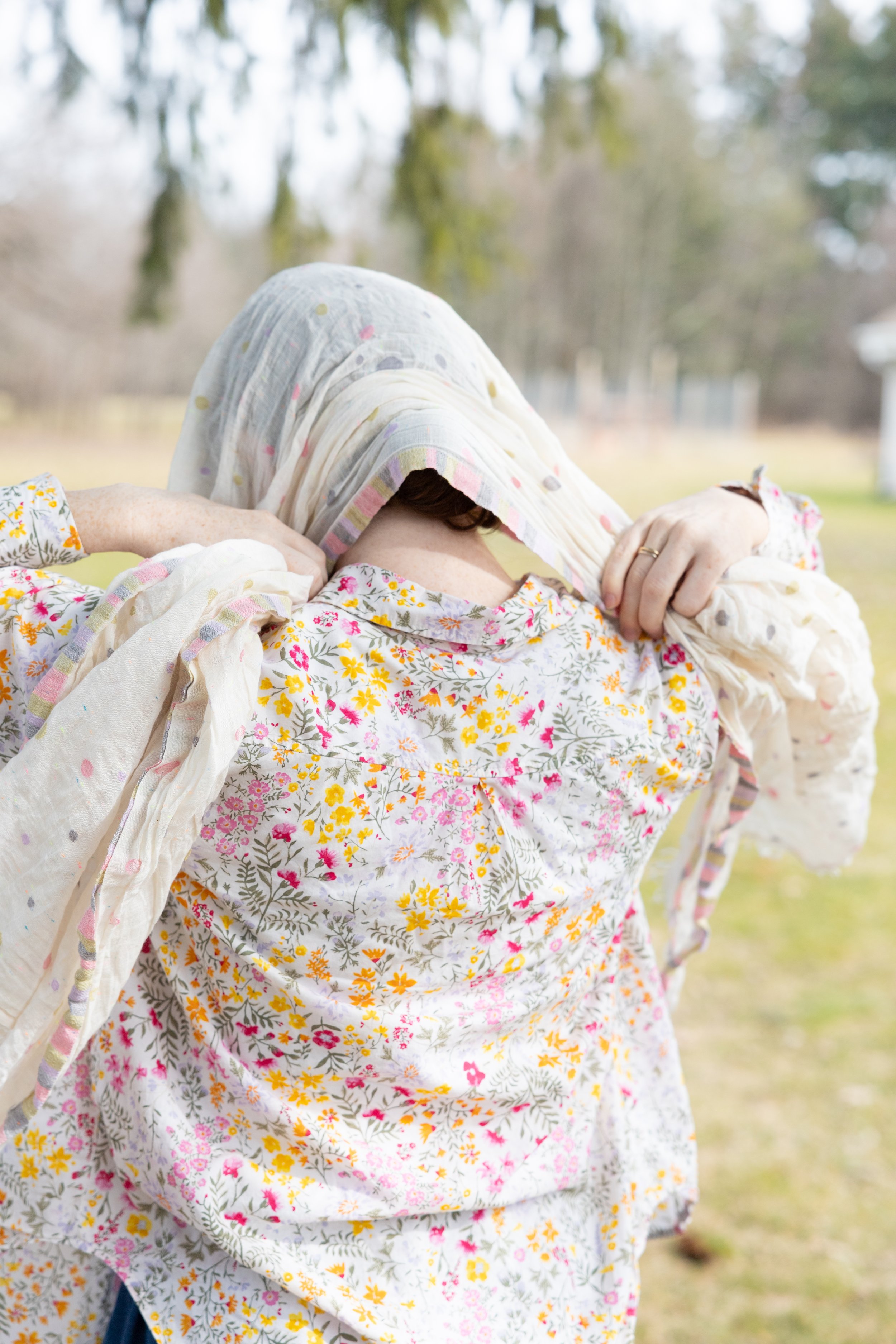
The Bun (Rectangular scarf)
Put your hair into a bun at the nape of your neck.
Lay your scarf smooth and taut across your head.
Bring the ends around to the back of your head and criss cross them under your bun
Bring the ends up around your bun, wrapping them until you have only short tails left. You might want to tie the ends once more. Tuck the tails in.




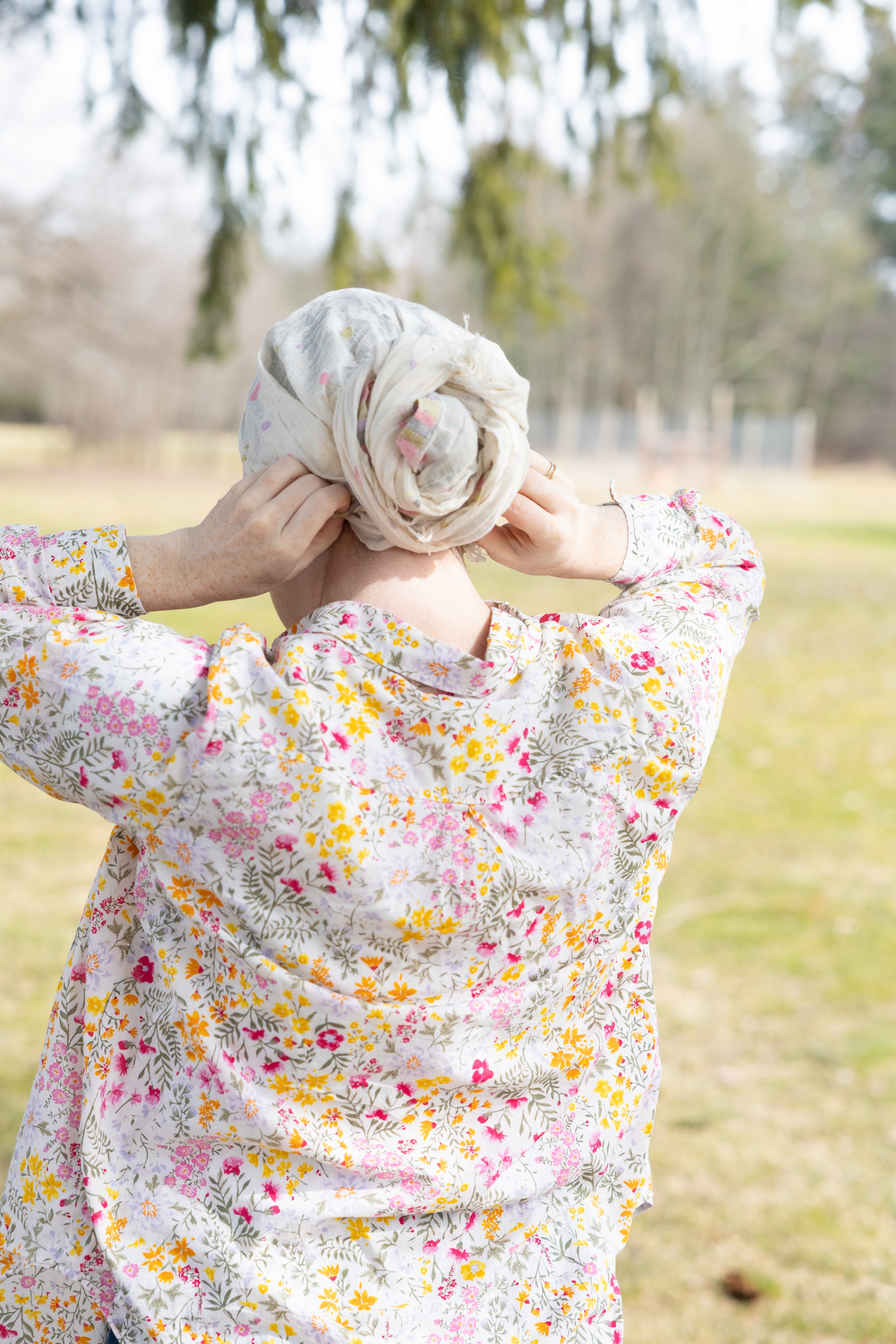

The Faux-Bun (Square or rectangular scarf)
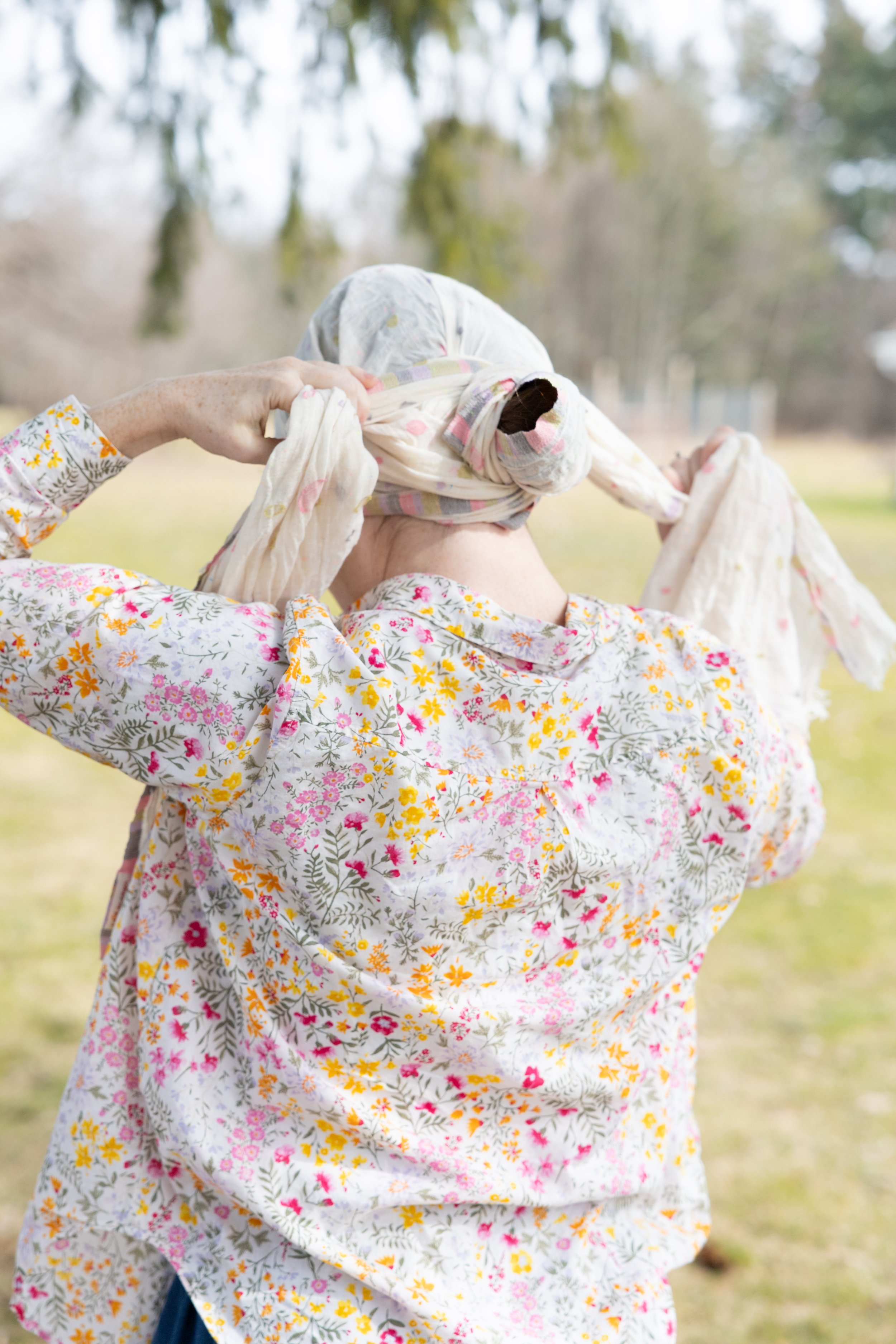
Note: If you have short hair or don’t care to put your hair in a bun for whatever reason, use this instead of the above tutorial!
Lay your scarf smooth and taut across your head.
Bring the ends around to the back of your head, bringing them together. You’ll want to adjust them so that they’re folded smoothly back over the bottom edge of the scarf; otherwise, the scarf will be too loose.
Using a hair-tie, gather the scarf into a “ponytail.” If you have long hair, you can gather it into your ponytail for an extra anchor.
Tie the tail into a bun. I like to twist the two sides together, then wrap the twist around the hair-tie and fasten with a second hair-tie, but your preferred method will work too!
If you’re worried about it sliding off, bobby pin the scarf behind your ears and under the bun.
The Grace Kelly (Square)
Note: While Grace Kelly’s silk scarves are iconic, I find that silky scarves still slip a lot with this style. When I use a cotton scarf, it stays in place perfectly.
Fold your scarf diagonally to make a triangle. Lay the long side across your head.
Wrap one end over the other and pull it through.
Pull both ends around to the back of your neck and knot them.
You can either pull the point of the triangle out over the knot (like a snood), make the knot into a more fashionable bow, or tuck the three ends under your collar.

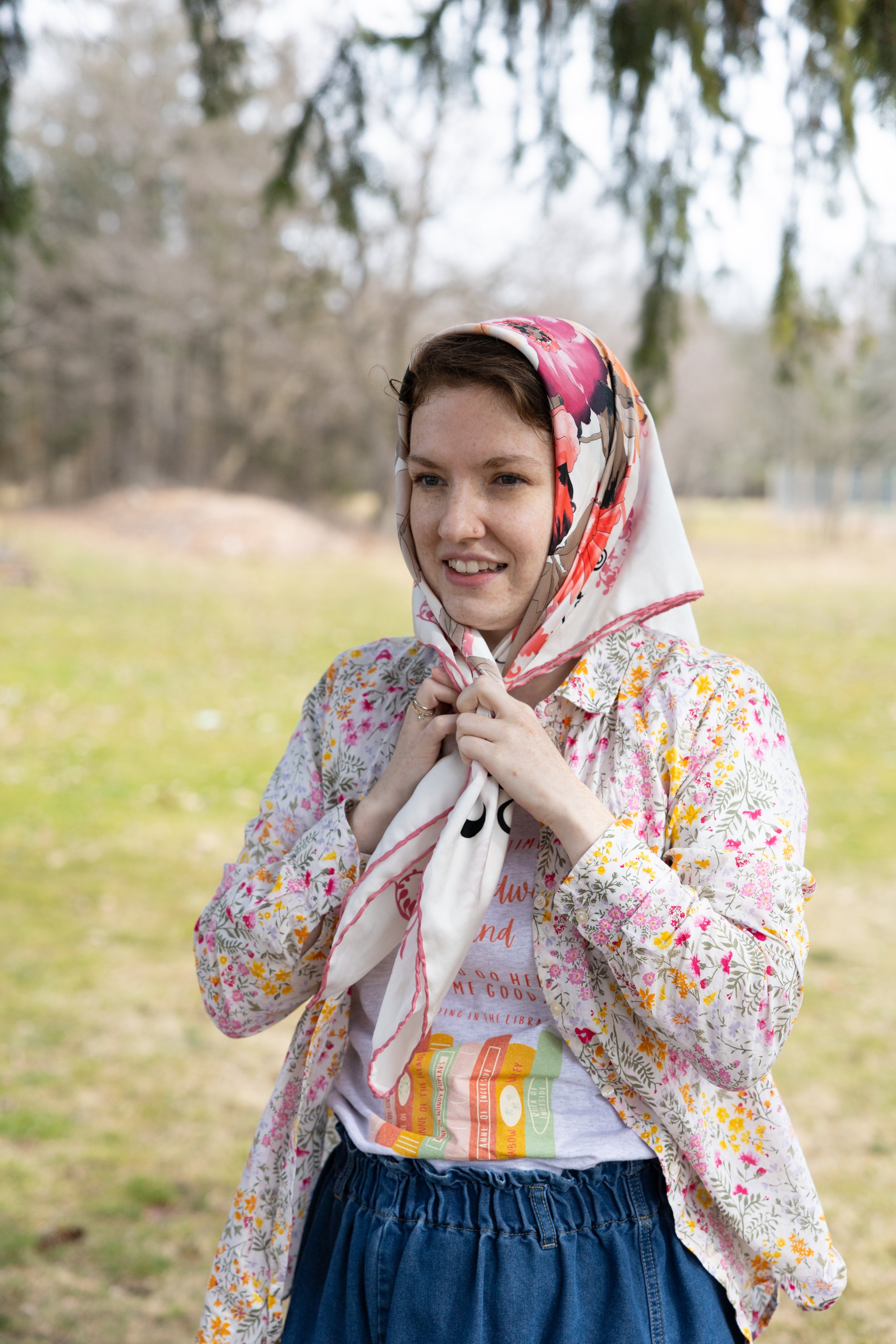
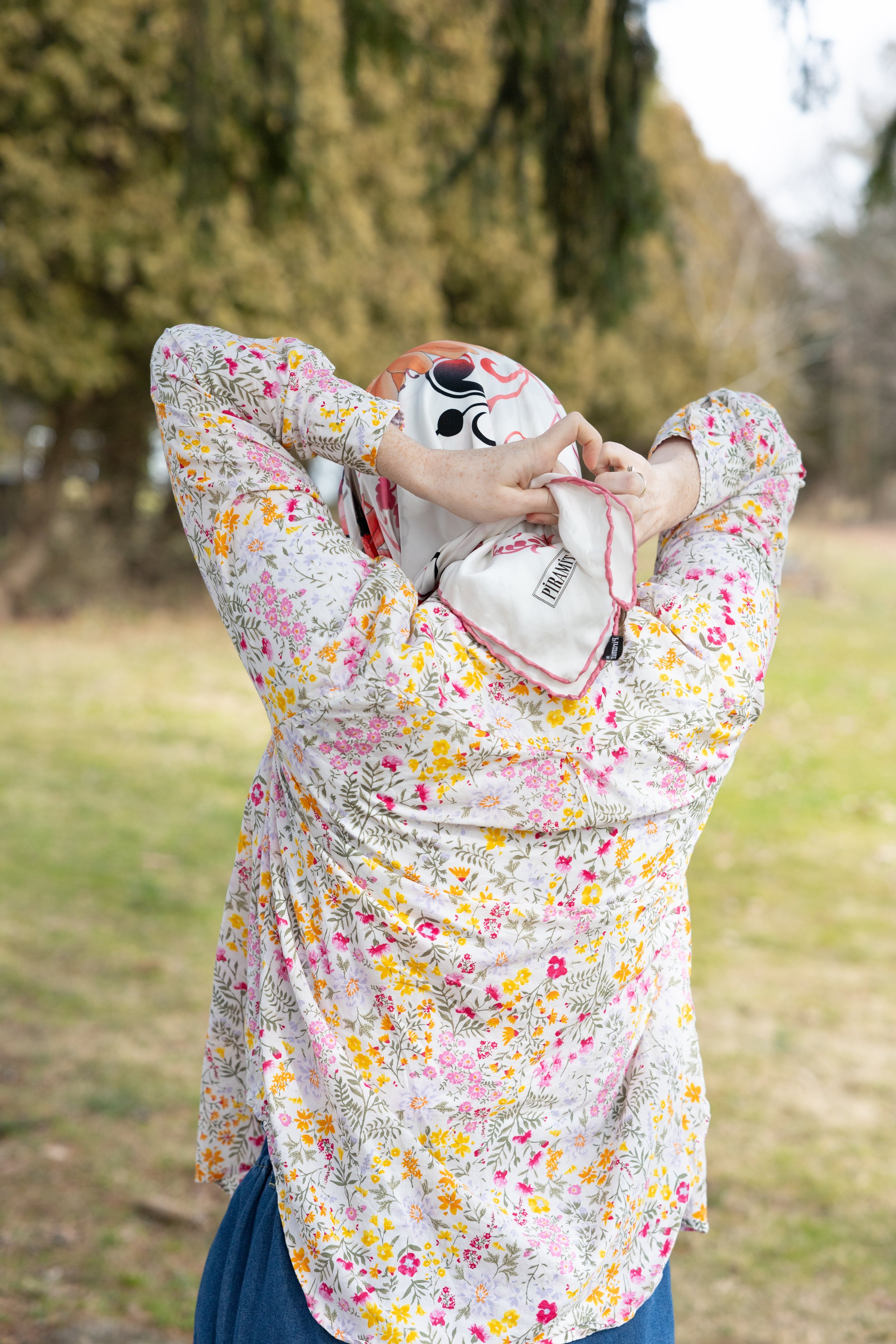
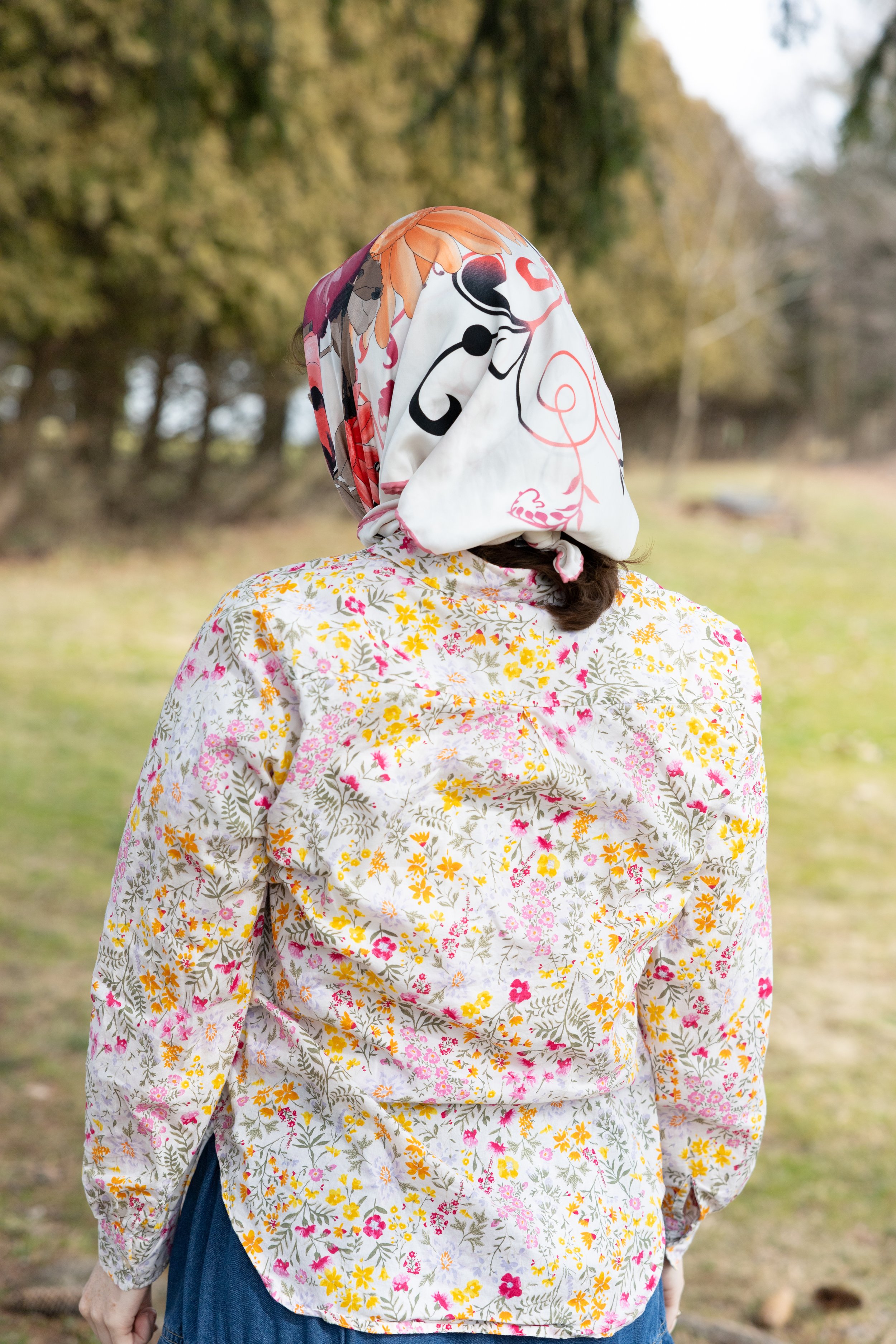

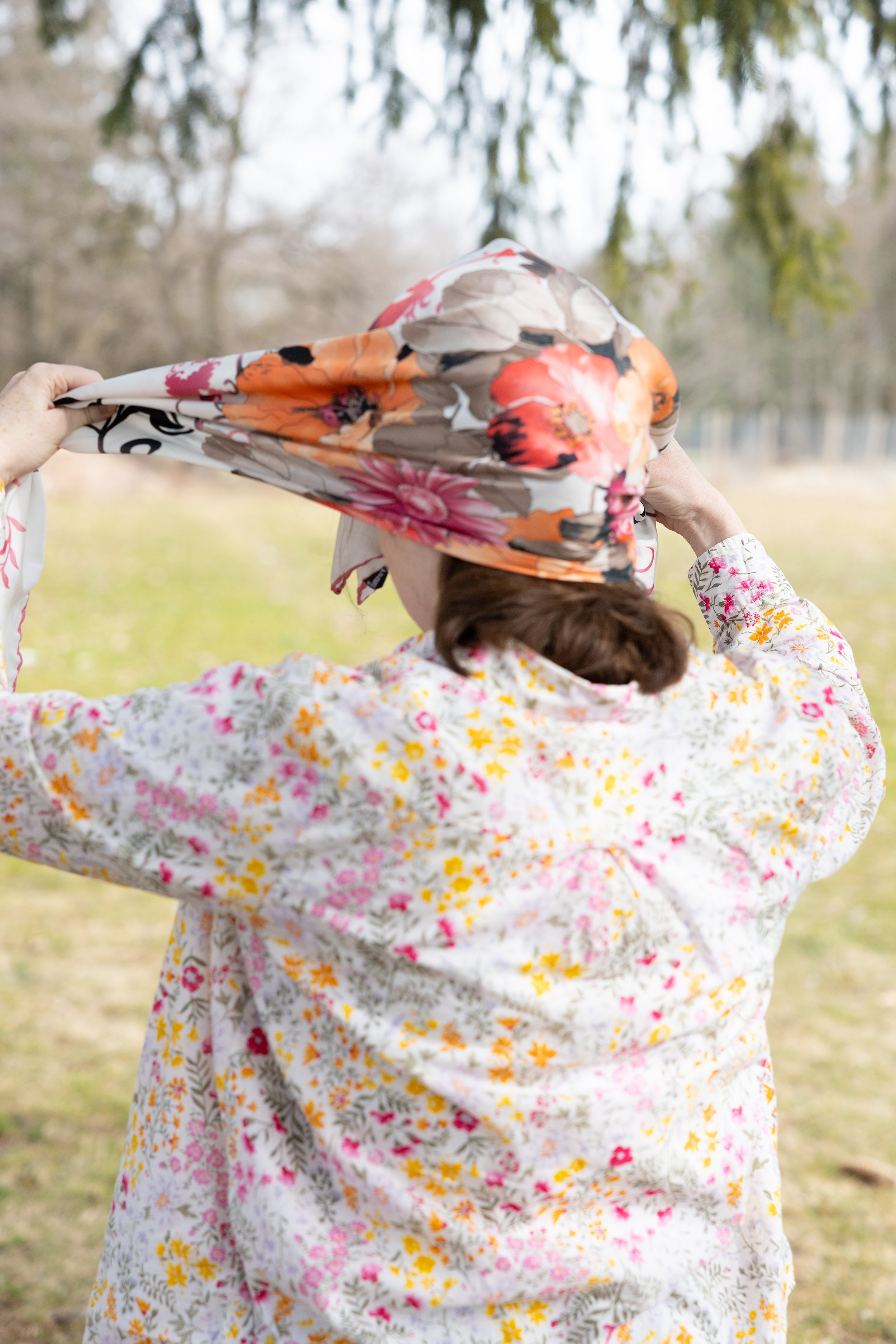
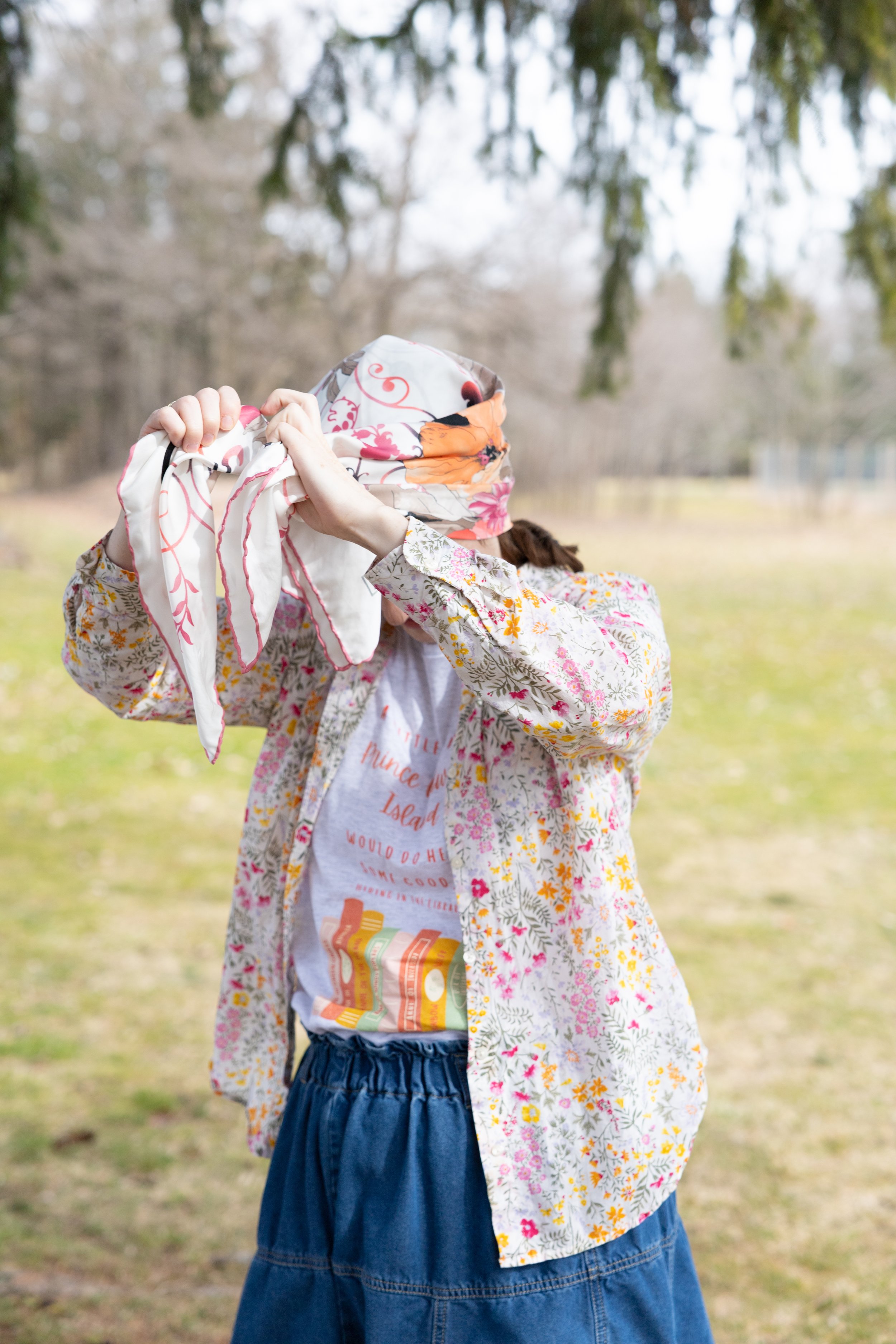
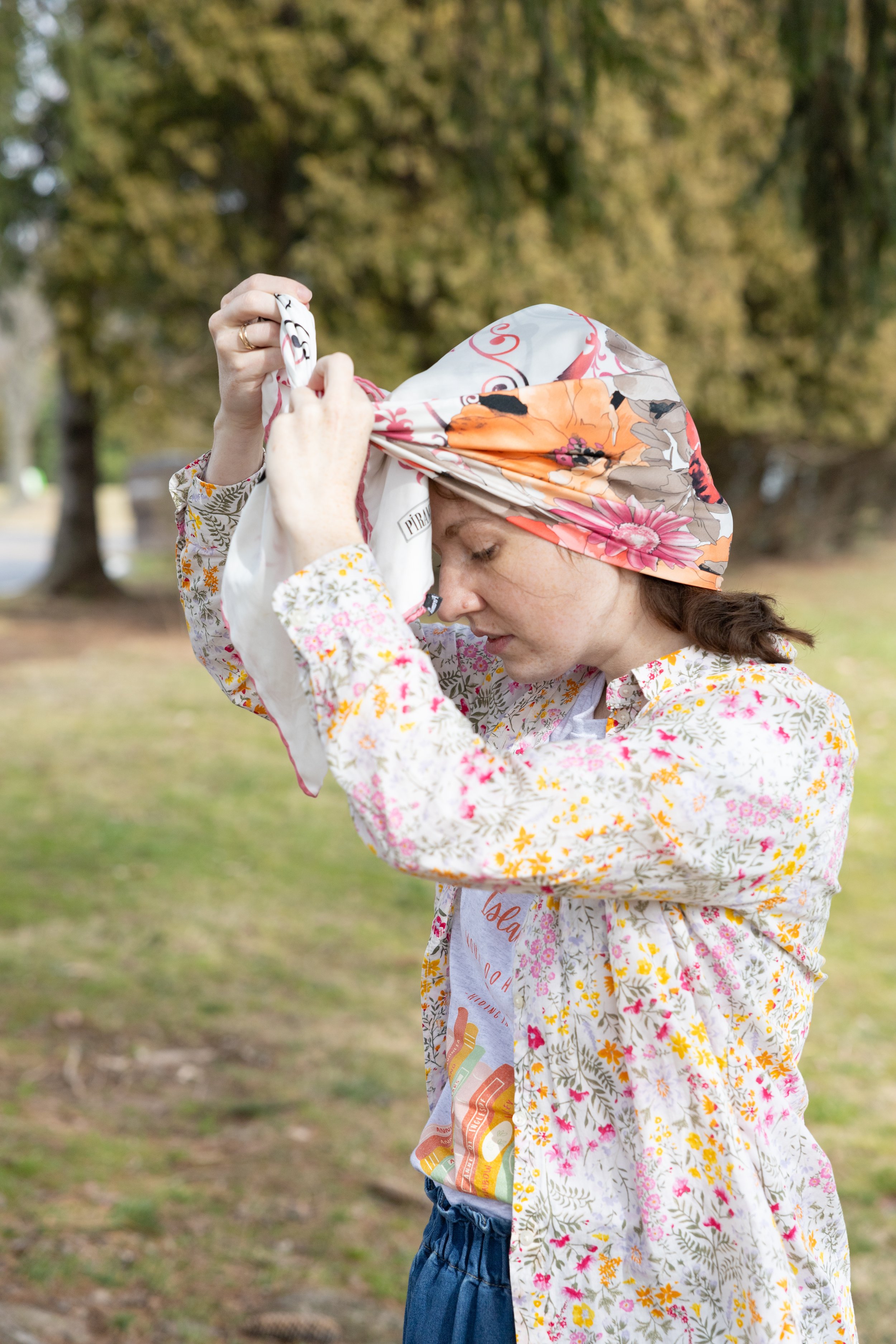
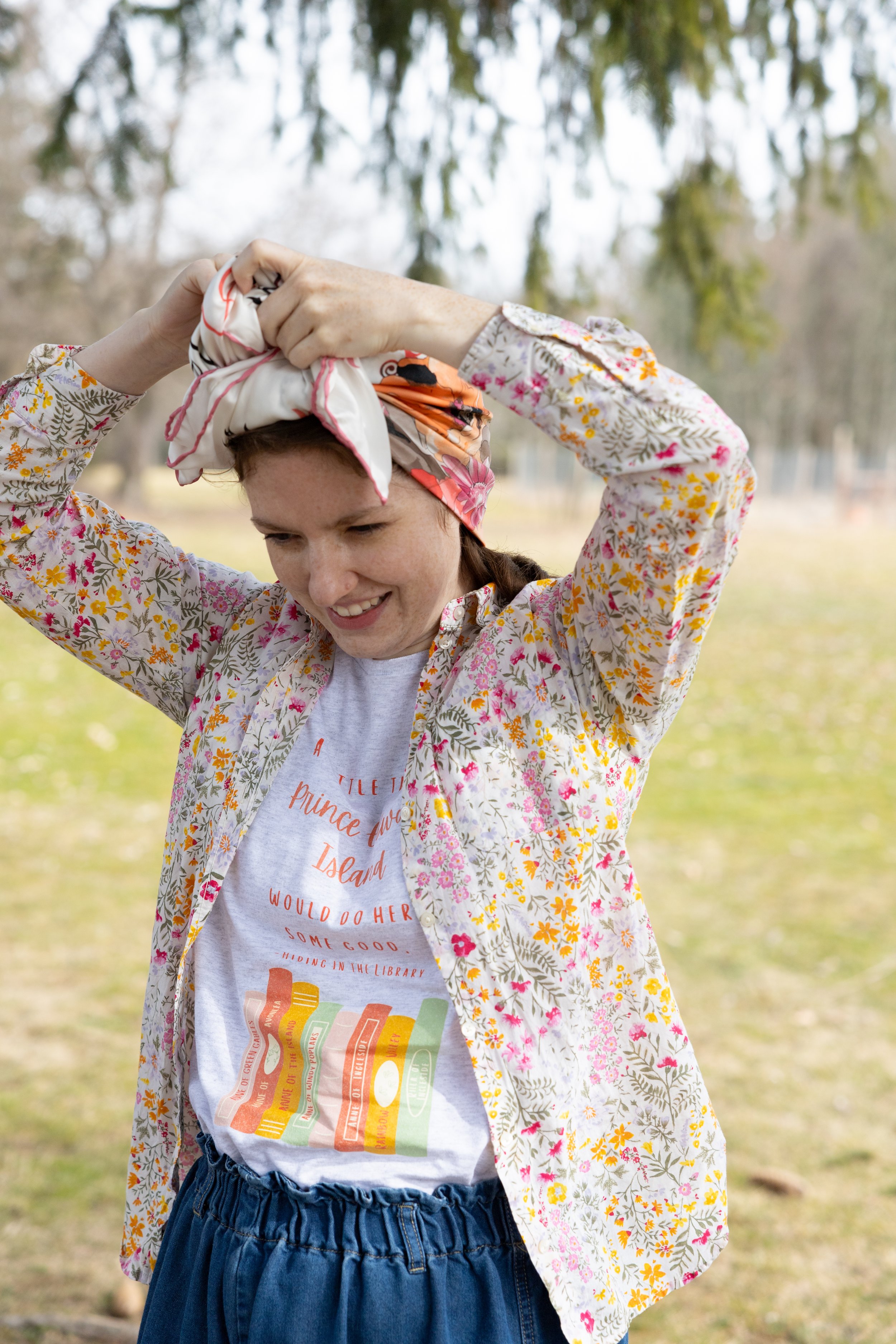
The Rosie (Square)
Fold your scarf diagonally to make a triangle. Lay the point of the wide angle a little ways back from your hairline/forehead.
Bring the other two points to the top of your head–over the wide point–making sure to keep the scarf smooth and flat.
The ends into a tight knot, then tuck the tails under the edge of the scarf. Secure them to your hair with bobby pins, which shouldn’t be visible under the scarf.
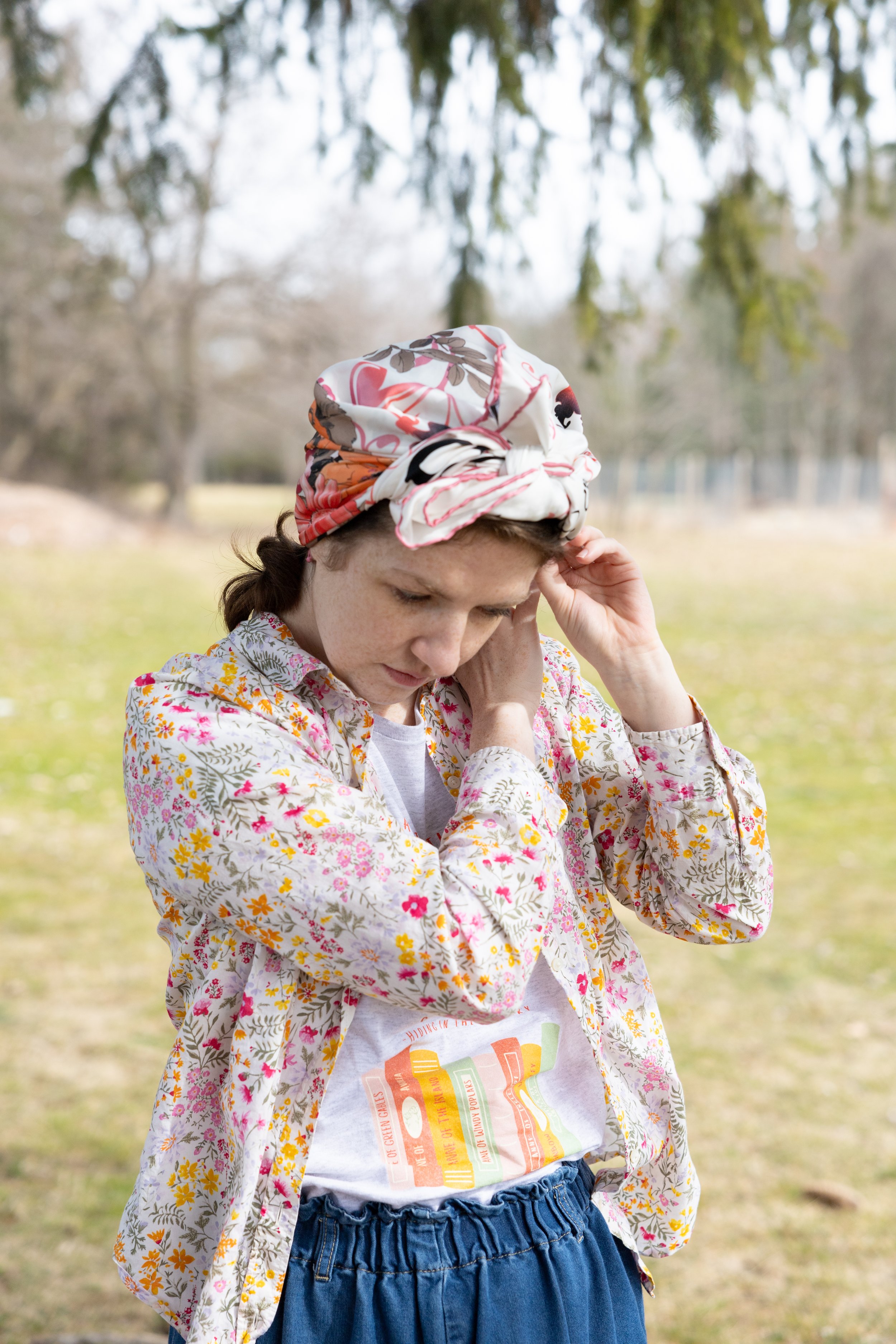
The Trendsetter (Rectangular)
Put the middle of the scarf in front of your neck, wrapping the tails around the back and to the opposite side.
Tuck each end through the front loop of the scarf.
Pull the back part of the loop up and over your head
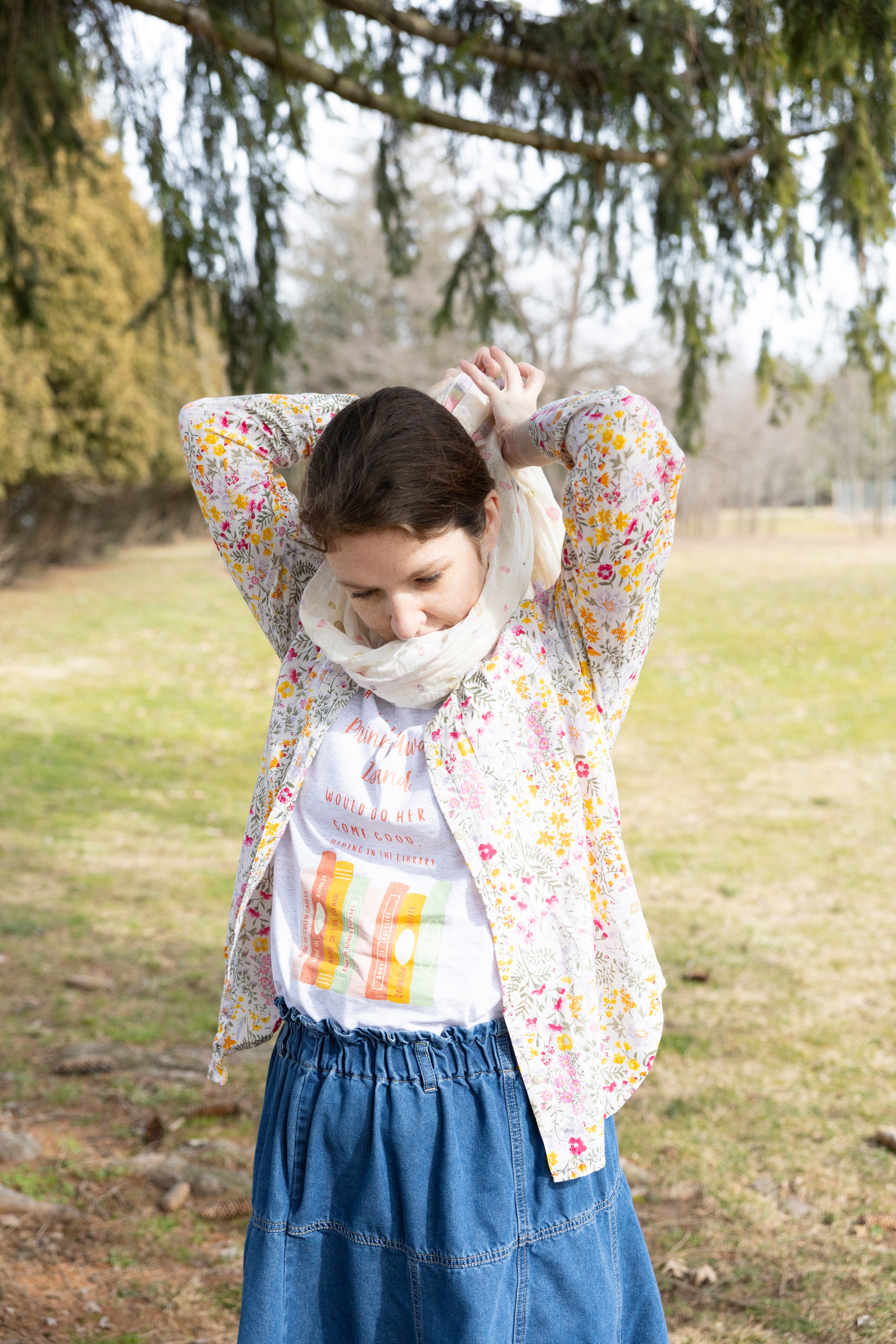
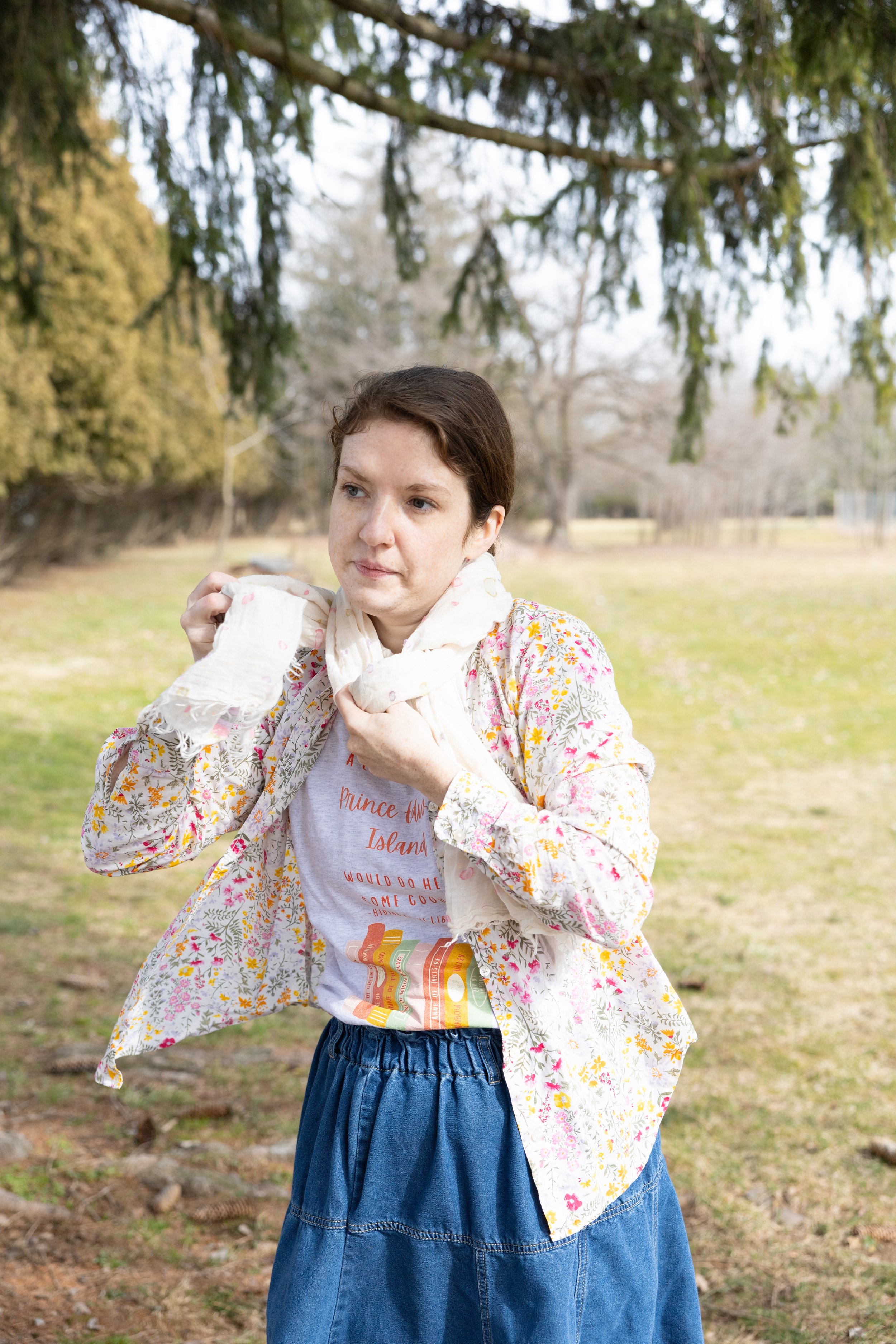
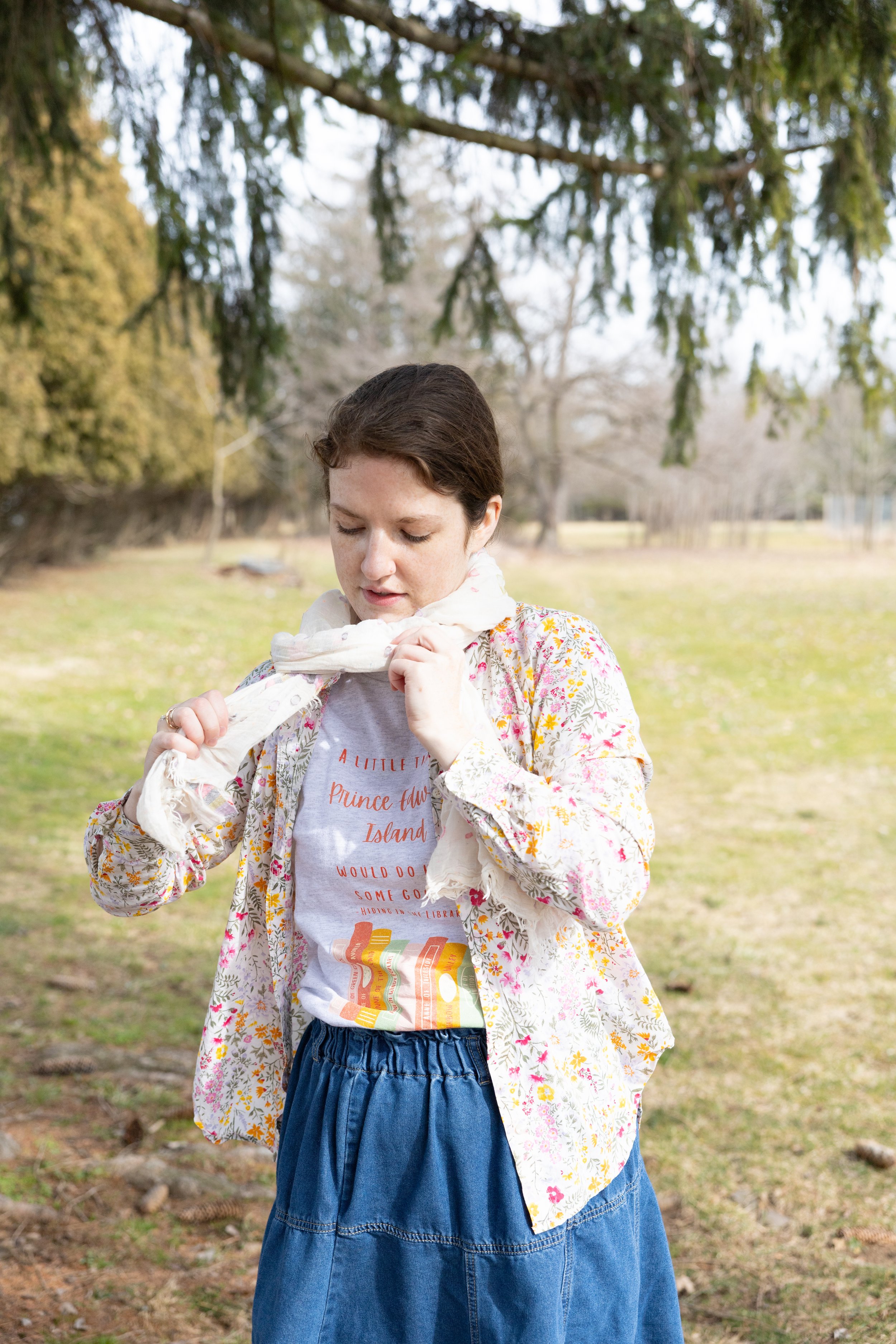
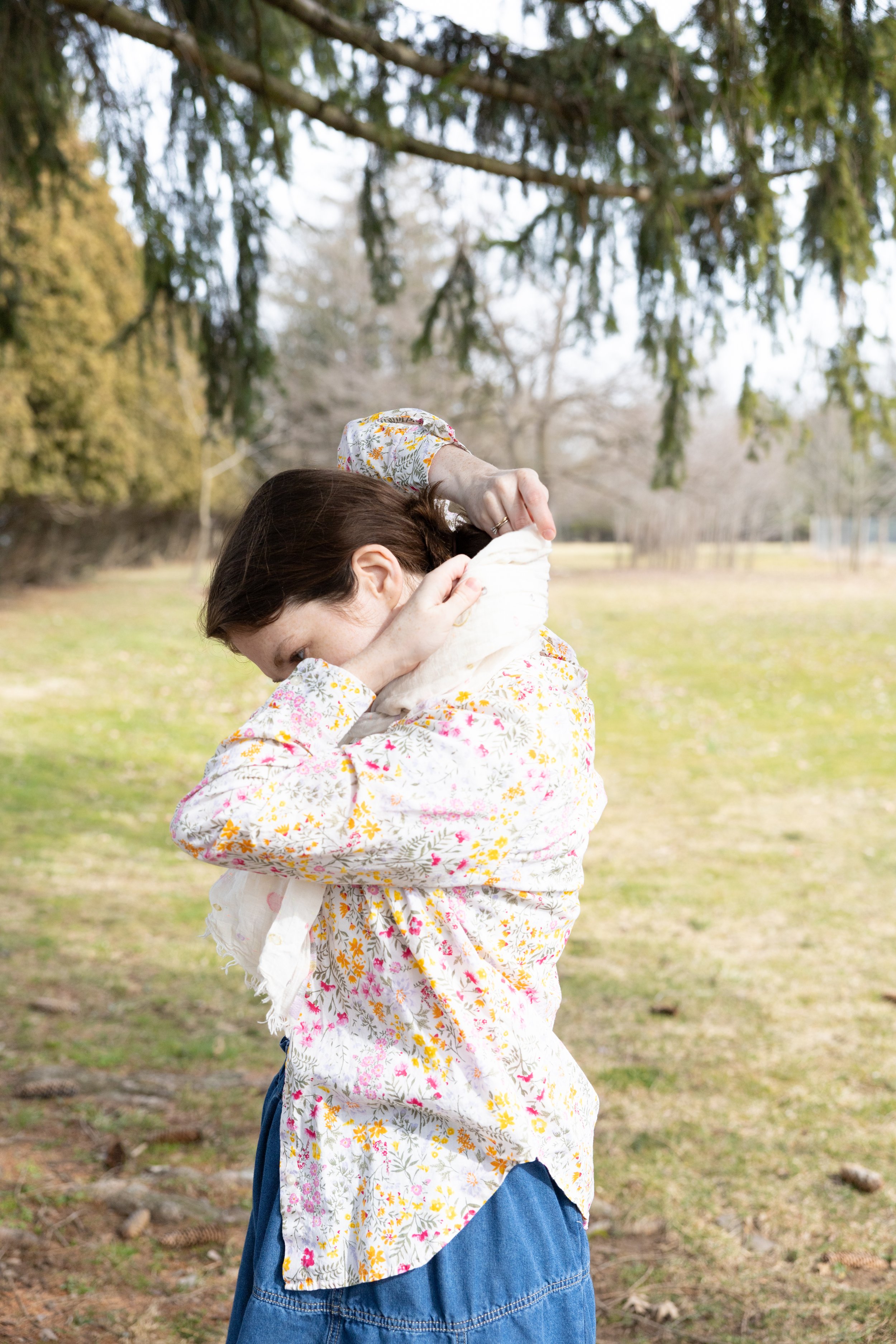
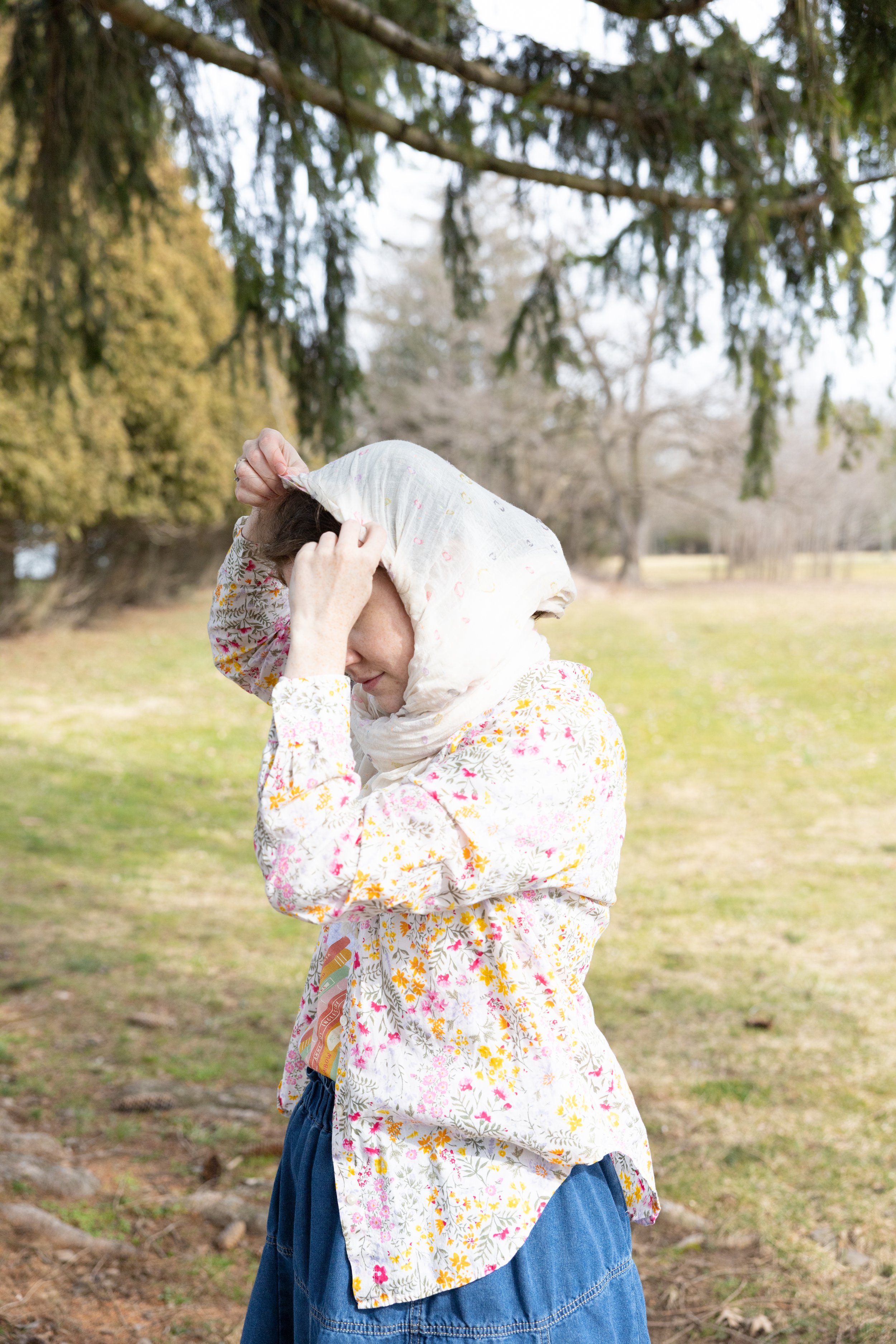
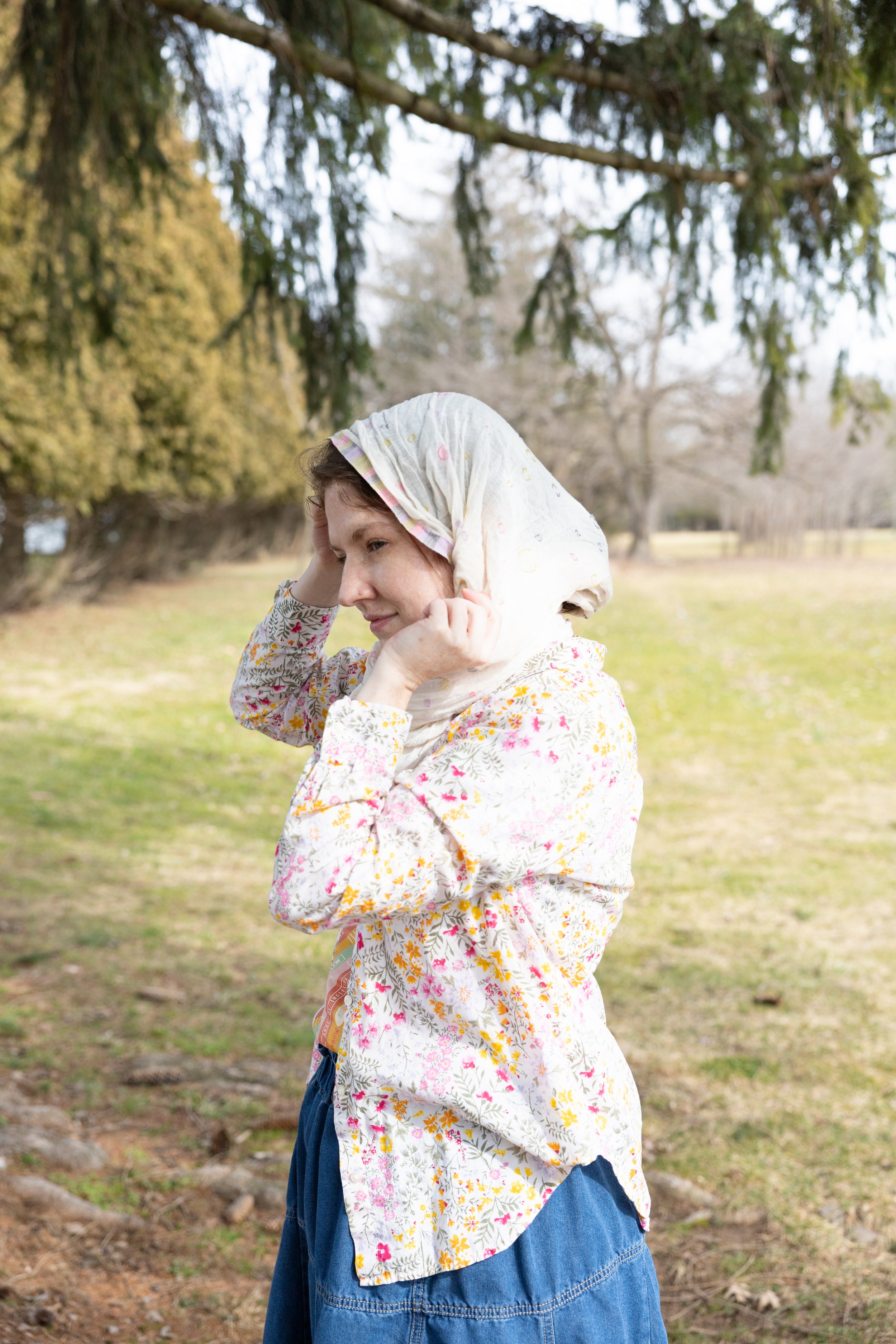
The Cottagecore (Make your own!)
Watch this quick and easy tutorial! This style works nicely because the ties are hidden under your hair, and they are easier to pin in place because they’re so thin.
Additionally, a simple triangle scarf (that is, NOT a square folded in half) also seems to stay in place very well.
Cut a triangle roughly 35”x14” with a hypotenuse of 22”. Roll the edges in once and sew to make your hem!
There you have it: six methods for effectively covering your head in church! Did I miss any styles? Let us know!

In the Shadow of the Monastery
Three years ago I moved to Goldendale from Wenatchee. Many things changed for me then, and one of them was that I was now minutes away from a large women’s monastery. Many of the Orthodox families in the area attend monastery services to be with family, soak up the grace, or simply because they live closer to it than to a regular parish. Although I attend the mission in town, I still visit the monastery often to assist the sisters with their work, and it has been highly beneficial. My and my parents’ plan was to make visiting the monastery part of my education. And I have been learning a lot–it almost feels like a type of home economics course. I’ve discovered how to chop the perfect size of lettuce and how to fold fitted sheets (yes, it’s possible). However, my education and learning is not the only thing that’s flourishing–let’s not forget that this is a monastery!
by Olivia, Fall ‘23 Intern
Three years ago I moved to Goldendale from Wenatchee. Many things changed for me then, and one of them was that I was now minutes away from a large women’s monastery. Many of the Orthodox families in the area attend monastery services to be with family, soak up the grace, or simply because they live closer to it than to a regular parish. Although I attend the mission in town, I still visit the monastery often to assist the sisters with their work, and it has been highly beneficial. My and my parents’ plan was to make visiting the monastery part of my education. And I have been learning a lot–it almost feels like a type of home economics course. I’ve discovered how to chop the perfect size of lettuce and how to fold fitted sheets (yes, it’s possible). However, my education and learning is not the only thing that’s flourishing–let’s not forget that this is a monastery!
As soon as you enter the monastery, you can feel the difference. There’s something about the quiet of the trees and the restful bleating of the goats that just fills your heart with delight; that and the continual prayer from the sisters that makes your soul dance with joy. It feels so different from the disorderly, wild, distracting world we all live in. There are no phones screeching notifications at you, no social media demanding your life, no one to try to impress or to be judged by. I like to call it a grace bubble, a place to take a break from the confusion of the secular world and to let our souls take a breath.
Some people may consider monasteries boring, or they may think that there’s nothing to do. I beg to differ. Every sister has a job, and guests are seldom without one. There is a little rest period after lunch, thank God, but other than that we work from breakfast to vespers. The work is also pleasant in many ways. Not only have I learned fabulous new things and have been assigned fascinating and potentially fun projects (it all depends on attitude!), but I am also bathed in grace as I work. Why? Because every single thing done at a monastery is for Christ, so whatever happens is blessed.
Of course you don’t need to do everything for Christ: our God is not a tyrant, and neither are the sisters. They don’t look over your shoulder as you mop, murmuring “you’re doing that for Christ, right?” Sure, you will get a little bit of the grace merely because the sisters around you are working for Christ's sake, but you won’t get the full benefit if you yourself are unwilling to work or unwilling to be joyful.
I like to work in the kitchen, where the miracles happen. I’m only half joking: the monastery food is crazily good, no matter what they put in front of you. Many moms around here have asked the sisters for their recipes, but what sits on the dinner table at home is nothing compared to the meals at the monastery, even if the cook uses the exact same ingredients. Wondering why? Well, it becomes very clear when you work in the kitchen alongside the sisters. This is the miracle: the room echoes, and all day long, it sounds like it is filled with chirping birds–the sound of the sisters whispering the Jesus Prayer into the food. Grace is an energy; prayer produces grace. So it only makes sense that whatever energy you are producing affects the food you are making. The grace of God, which makes everything beautiful, also has the ability to make food delightful.This is also true about bad energy. If you’ve had a really hard day, and you’re sour and feeling like you are about to detonate with wrath, the food will not be as miraculously delectable as if you had had your mind on Christ. It’s the hidden yet most crucial ingredient to making good food.
I also like to work with the guest house sisters. They do chores, chores, and more chores. To some that might sound like a nightmare, but for me, it is fantastic. We clean the guest house so that staying at the monastery is welcoming; we clean the trapeza so that eating is enjoyable; we chop wood so that winter is cozy. It feels so good to think that you are bringing delight and comfort to another, just by cleaning. One of the sisters told me something that Elder Ephraim had said: “Hospitality and cleanliness are the highest virtues.” It sounded a little strange at first. What about humility or diligence? But when I thought about it, I eventually got what he was saying. What is more humble than getting on your hands and knees and cleaning a toilet? What is more diligent than mopping the same floor day after day? What is more selfless than cleaning an area that you aren’t meant to use anyway, like the guest house? It is dumbfounding what you learn, and what grace you acquire by doing chores.
I realize how insanely fortunate I am to have this ability to escape, truly, whenever I want. I can drive myself to the monastery, even just to stay for a few hours in the morning; it’s only fifteen minutes away. Some of my friends live farther away from monasteries, so they have to pack a week’s load of stuff, go on a long road trip, and get only a taste of the monastery before driving all the way back again. Some people are entirely fine with that. I guess God understood that the ability to visit this monastery whenever I needed would draw me closer to Him, and it has.
Working at the monastery has taught me how to do, and the value of doing, everything for Christ’s sake. I mean, He died for my sake; cleaning and cooking is the least I can do. I don’t believe it is just monastics that benefit from living this life; I think it is the calling of the Christian life in general. If we love Christ, why wouldn’t we want to do everything for him? Monasteries in general are so beneficial, they are havens in this turbulent world. I am growing emotionally and spiritually in the shadow of this monastery, and working there for Christ’s sake has brought so much light into my life.