


Hiding in the Library: Orthodox Books for Children and Teens
There are so many books out in the world, and not all of them are edifying. What we put into our brains matters. If we put junk into our brains it will affect our souls and our thoughts, but if we put edifying knowledge and pure thoughts into our brains, it will be beneficial for us. Our faith calls us to keep a pure mind and heart, for what goes in comes out. Sometimes it is hard to find good books and it is even harder to find good Christian and Orthodox books for teens and children to read. So here are some I have enjoyed!
by Sevastiane, Summer ‘24 Intern
There are so many books out in the world, and not all of them are edifying. What we put into our brains matters. If we put junk into our brains it will affect our souls and our thoughts, but if we put edifying knowledge and pure thoughts into our brains, it will be beneficial for us. Our faith calls us to keep a pure mind and heart, for what goes in comes out. Sometimes it is hard to find good books and it is even harder to find good Christian and Orthodox books for teens and children to read. So here are some I have enjoyed!
Letters to Saint Lydia by Melinda Johnson: I would recommend this book for somewhat older teens. It follows a non-Orthodox girl and her journey to finding the faith through her letters to her patron, Saint Lydia. Lydia’s family converts to Orthodoxy without her and she doesn’t know what she wants to do, so she writes to Saint Lydia. This book is very relatable since it is set in modern times and covers a lot of difficult topics teens face today. I loved this book very much and I recommend it to everyone I know. Ten out of ten for sure!
Voyage to the Rock By Father Matthew Penney: For those of you who like mystery books, this one is great. It is like any other mystery book you would find in the bookstore, but the main characters are Orthodox! This one is great as a read-aloud or for tweens who want to read it themselves. It follows Martin, a priest’s kid, who has to move to Newfoundland, Canada to help his family build a parish. There he finds an old cross. Is it the cross from the voyage of Saint Brendan the Navigator? With his sister and his new friend Ashley, Martin tries to figure out the mystery of the cross, all while the evil Sullivan O’Connell hunts them down. This one is an enjoyable read.
Saint Spyridon’s Shoes by Christine Rogers: This book is good for any age. This book takes place in Corfu, where Spyros fishes on the beach and longs to attend school like his friend, Nico. He then meets an old man on the beach and befriends him. This is a story about their friendship. The friendship turns out to be a lot more important than Spyros realizes. This book is short and sweet and a great one for everyone to read!
Who is God? Who am I? Who Are You? by Dee Pennock: This is one of my favorite books to read. This book also covers a lot of difficult topics for teens about living in the world. It has tons of good quotes and talks about free will and how to love our neighbor. This book covers all the hard topics but formats them in a fun and interesting way to read. The illustrations might look funny, but this book is truly one of the best for teens!
Icon by Georgia Briggs: I cannot stress enough the importance of this book for teens. I love this book with all my heart. Sometimes living in the world as an Orthodox Christian can be hard. Christ says to live in this world but not of this world, and sometimes we can get mixed up and start to morph to the expectations and pressure from our friends and non-Christian family and the secular world. We can start to think that it is more important for us to have money and lots of clothing and to keep up to date with the latest trends. This book is a great example for remembering our faith in the modern world. . Icon is about a young Euphrosyne, whose family is killed, so she has to move in with her grandparents. It is set in a future where being Christian is illegal, and people have to change their names and their whole identity. This book is about one girl fighting for what she believes in and putting her trust in Christ in times of struggle. Euphrosyne is a character you can both relate to and try to imitate. This book is a good reminder of what our time on earth is really for.
My Elder, Joseph the Heschycast by Elder Ephraim of Arizona: Saint Joseph is one of my favorite saints and this book is his thorough life story. It is thicker than the books mentioned above, and it is not fiction, but his life story is amazing. At the start of the story, he struggles with the same problems we all have, like anger, but he overcomes them and achieves a state of complete grace and prayer from the heart. Elder Joseph also had a very close relationship with the Theotokos, and he would pray to her all the time, for any need. Saint Joseph was able to see demons and physically had to fight them for them to disappear. I really love this book and think it is a great book for early teens.
Precious Vessels of the Holy Spirit by Protecting Veil Press: The contemporary elders of Greece are all newer saints or people believed to be saints but awaiting canonization. This book covers many of their lives. It has a short biography about each of them, as well as the counsel or advice that they gave. I love this book because it has so many saints, many of which are newer saints. Their advice is priceless and you can learn a lot from reading this book. This book is more for teens, and adults can read it too!
While these are just some of the many Orthodox books out there, all of these books are fantastic reads, and there is something for everyone, from mystery to biography. I loved reading these books, and I hope you will too. I hope you can learn from reading these books!

Easy Ways to Serve as a Young Person
The Bible tells us to serve each other and to treat our neighbors as ourselves. If you want to do something that will benefit other people, there are so many things that can be done. It can feel overwhelming to consider taking on a big project, but helping others doesn’t have to involve taking on something big. There are so many little ways you can help.
by Sevastiane, Summer ‘24 Intern
“Be devoted to one another in love. Honor one another above yourselves.”- Romans 12:10.
The Bible tells us to serve each other and to treat our neighbors as ourselves. If you want to do something that will benefit other people, there are so many things that can be done. It can feel overwhelming to consider taking on a big project, but helping others doesn’t have to involve taking on something big. There are so many little ways you can help.
If you are crafty, something simple and fun is to make icons. You don’t have to draw icons or paint anything; rather, you can collect the paper icons that you have and ask your friends to contribute. These icons can come from church bulletins, calendars, or greeting cards. The icons can be big or small, as long as they are paper. You don’t want any icons that have tears or are bent. After collecting icons, glue them on a piece of cardstock and make sure they look nice. This is a task you can do over time. After collecting a decent amount of icons, you can put them in a big envelope. You can give these icons to children who may not have access to wood icons. For example, one of my friends went on a mission trip to Africa and was able to take an envelope that I had collected which contained about 50 paper icons. She distributed them to the children there, most of whom did not own icons. If you don’t know someone personally going on a mission trip, consider contacting OCMC to find out whom you can send them to.
Another way to help people is to make “giving bags.” These are simple and can be made easily. You can put small things in the bags and give them to the people you see soliciting for help on the street. A small bag could contain non-perishable snacks and simple things like sunscreen, soap, hand sanitizer, a toothbrush and toothpaste, socks, water, and other daily necessities. These are nice to make and can be kept in a car, which makes giving them directly to people very easy.
If you like being outside, a great way to give to other people is to make seed kits. You can collect seeds from fruits and vegetables with simple instructions on how to plant them and how important nutritious fruits and veggies can be. You can find local schools and organizations to give them to.
If you enjoy working with children, there are many opportunities to assist within the community or to help a parent that you know. Many after-school or summer camps welcome counselors-in-training to assist younger campers. You can even look closer to home and consider volunteering with your parish’s Sunday School or Vacation Church School programs. You could also get to know the moms in your parish and offer to watch their children occasionally so they can get caught up on chores or have an hour or so to rest.
You can tutor a younger sibling or neighbor if you have skills in a particular subject. Many libraries offer tutoring programs and are often looking for tutors. There are even tutoring programs online where you can log in and teach students around the world. This is another area where you can start by figuring out who in your church needs help.
A great way to volunteer if you like being around people is to volunteer at a senior center. You can make cards for the seniors or you could read to them, offer help with technology, play games with them, or just keep them company because a lot of the seniors can be lonely.
If you are more of an animal lover, volunteering at a local animal shelter is always a fun thing to do! You can walk dogs, play with kittens, or do any work that they need you to do. There are also many pet cafes where you can go and play with the dogs and cats even if you can’t adopt one.
If you are someone who loves to read, a good idea might be starting a little free library. You can get rid of old books and build a little bookshelf outside and put your books in them. People love getting free books and exchanging them! For people who don’t like to buy books, this is a great option.
On the topic of books, another great idea is a book drive. Collect all the old books you and your family don’t want anymore and you can give them away for free in front of your house. Advertise like you would a garage sale and you can accept donations. Make the book drive look more organized and separate the books by genre. Whatever donation money you earn can go towards the needy fund at your church or a charity, such as your local Friends of the Library.
A small and easy way to get rid of your old books would be to donate them to your local library. It is always nice to do and you can ask your friends if they have anything to donate as well. The libraries appreciate it and once you get rid of your old books you can get more new ones to fill your shelf. Just be aware that if you live in a more populated or wealthier area, the books will probably go to the Friends of the Library book sale instead of being added to the collection for circulation.
If you are more artistic, a nice way to spread joy to people is to make a rock garden out front with positive messages. You can make a take-one-leave-one set up, or just make a bunch of rocks for people to see. It is always nice to go on a walk and be reminded that you are loved or that everything is going to be ok. Put your personal touch to the rocks. Some of them can be just pretty paintings but some of them can have inspiring–or even Orthodox–quotes. It’s nice to have a balance of both.
Another artistic thing to do is to make cards for kids in hospitals. There are many organizations you can partner with to do this, and it is always satisfying to make cards and know that they are appreciated. It is nice for the kids who receive the cards to know that they are being thought of. You can make cards during the holiday seasons or just for fun., but the more time you put into making them beautiful, the bigger impact it will have on the kids!
This is more for helping nature rather than people: plant flowers that are native to your homeland and that attract bees, butterflies, and birds. You can make a home for them out of all the flowers you can plant, and it is always nice to have birds and butterflies around your home to watch.
During Christmas, have a toy drive or save up and donate to a toy drive that is already going on. The toys will go to girls and boys who are less privileged. Sometimes toy drives want toys that are gently used so you could give some of your toys away instead of having to buy brand new ones.
These are all small but important ways to give to other people. The bonus is that these are enjoyable ways to serve, instead of feeling like you’re working!
What are some other ways you serve others?

How Orthodoxy Changed Me, Part 2
When my mom first announced to my family that we would be attending a new church–that is, the Orthodox Church–I didn’t know what to feel, let alone to think. I was fourteen at the time and had never had any particular consistency with the denominations of my church; we mostly went wherever was closest to us. So, her announcement didn’t seem too out of the ordinary, and we didn’t put too much thought into it; we loved God and knew we should attend Church every Sunday. But what inspired this particular decision?
This is the second part of a series. Read the first part here.
by Londyn, Summer ‘24 Intern
When my mom first announced to my family that we would be attending a new church–that is, the Orthodox Church–I didn’t know what to feel, let alone to think. I was fourteen at the time and had never had any particular consistency with the denominations of my church; we mostly went wherever was closest to us. So, her announcement didn’t seem too out of the ordinary, and we didn’t put too much thought into it; we loved God and knew we should attend Church every Sunday. But what inspired this particular decision?
Since I was born, I’ve been a regular church attendee. I was baptized at six, alongside my dad, and later baptized again at age twelve in the Anglican Church. Between those years, we had tried a couple of other denominations, including Baptist and non-denominational. I appreciated the Anglican Church when I entered the building and experienced the service. But I had never heard much of the church, the only time being a brief mention of C. S. Lewis’s Christianity. Nonetheless, I have always been an eager learner so I was more than willing to participate in the service.
We quickly got plugged into the church and spent two years there. We believed we were all satisfied for approximately a year and a half of that time. But slowly, and yet again, we felt a nag, like something was missing. My mom would speak to me and ask questions about my views and thoughts of the church we participated in. Through our discussions, both full of positive and negative views, we almost considered attending a Catholic service. I was surrounded by quite a few Catholics, especially friends, and nearly thought this was a good idea—until I heard someone say to my mom, “Well, just choose whichever church feels right to you.”
Which church feels right? I thought to myself. This doesn’t seem sustainable. My family's “feelings” on different denominations have changed throughout the years and have always left us yearning for more. We can’t continue our walk with Christ based on our feelings.
However, we continued attending the Anglican Church for approximately another six months. Slowly, our church and priest were transitioning things to be more and more traditional. We switched from the more Protestant hymns and even popular-sounding Christian music to small components of chanting–something entirely new for me (and all of us in my family!). The first time I heard it in the service, I looked up from my service book; I definitely wasn’t expecting it. But I felt drawn to know, hear, and participate more. In my youth group, I heard a mention of Icons–another thing I had no clue about. I didn’t even know what to picture; I had never been exposed to that word! Oh, how much I had to learn.
In August of 2022, my mom made the abrupt decision I mentioned before. We were going to attend an Orthodox church and see what happened. She told my siblings and me that she had emailed the priest and that we would try out our first day that Sunday, which was only two days away. To be completely honest, I was upset. It felt too abrupt–we were happy enough at our Anglican church. Weren’t we?
And that’s just it. You can’t simply be “happy enough” or “just” satisfied in your love of Christ; it is so much deeper. The moment I stepped into the Orthodox Church, however, I was taken aback. The walls were adorned with icons; prayer, faith, and sincerity were all around me. Not only did I sense a holy presence, but I could see, smell, and fully participate in this glorious finding. I felt at home–even though I had just entered.
After five months of being attendees, we spoke with our priest and began catechism classes. Every hour per week we spent for months with him was like discovering my faith and love for Christ again. I found what I was missing. The truth and beauty of the Church, the Church that has been passed down for thousands of years! Glory be to God for this beautiful finding! I wanted to be chrismated and participate in the Holy Eucharist. And here is the start of when my spiritual life was entirely changed.
It took me months and, honestly, still years to come to become entirely accustomed to the services, the holy traditions, the feast days, and even the fasting. And through everything I have learned and experienced so far, I know that the missing part of me is finally found. I was always told that being a Christian is difficult, but I know, see, and believe that the sufferings here on earth we deal with are what make us stronger in our faith. I didn’t truly know what I believed in my faith for the first fourteen years; I listened to what I was told and never gave too much thought as to why there are so many offshoots of Christianity. But the moment I was exposed to the truth, I wanted nothing more than to always be surrounded by it.
Looking back, I wish that I was always exposed to the beauty of the Church and, if you’ve read my previous post, the beauty of homeschooling. However, the journeys that I went through are just the start of my life. The base I have been given is a strong foundation that I pray to keep for the rest of my earthly life. May God grant us all many years!

How Homeschooling Changed Me, Part 1
In just a few months, I will enter the eighth year of my homeschooling journey. My mother pulled me out of school at the end of second grade, and since then she has always been my favorite teacher.
The adjustment to attending a public school and switching to a classical education those “many, many” years ago was a slow process. On top of the rules at school that made my mom uncomfortable (why wasn’t she allowed to visit me during the days?), I experienced and saw bullying. My mom barely knew what I was taught during the long eight hours I was away from her, and I didn’t see my siblings as much as I would have liked. By the time I woke up in the morning, got ready, had breakfast, and raced to the bus stop, I already felt a longing for the comfort my mom has always provided me. Hours later, at lunch time, I would wonder why I couldn’t be at home enjoying a simple lunch with my family. Instead, I was crushed in a huge lunch hall with hundreds of loud and disrespectful children.
by Londyn, Summer ‘24 Intern
In just a few months, I will enter the ninth year of my homeschooling journey. My mother pulled me out of school at the end of second grade, and since then she has always been my favorite teacher.
The adjustment to attending a public school and switching to a classical education those “many, many” years ago was a slow process. On top of the rules at school that made my mom uncomfortable (why wasn’t she allowed to visit me during the days?), I experienced and saw bullying. My mom barely knew what I was taught during the long eight hours I was away from her, and I didn’t see my siblings as much as I would have liked. By the time I woke up in the morning, got ready, had breakfast, and raced to the bus stop, I already felt a longing for the comfort my mom has always provided me. Hours later, at lunch time, I would wonder why I couldn’t be at home enjoying a simple lunch with my family. Instead, I was crushed in a huge lunch hall with hundreds of loud and disrespectful children.
I had friends that I loved, so I was comfortable. Looking back, though, I know I wasn’t thriving. Whether or not my mom could fully sense my thoughts and feelings, she knew something was up. And though it took time for her to convince my dad this was the best option for me, years later, my family can’t imagine a different path. Homeschooling changed me.
I can’t truthfully say that I remember my first year of school at home crystal clear. I can say, however, that I was happy. Something was different—did I connect the dots as to what had changed? Maybe yes, maybe no. But simply looking back at the pictures my mother took that year, I see so much joy: my siblings and myself, as we sat around our dining table, listening to classical stories she would read aloud, munching on muffins we had made that morning, and sipping tea in pretty china. We studied the art of Van Gogh, Turner, and Constable; we listened to and discussed classical music that has been passed down for centuries. I believe I was exposed to more truth, beauty, and goodness that year than I had been handed my entire life in public school! And since then, my love for education has only grown.
In all that I have shared, I have not dramatized my adoration for my home education; it is all true. I have not, however, mentioned the tears. And yes, there were tears (over something I now plan on majoring in college – Mathematics!) however, not in its entirety. I have always had a hankering for math, but my mother and I must have thought that long division (of all things!) would be the death of me.
I wanted to give up; I was tired and frustrated. But my mom taught me something that day that has stayed with me all these years. Don’t give up. And so I listened; I tried. It took weeks and weeks for me to finally master the “Dirty Monkeys Smell Bad” (divide, multiply, subtract, bring down). But once I pushed through and finished, I felt accomplished. I had done something.
As I finish up my last few years of home education and prepare for my away-from-home college studies, I remember where I came from. I remind myself of the beginning; the reason I truly love learning. Why am I going to college? To further that desire I have. To know and learn as much as I can: knowledge is a gift from God, a gift I want to nourish.
In the second part of this post, I will dive deeper into something that took me longer to find than my search for wisdom–my search for and conversion to the Orthodox faith. Knowing and having a desire for truth began with an education at home; my first step into the Church has only strengthened this.
Those few words that my mom shared with me that day have stuck with me greatly: Don’t give up. Whatever it is that I am facing (often a tad more challenging than long division!) I know that if I make up my mind that I will do something, I will do it. I don’t let the words of others distract or discourage me. By being surrounded by such a beautiful, loving, and inspirational woman who gave me this education, I have also been given a yearning for some of the greatest gifts: knowledge, love for Christ, and truth.
Read Londyn’s conversion story here!
Serving the Church (When You Don't Have Time, Energy, or Money)
It pretty much goes without saying that each Orthodox Christian is called to contribute to the life and health of their own parish–it’s part of our tithe, our almsgiving, and our prayer. It brings us closer to Christ and to those in our community by turning our gaze outward from ourselves to the whole body of Christ. And, of course, it’s simply a necessity if we want our parishes to operate smoothly and bear fruit.
At the same time, it can be a challenge to find a ministry that fits well. It doesn’t make sense, for example, to join the cleaning rotation when you have to rush home to put grouchy toddlers down for a nap. Nor does it make sense to commit to something that you’re simply uninterested in and therefore have no motivation to help with longterm. And it definitely doesn’t make sense to make a commitment that you simply don’t have time for! And sure, giving beyond your normal tithe is always helpful, but not always possible…and monetary giving doesn’t help your family become part of the fabric of the community in the same way that interfacing with your fellow parishioners does.
by Mindi Popovich-Schneider
It pretty much goes without saying that each Orthodox Christian is called to contribute to the life and health of their own parish–it’s part of our tithe, our almsgiving, and our prayer. It brings us closer to Christ and to those in our community by turning our gaze outward from ourselves to the whole body of Christ. And, of course, it’s simply a necessity if we want our parishes to operate smoothly and bear fruit.
At the same time, it can be a challenge to find a ministry that fits well. It doesn’t make sense, for example, to join the cleaning rotation when you have to rush home to put grouchy toddlers down for a nap. Nor does it make sense to commit to something that you’re simply uninterested in and therefore have no motivation to help with longterm. And it definitely doesn’t make sense to make a commitment that you simply don’t have time for! And sure, giving beyond your normal tithe is always helpful, but not always possible…and monetary giving doesn’t help your family become part of the fabric of the community in the same way that interfacing with your fellow parishioners does.
Each parish, though, has so many little needs and wants that there is something for every single member to help with! Here are some ways that you can serve the Church without time, money, or (much) energy:
Look for the small contributions. At my parish, coffee hour is a big deal. We have about 250 attendees per week, making up a close-knit community that cherishes fellowship. We always seem to be short on food and volunteers, and it’s no wonder. Preparing food for that many people is overwhelming, especially if you have little kids. You might have a similar conundrum at your parish. Still, there are a lot of ways to help out, even if you can’t commit to joining the rotation or bringing a meal for everyone to share. For example, you might replenish paper goods or tea and coffee. The little additions, such as coffee creamer or grapes, are always appreciated. You don’t have to be responsible for hosting an entire coffee hour by yourself, but there are lots of ways you can help out the ministry without breaking the bank–or your back! The same goes for the cleaning team. Perhaps they need refills of supplies. Maybe it would cut back the time they spend on the weekend if someone swept after weekday services.
Leave it better than you found it. For our Lenten retreat one year, my old parish invited Kh. Krista West to speak on beauty. Even though part of her discussion focused on having beautiful books in our homes, the part that stuck out to me the most was her exhortation to help beautify our parishes. All of us, she said, can contribute, even if we’re not on the cleaning rotation or beautification team. I don’t know about your parish, but every time I walk into our nave, I see picture books, toys, or papers left behind from the last service (a really good problem to have!). Since hearing Kh. Krista’s talk, I’ve tried to be intentional about picking up anything that isn’t where it’s supposed to be. Fr. Noah likes to say that when we come to church, we’re God’s children playing house–and shouldn’t our house be a tidy offering to God and a welcoming environment to guests trying to find Him? This isn’t a big time commitment–all it takes is thirty seconds here, one minute there–but it goes a long way to helping the community as a whole. This might be something you already do as you notice things, but making a personal commitment to going out of your way to tidy as you exit the nave, narthex, or great room will make a huge difference.
Pick one small project once in a while. If you look around your parish, you’ll probably see a lot of little things that need to be fixed–or could be improved! For example, when I found out that a couple of my friends were struggling to come to church because there was nowhere for them to nurse besides the bathroom or the (very exposed) library, I sought a blessing to hang a curtain and a sign in one of the classrooms that wasn’t in use. It took about two hours total to come up with fabric, a hanging system, and a sign. The next project I hope to tackle is our bulletin boards. The cork is cratered, the signs discolored and rippled, and the decorative ribbon unraveling. It won’t take long to cover the boards in some leftover fabric and make updated, laminated signs. My point is this: identify something that makes you wince a bit when you see it, get a blessing to work on it, and fix it. It probably won’t take long, and it will almost definitely provide a nice break from your other responsibilities!
Make it part of homeschool. It can be hard to fit even weekday services in between homeschool, extracurriculars, and housekeeping–how on earth are you supposed to squeeze additional ministries in? Well…don’t! Make it part of your schoolwork. Choose a weekday–maybe once a week or once a month–and take your kids to church. Ask your priest what needs to be done (if he doesn’t have any ideas, cleaning the glass and candle stands in the nave is a great start!) and teach your kids how to do it. Cleaning something? That’s home ec! Organizing books in the parish bookstore or library? Literacy skills! Refreshing the flowers in front of the icons? Nature study! And let’s be real, you don’t really even need to justify your task. We’re here to raise Christians, not academics, and the lessons they’ll learn caring for God’s house are far more precious than any they will learn from reading a book.

We Need to Get Over Ourselves to Give Ourselves
When I asked a chanter at my church how to get over my chanting nerves, he laughed and said, “Realize it’s not about you.” Ouch. This was a difficult comment for me to swallow because I realized just how self-absorbed I was! My fear and insecurity were preoccupying my ability to truly serve God and praise Him with my voice. I needed to come to the realization that it wasn’t about me: it was about God! I had to get over myself.
by Cecilia, Intern
When I asked a chanter at my church how to get over my chanting nerves, he laughed and said, “Realize it’s not about you.” Ouch. This was a difficult comment for me to swallow because I realized just how self-absorbed I was! My fear and insecurity were preoccupying my ability to truly serve God and praise Him with my voice. I needed to come to the realization that it wasn’t about me: it was about God! I had to get over myself.
Coincidentally, just a few days before this conversation, my priest relayed to me a saying he had heard once: “you need to get over yourself to give yourself.” I was confused by this at first, not seeing how it practically applied to my life, but after hearing this chanter’s response to my question, I began to see the truth of this axiom everywhere!
Now, when we are told to “get over ourselves”, it’s usually because we are acting self-important or are obsessing about something that (in all likelihood) troubles us alone. In this phrase, “getting over ourselves” can also refer to being at peace with who we are: who God made us to be. There are things we don’t necessarily love about ourselves, but to fully surrender ourselves to God, we must work with what we’ve been given! Our talents, disposition, and personality can and should all be instruments in serving God. We also must be careful to not compare ourselves with others so critically! Perhaps others seem more talented or better suited to serve, but let us remember: life is not so much about what we are given, but what we do with what we are given. So how can we start to give ourselves?
What better example is there to look to but Christ? I am reminded of the verse in Philippians, telling us that He “emptied Himself, taking on the form of a servant.” The Greek word used for “emptied” in this verse is ekenosen, which means to divest yourself of your prerogatives and abase yourself. What a contrast to what I do! Christ utterly emptied Himself of any prerogatives (and what prerogatives He as God has!) in order to endure the Passion and Cross, thus saving mankind. And to this great sacrifice, what do I give back? I am utterly nothing without God, yet I am so stingy in giving any efforts or talents back to Him.
And when I do have opportunities to serve, I often consider them unworthy of my time or beneath my talents. Now, if you have watched Man of God (and if you haven’t, you must!), you may remember the scene of St. Nektarios on his hands and knees, scrubbing the bathroom floors. It is evident that he considered no task beneath himself, and served God joyfully in whatever way he could. He “got over himself”, so to speak, and refused to allow his ego to prevent him from serving the Lord. In the same way, let us follow Christ’s example, wishing to serve, not to be served (Matt 20:28). Christ set aside all of his glory and self-concern to serve us, so let us be faithful in the same way, in both small and great things. St. Nikon writes, “Perform every work attentively, no matter how unimportant it may seem, as if done before the face of God." So, for a start, we can let go of what we think we are worthy of doing, and try to fully give ourselves to God in every opportunity that arises.
When we are so focused on ourselves (what we’re doing, or how we’re doing it, or what people are thinking of us as we’re doing it), we’re not focused on others. We must get over ourselves and make our lives more about others. Let us look around! Surely, there are people who we can serve right where we are, right now, if only we can overcome our fear of serving others, our insecurity, and our self-importance.
Second, we must try to refrain from projecting ourselves onto others. Thomas Merton wrote that “the beginning of love is the will to let those we love be perfectly themselves, the resolution not to twist them to fit our own image. If in loving them we do not love what they are, but only their potential likeness to ourselves, then we do not love them: we only love the reflection of ourselves we find in them.” Thus, we should make a start in getting over ourselves by truly appreciating people for who they are. We can do this by genuinely listening to others with compassion and patience, instead of pouncing on any opportunity to share our (apparently so profound) thoughts.
I must mention my experience at my parish’s outreach ministry to the homeless in Philadelphia. A few teens from my youth group and I served a few weeks ago, and I was astonished by one of my friends who spoke to the poor as if genuinely on the same level as them. She did not view the outreach as helping the people per se, but rather as serving them as a completely equal neighbor. She conversed with them so easily because she was not overbearing, but completely just existing as a friend and neighbor.
To serve is to imitate God Himself, for He came into the world to do so. Let us strive to imitate Christ’s example, giving ourselves to Him and to others for the glory of His name!
The Six Areas of Early Literacy
Something you might not know about me (or maybe you already do know this, and you’re about to be like, “please, Mindi, enough already!”) is that I used to be a Children’s Librarian. One major aspect of my job was planning storytimes, which meant thinking a lot about pre-literacy skills and teaching parents how to help their children hone these skills. So today, I’m going to talk about the six areas of early literacy and ways that you can strengthen your child’s skills in these areas, specifically by engaging with our Faith!
by Mindi Popovich-Schneider, Saint Emmelia Ministries Assistant
Something you might not know about me (or maybe you already do know this, and you’re about to be like, “please, Mindi, enough already!”) is that I used to be a Children’s Librarian. One major aspect of my job was planning storytimes, which meant thinking a lot about pre-literacy skills and teaching parents how to help their children hone these skills. So today, I’m going to talk about the six areas of early literacy and ways that you can strengthen your child’s skills in these areas, specifically by engaging with our Faith!
The first area is vocabulary. Children ages newborn to four should hear between 17,000-21,000 words per day. Research shows that children who hear substantially fewer words than this tend to struggle in the first few years of school. Now, since we’re all hanging out on the Saint Emmelia Ministries website, I would hazard a guess that not a lot of us put much stock into public education’s metrics for success. Still, I think the message is clear: words matter! Reading (naturally!), narrating what you’re doing, and asking open-ended questions and modeling a response–all these things can increase the number of words your child hears per day.
Fortunately, being Orthodox puts us at an advantage: take your child to any service, and they will hear between 25% and 40% of those words. Add in morning, evening, and mealtime prayers, and you’re zooming towards that goal! On top of all of that, you’re automatically introducing them to lovely, delightful words that most kids don’t have the opportunity to encounter.
Singing is incredibly important for developing literacy skills. When we sing, we draw out our syllables naturally. Children then can hear the individual sounds and understand that words are broken up into smaller parts. This understanding is called “phonological awareness,” which later helps children sound out words while reading.
Here again, because music is such an important part of our faith, Orthodoxy comes in handy! Sing hymns with your kids throughout the day, and they’ll DEFINITELY be hearing all those phonemes (“aaaaaaaaa-leeeeeeeeee-luuuuuuuuuu-iaaaaaaaa”)!When you’re out and about–talking walks, going to the grocery store, etc.–you probably talk to your little ones about what you see (personally, puppy doggies and “cycs”–motorcycles–are a BIG topic of discussion any time we leave the house!). Do you ever pause and talk to your kids about signs or logos? Well, that is one incredibly easy way to help develop print awareness, the understanding that letters and numbers have meaning. When reading books with your children, point out specific words, especially if those words are in a font that stands out from the others. Books with very few words are also great for developing this skill because it makes it easier for kids to connect an isolated symbol with its meaning.
When you’re looking at icons, be sure to point out the writing. Explain that the writing is the saint’s name. Show them the text on the scrolls and explain that it’s something that particular saint said.
Move over, geometry: shapes are important for reading too! After all, what are letters but shapes combined in different ways? Shape-sorting games are a great foundation for learning to write letters. As you play, talk about the similarities and differences in shapes. When you’re out and about, identify the different shapes you see. All of this helps build letter knowledge, the ability to distinguish between and identify letters.
Thank goodness that Orthodoxy is so tactile! As you look at all the objects around you in your home or at church, talk about the shapes they are made up of. Use your child’s fingers to trace the length of a candle or the roundness of the antidoron.
If your family is anything like mine, you’ve probably had to read one or two books over and over and over and over. While you might be reciting Goodnight, Moon in your sleep, this repetition is actually incredibly important for kids because it strengthens their narrative skills, or the ability to understand stories. When a child hears a story over and over, they begin to recall what happens next, unconsciously absorbing an ordered sequence of events.
Playing pretend–even something as basic as pretending that a blanket is a priest’s robe–can help strengthen narrative skills because it helps kids think symbolically. Playing “Liturgy” can also help kids strengthen their understanding of sequence. As your kids gain more speech, have them narrate to you what you’re doing as you prepare to say prayers (or as you watch liturgy from the Narthex!)
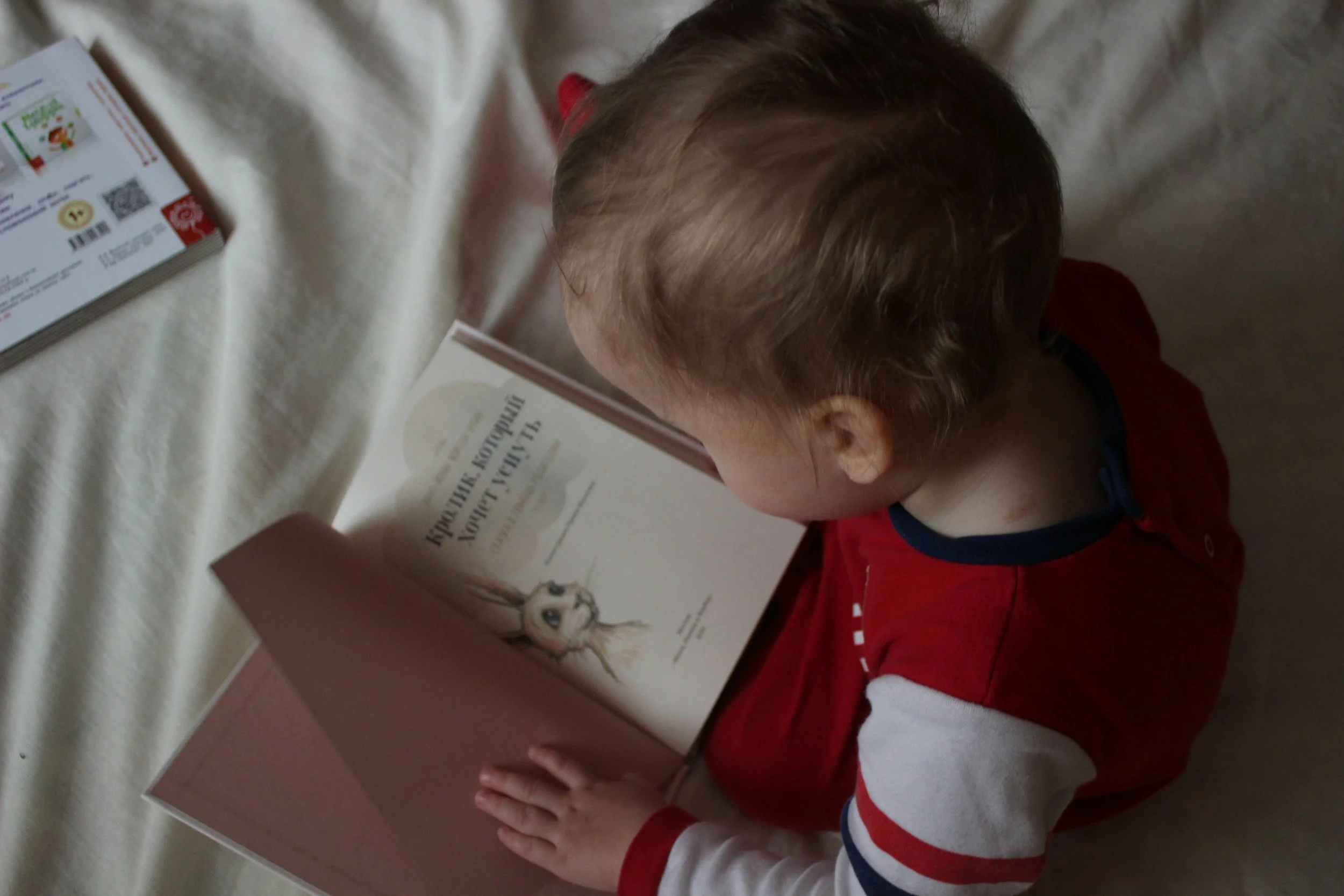
The best literacy area (in my opinion) is print motivation, or a child’s interest in and enjoyment of books. For very young children, this means allowing them to explore books in their own way: going backwards and forwards as they wish, lingering over pictures, skipping pages or reading them over and over, and even chewing on pages! At any age, being snuggled up together creates an association between reading and feeling loved.
Reading books about Orthodoxy can be motivating because they have an immediate connection to your child’s life. When kids recognize something in a book–perhaps a priest’s robe or a specific icon–they are more likely to want to engage with the book and find out what is going on in the pictures.
One of my biggest takeaways from my time in libraries is that almost everything we do contributes to early literacy in one way or another. You can make these activities extra rich by engaging with your kids through questions and making connections to the six different areas of literacy. And of course, as with everything in life, the best place for growth is in the beauty and love of the Church!

Applying for College as a Homeschooler
“So, how will you get into college?” If you’re a homeschooling high schooler, you’ve heard that question. I did, and it worried me. Now that I've been accepted to college, I’ve learned the answer is: “Just like everyone else.” Homeschoolers have the same rate of acceptance as brick-and-mortar school students, and there generally aren’t any application requirement differences for homeschoolers. Nevertheless, the process will inevitably feel different sometimes.
by Ilinca, Fall ‘23 Intern
“So, how will you get into college?” If you’re a homeschooling high schooler, you’ve heard that question. I did, and it worried me. Now that I've been accepted to college, I’ve learned the answer is: “Just like everyone else.” Homeschoolers have the same rate of acceptance as brick-and-mortar school students, and there generally aren’t any application requirement differences for homeschoolers. Nevertheless, the process will inevitably feel different sometimes.
Requirements
Many parts of the college application process are the same for homeschoolers and their public or private schooled peers. It was actually college essays which took the most time for me. Contrary to myth, colleges do not require homeschoolers to send in their high school diplomas or take the GED. The application forms I had to fill in were usually homeschooler-friendly. When they weren’t, articles on how to answer them abound on the internet. No college complained about my homeschool transcript or my parent-written counselor recommendation.
Deciding where to apply
The first step of college applications is choosing which colleges to apply to. First, I thought about what I wanted in a college: I wanted it to be close by, to have my major and a wide variety of others, to be co-ed, and not to be ridiculously expensive. I researched colleges (mostly through internet searches), consulted my parents, and took the opportunity to hear a variety of opinions when people asked me, “so, where will you apply to college?” (NB: Saint Emmelia’s has compiled a list of colleges that are Orthodox & homeschool-friendly. Check it out here!)
Standardized Tests
Even though most colleges are “test-optional” now, I took the SAT. It’s objective; no one could argue my score is the result of my adoring parents assigning me a good grade. Standardized tests also increase chances of getting admission or a scholarship. Finally, there was little risk involved: if I hadn’t scored well, I just wouldn’t have sent my scores. While the SAT is often given at a public school, it’s managed by the College Board, not the school system, so I had no trouble signing up as a homeschooler. I found practice tests online, and the time management I learned as a homeschooler helped me get through them. I chose the SAT over the ACT and CLT, the two other popular standardized tests options, because 1) all colleges accept it, which rules out the CLT and 2) it gives more time to answer each question than the ACT.
Letters of Recommendation
The prospect of finding letters of recommendation was concerning. How could I rival a public school kid’s arsenal of skilled recommendation writing teachers and guidance counselors? I learned that I had more wonderful teachers and other potential recommenders than I thought. My biggest trouble ended up being choosing between them! As for the guidance counselor recommendation, I found out that is technically my mom. I was definitely grateful that, throughout high school, I took classes and did activities outside my home, because that gave me the opportunity to meet the people that wrote my letters of recommendation. I would definitely recommend doing that, because it’s best if at least one of your letters of recommendation is written by someone outside your family: colleges will see that all the wonderful things your parent-counselor says are confirmed by other people.
Transcripts
While homeschoolers don’t need to hand colleges their homeschool diplomas or take the GED, they do need to send in their homeschool transcripts. Unfortunately, we didn’t realize how long this step would take, so, while we had always kept track of my classes, we procrastinated putting my transcript together until a month or two before the deadline. First, we checked state laws for transcripts on HSLDA. Because I follow a curriculum, all my classes were named and described. But when it came to actual organization, my family didn’t have experience there (I’m the oldest child), so we used Academicrecords.net, a transcript-making website. While we didn’t end up using the transcript it generated because it was rather rigid and couldn’t accommodate the high school classes I took in Middle School, it was very helpful. It brought our attention to grading scales, GPA (weighted or unweighted), class levels, and other important elements of transcript formality. We ended up using a SEM transcript template. GPA calculations turned out easier than we thought. As for choosing between a weighted or unweighted GPA, after doing our research and calling colleges to ask which they prefer, we decided to go with a weighted GPA because 1) it could highlight the higher level classes I took and 2) the colleges and scholarships I was looking at preferred it.
The Counselor Recommendation and School Report
Finally, there was the counselor recommendation and school report my mom had to write. We didn’t realize how long this would take either. Among other things, it required a letter of recommendation written by my mom, a descriptive list of all classes taken outside the home, and an explanation of our educational philosophy and grading scale. My mom and I looked through our curriculum and brainstormed together before writing. We made it clear in the school report that we are Christian and I was educated in a Christian way, even to secular schools. If a school isn't willing to put up with that, we would rather they turned us down early. But, surprisingly, it did not give us any problems. For the grading philosophy, we used the grading scale we put on the transcript. For class descriptions, I copy-pasted from my syllabuses.
Conclusion
College applications as a homeschooler were easier than I had thought based on the amount of concern homeschoolers typically receive on the topic. If I could give my past self advice, that would be:
First, make yourself a schedule, and give each piece of the application a different due date, some well before the application’s official due date. Especially with college essays, it’s tempting to “just work on it one more day,” and procrastinate the rest of the application due to unnecessary perfectionism.
Second, don’t be afraid to answer people when they ask where you want to go to college. They can give you a lot of good advice, and if they don’t, you’re not obligated to obey.
Finally, don’t worry! I was afraid to press the submit button for each college. There was still so much room for improvement! And what if ten more minutes of work spells the difference between rejection and acceptance? But really, if you worked hard on it, and checked it two or three times, go ahead and send it! Don’t worry! Admissions officers don’t expect anyone, not even homeschoolers, to have perfect applications.
If you would like to ask Ilinca questions, email us at office@saintemmelia.com. Make sure to check out our “High School & Beyond” resources!
My Gratitude For Journeying Through Lent As A Homeschooler
“The only thing in his sock drawer is a sandwich!” my brother said as he frantically prepared for school one morning. It was Holy Week, and he was looking for socks. He couldn’t find any in his dresser, so my mom told him to look in his brother’s drawers. He found only a sandwich, forgotten by our exhausted brother one night after services. We were trying to juggle the demanding work of private school with the many services we had during that week.
By Anya, Fall ’23 Intern
“The only thing in his sock drawer is a sandwich!” my brother said as he frantically prepared for school one morning. It was Holy Week, and he was looking for socks. He couldn’t find any in his dresser, so my mom told him to look in his brother’s drawers. He found only a sandwich, forgotten by our exhausted brother one night after services. We were trying to juggle the demanding work of private school with the many services we had during that week.
For us Orthodox Christians, the climax of the liturgical year is the Feast of Feasts—the celebration of the Resurrection of Christ. Preparing for Holy Week and Pascha is a very important season, as we focus on our spiritual growth through prayer, abstinence, alms, and confession. It is a blessing that, as homeschoolers, we are able to arrange our days and weeks to focus on Christ, His Church, and what He did for us. We can adjust our family schedules to prepare for and go to weekday services. For instance, we celebrate Presanctified Liturgy on Wednesdays and Fridays, and before each of these, we are asked to abstain from eating to receive communion. Often, school days can be tough and draining, and trying to fast and spiritually prepare for liturgy on top of homework and extracurricular activities is especially challenging. I cannot recall how often we had to rush home from a long day at private school and cram in all our school work before going to church. What a difference homeschooling made for us! The flexibility allows us to plan our lessons and workload around church.
As I ponder celebrating and participating in the Lenten season, there are many things that I am grateful for.
I am grateful for the flexibility we have as homeschoolers during a time of year when our schedule rarely fits into the world’s. We live in an increasingly secular world, and the bit of Christianity that is around us is very Western in its orientation and calendar. Dates for Lent, Holy Week, and Pascha (Easter) rarely align between East and West, and on the rare occasions they do, our observances and focus during this time vary significantly from those of our neighbors. The flexibility of homeschooling allows our family to balance our call to fasting, repentance, prayer, and moderation without worrying about how to mesh these priorities with those of public or private schools.
I am grateful that during this time of preparation in the Lenten season, my family and I can take advantage of flexibility in scheduling. We can schedule time to help the church prepare in other ways. Since parishes have more services and people attending during this season, the church might need more cleaning and help with making and putting out service books, scraping wax off the floor, decorating the tomb, preparing candle sleeves, etc.
I am grateful for my family during this time, and for the unique things we do and the traditions we share. Many of us go to choir practice together. We make kulich (Pascha Bread); we visit the Russian store to buy all our favorite feasting foods for our Pascha baskets, often making Pascha baskets for our friends, too. Most importantly, each service can spark so many conversations with family about Theology, the life of Christ, and the lives of saints from hymns and homilies.
I am grateful that in the eight to nine days leading up to the Feast of Feasts, we have no school scheduled. We know, in advance, our schedule of services and know that we want to do very little that week other than focus on the meaning, lesson, and beauty of each service, and how it helps prepare us for what we are about to celebrate. On Lazarus Saturday, our focus shifts from ourselves to Christ. On Palm Sunday, we remember the Entrance of Our Lord into Jerusalem after His miracle of raising Lazarus from the dead. Early in Holy Week, at the Bridegroom Matins services, we learn from the Parable of the Ten Virgins, which calls for preparedness at the Second Coming. On Holy Wednesday, we are anointed and receive the sacrament of Holy Unction. On Holy Thursday, we go through the gospels and hear the story of Christ’s Passion. On Holy Friday, we contemplate the burial of Christ and His sufferings with solemnity. On Holy Saturday, we celebrate the beautiful Vesperal Divine Liturgy of St. Basil when the altar cloths are changed from black to white, and we first hear of the Resurrection.
I am grateful on Pascha, as we all are, that Christ has risen from the dead and has trampled down death by death, bestowing life to those in the tombs. We celebrate and partake in all the richness and beauty that is Pascha, and break the fast.
I am grateful that during Bright Week, we don’t just forget about Pascha and move on as we would if we would have had school that week. Instead, the feast continues, and we can go to all Bright Week services and learn from them as well.
The story I shared about my brother reminds me of the many demands we have during the time of Lent and Holy Week and how hectic it can get. At that time, my brothers and I were attending a private school, and much of our time and schedule was dictated by their Roman Catholic calendar, which only occasionally overlapped with that of the Orthodox Church.
When we began homeschooling, one of the gifts it gave our family was the ability to focus on learning through experiences. The flexibility of homeschooling allows us to experience, in its fullness, all the Church has to offer the faithful during Lent and Holy Week. It is not only a time of year to learn and experience, it is a time when we more earnestly live and see the gift God has given us because He loves us and wants us to live in eternity with Him.
I am grateful I don’t miss out on these blessings which I am grateful for.

4 Reasons to Attend the EAST Conference
If you haven’t attended a Family Homeschool Conference, you may be thinking, “what’s all the fuss about?” Well, there’s plenty to fuss about, but here are just a few of the many reasons you and your family should join us April 18th-21st at AV Camp!
by Mindi Popovich-Schneider
If you haven’t attended a Family Homeschool Conference, you may be thinking, “what’s all the fuss about?” Well, there’s plenty to fuss about, but here are just a few of the many reasons you and your family should join us April 18th-21st at AV Camp!
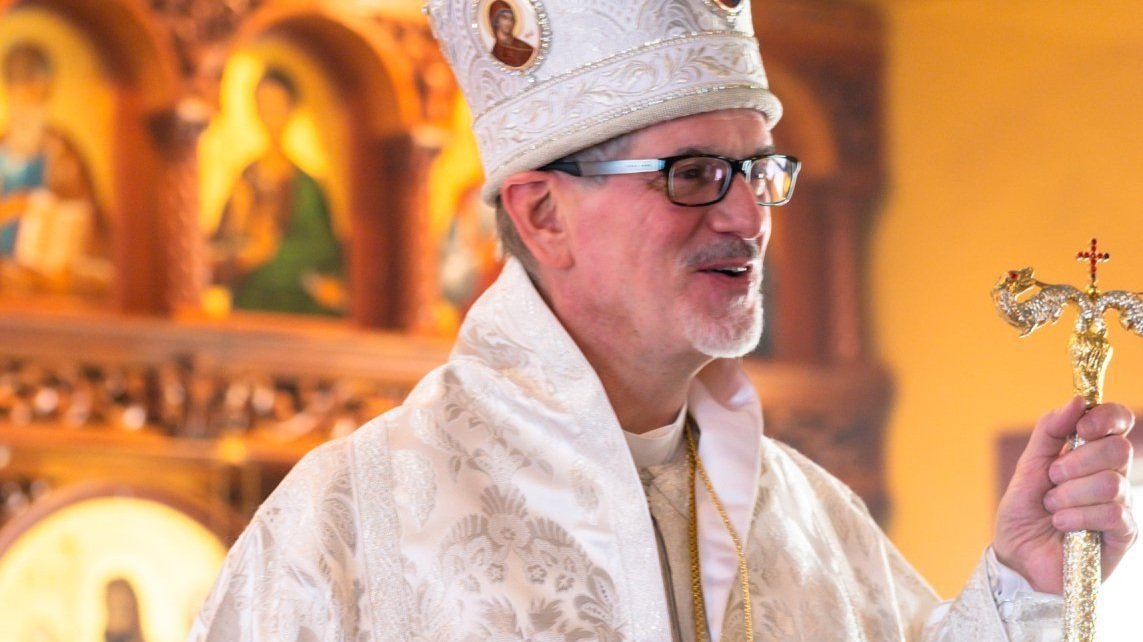
#1. The speakers. If you haven't heard Bp. ANTHONY speak before, you're in for a treat! On top of that, Andrew Kern and Drs. David and Mary Ford will be featured, along with other knowledgeable, insightful homeschool parents!
#2. The location. We're thrilled to be at Antiochian Village Camp this year, and all that entails: heated one-family cabins with private bathroom, beautiful hiking trails, AV Ball and campfires, the relics of St. Raphael of Brooklyn, Fr. Chris and the rest of the wonderful staff...the list goes on!
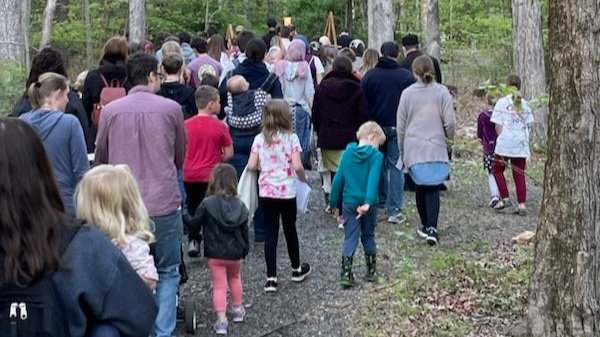

#3. The friendships. We can't say this enough: what makes our Family Homeschool Conferences unique is the opportunity for all ages to fellowship with other Orthodox homeschoolers. Our volunteers are hard at work planning activities that will allow adults and kids time to get to know each other and form long-lasting friendships!
#4. We will make it possible for your family to come! Thanks to generous donors, we have scholarships available. You can also get additional discounts by assisting with a children's workshop or sharing housing with friends. Email programs@saintemmelia.com for more info. If you are experiencing any barriers to attending, please reach out!

There you have it: four of the MANY reasons to come! What did we miss? Why does your family attend the regional conferences?
Register now!

The (Somewhat) Definitive Guide to Tying Headscarves
As with almost everything else, there is a wide spectrum of opinions on headcoverings in the Church–where and when they should be worn, when girls should start wearing them, and why (or why not) they should be worn. Regardless of your opinions on headcoverings, if you have ever tried to wear one while wrangling children (or watched someone wear one while wrangling children!), you know that they can be difficult to keep in place. Between children tugging on the ends or trying to play peekaboo (just my toddler?) and the combined heat of a scarf and a little one, scarves can become a downright nuisance!
Here, I’ve collected six alternatives to the standard single loop or knot-under-the-chin styles. If you struggle with keeping your headscarf in place, or you’re interested in starting to cover your head, hopefully these methods will keep you cool as a cucumber (both literally and figuratively) during services.
by Mindi Popovich-Schneider, Saint Emmelia Ministries
As with almost everything else, there is a wide spectrum of opinions on headcoverings in the Church–where and when they should be worn, when girls should start wearing them, and why (or why not) they should be worn. Regardless of your opinions on headcoverings, if you have ever tried to wear one while wrangling children (or watched someone wear one while wrangling children!), you know that they can be difficult to keep in place. Between children tugging on the ends or trying to play peekaboo (just my toddler?) and the combined heat of a scarf and a little one, scarves can become a downright nuisance!
Here, I’ve collected six alternatives to the standard single loop or knot-under-the-chin styles. If you struggle with keeping your headscarf in place, or you’re interested in starting to cover your head, hopefully these methods will keep you cool as a cucumber (both literally and figuratively) during services.
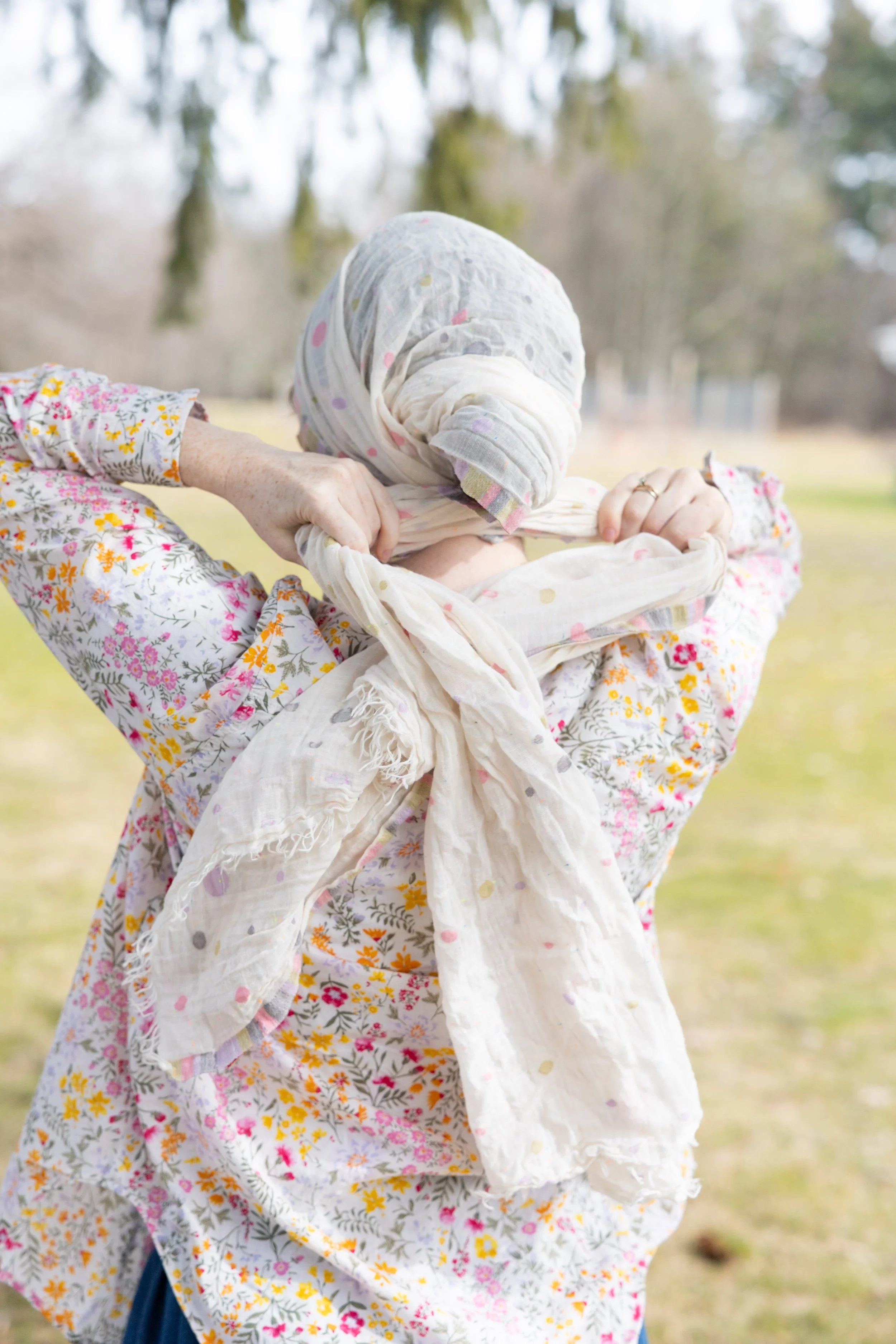
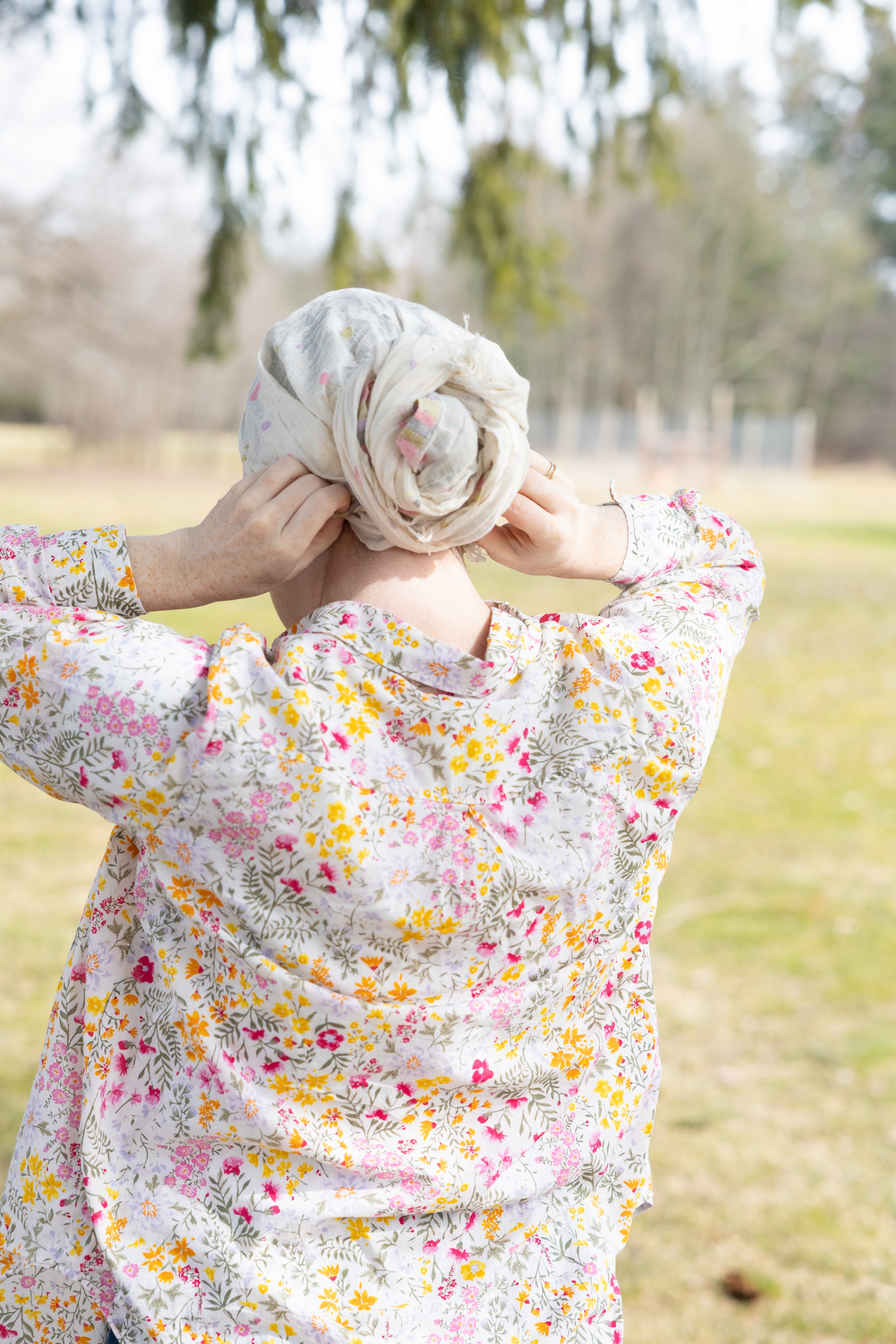
The Bun (Rectangular scarf)
Put your hair into a bun at the nape of your neck.
Lay your scarf smooth and taut across your head.
Bring the ends around to the back of your head and criss cross them under your bun
Bring the ends up around your bun, wrapping them until you have only short tails left. You might want to tie the ends once more. Tuck the tails in.
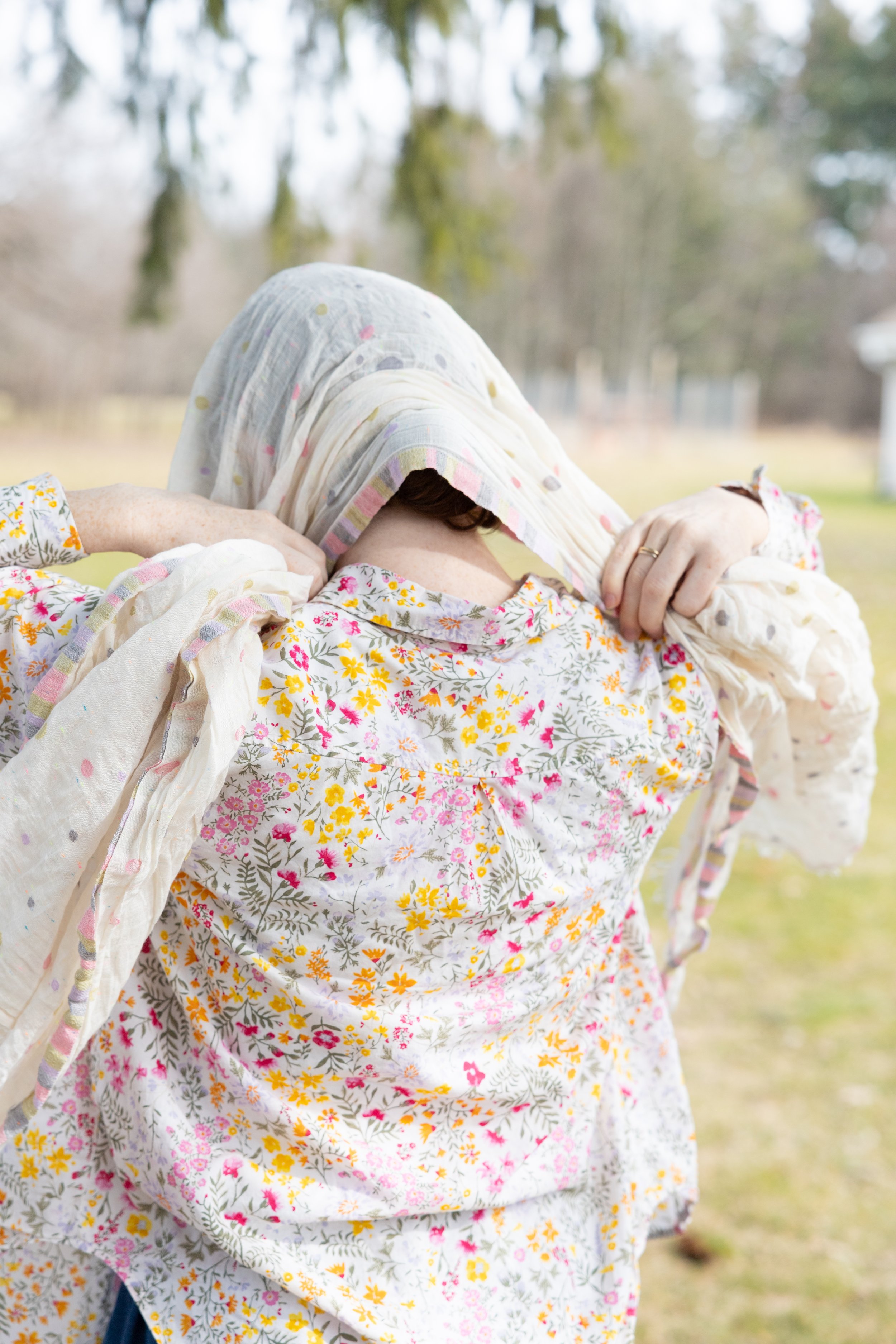

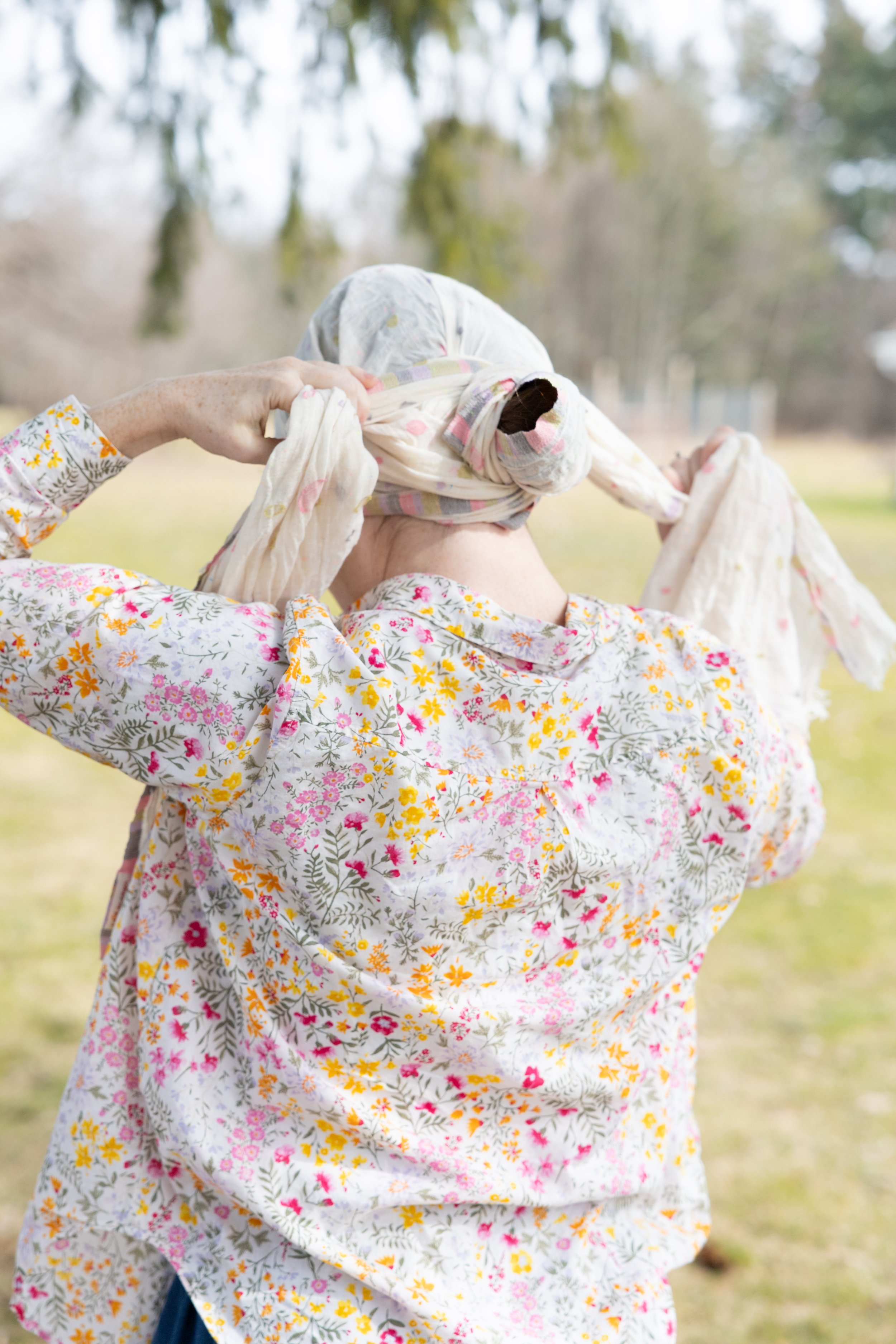
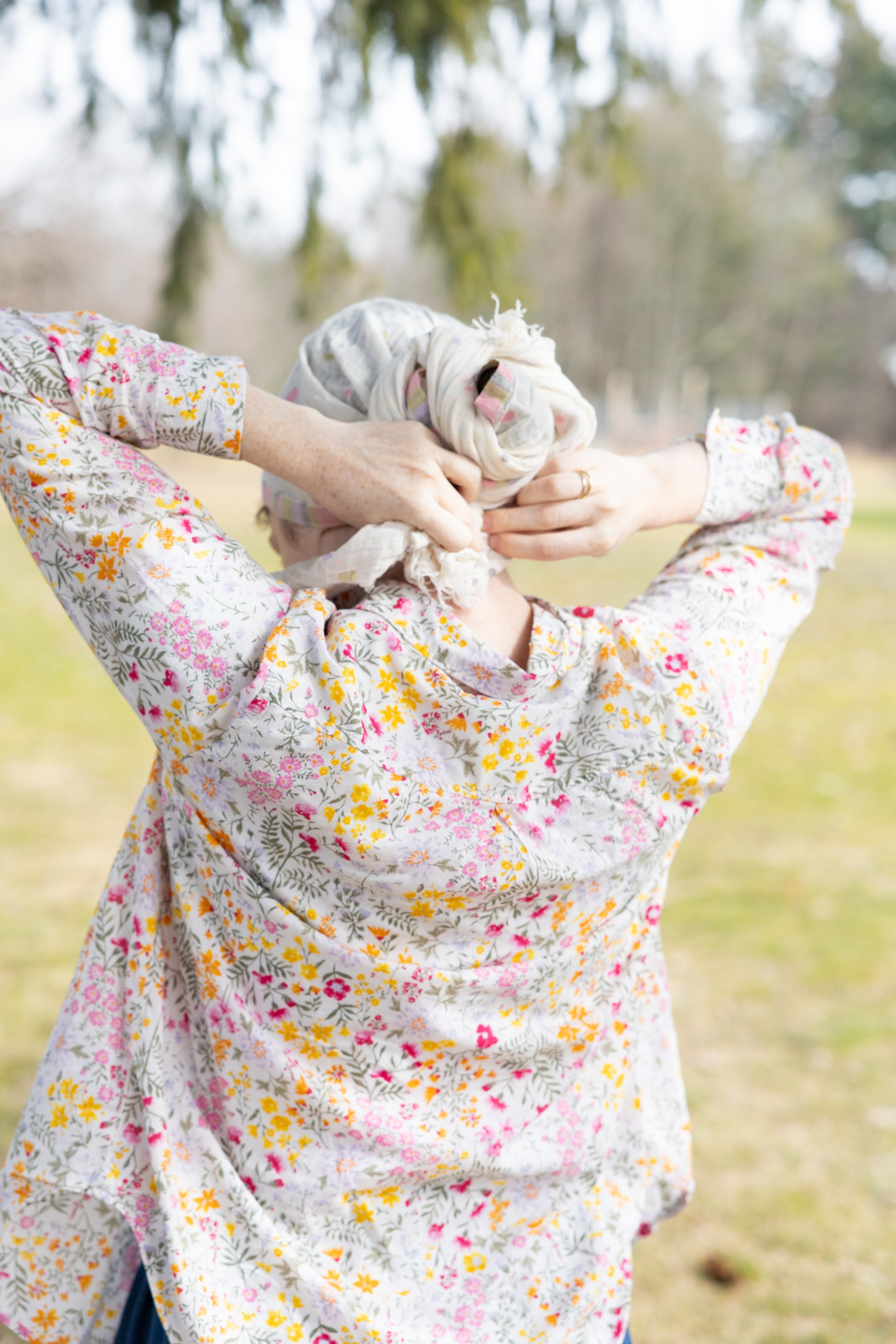


The Faux-Bun (Square or rectangular scarf)
Note: If you have short hair or don’t care to put your hair in a bun for whatever reason, use this instead of the above tutorial!
Lay your scarf smooth and taut across your head.
Bring the ends around to the back of your head, bringing them together. You’ll want to adjust them so that they’re folded smoothly back over the bottom edge of the scarf; otherwise, the scarf will be too loose.
Using a hair-tie, gather the scarf into a “ponytail.” If you have long hair, you can gather it into your ponytail for an extra anchor.
Tie the tail into a bun. I like to twist the two sides together, then wrap the twist around the hair-tie and fasten with a second hair-tie, but your preferred method will work too!
If you’re worried about it sliding off, bobby pin the scarf behind your ears and under the bun.
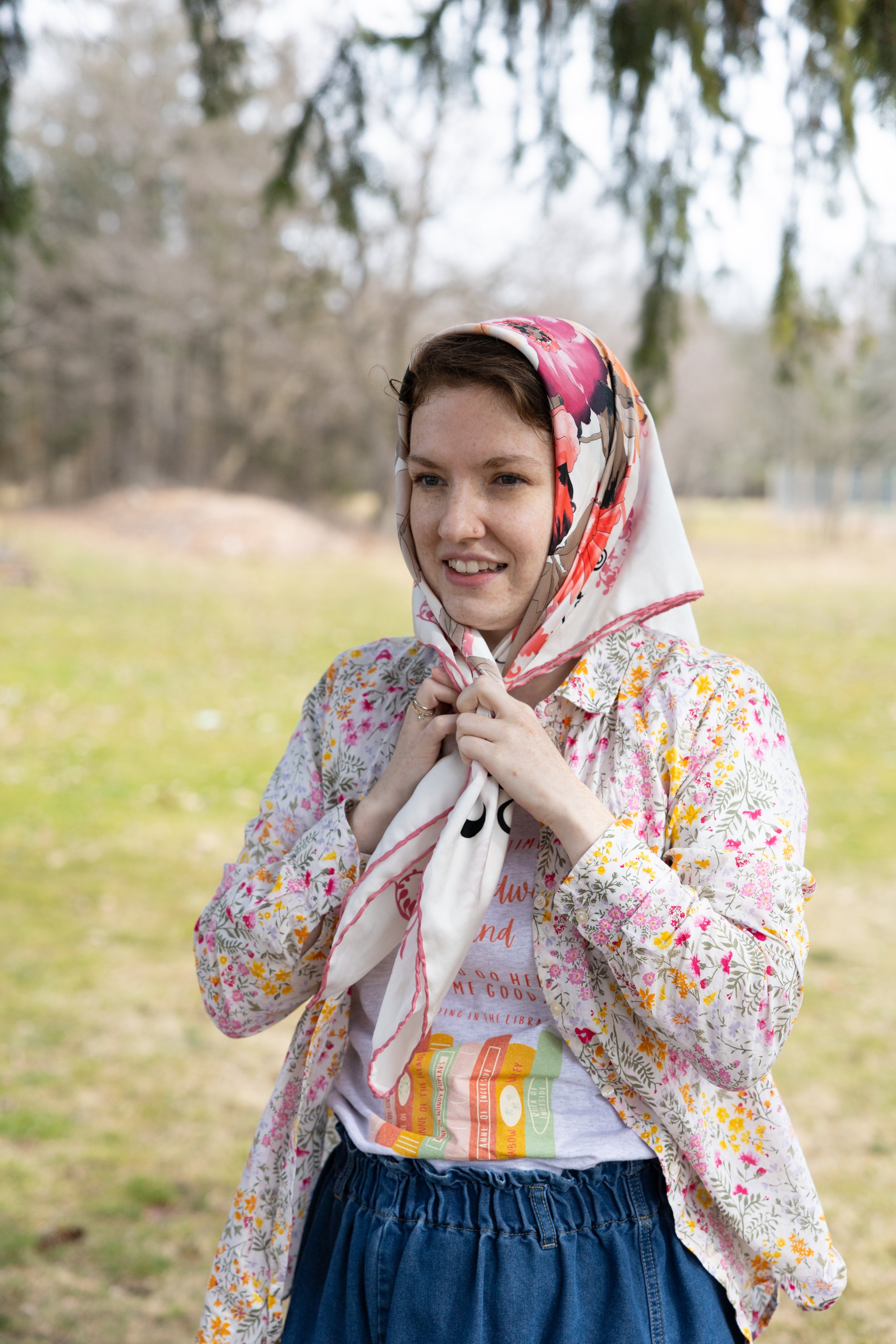
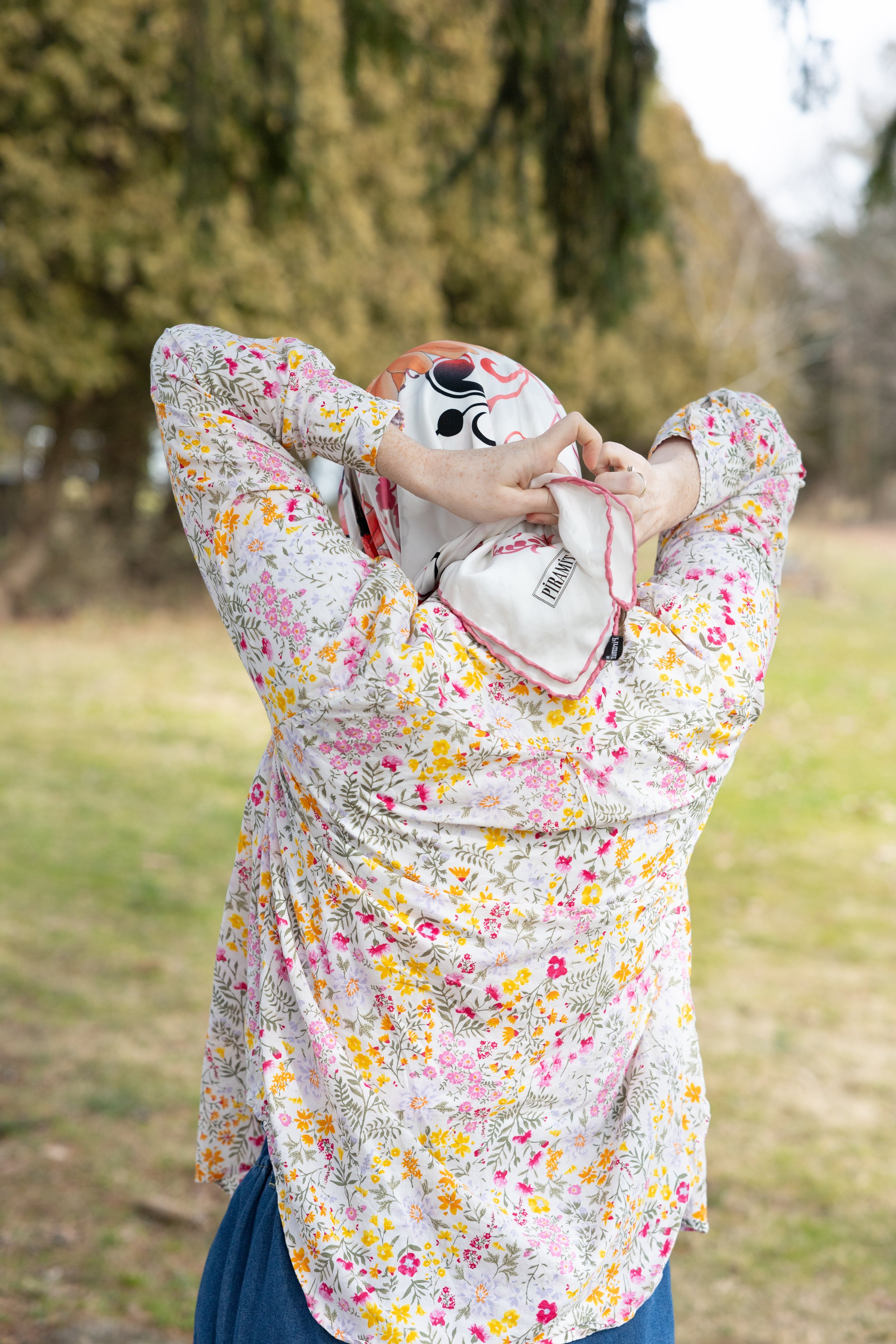
The Grace Kelly (Square)
Note: While Grace Kelly’s silk scarves are iconic, I find that silky scarves still slip a lot with this style. When I use a cotton scarf, it stays in place perfectly.
Fold your scarf diagonally to make a triangle. Lay the long side across your head.
Wrap one end over the other and pull it through.
Pull both ends around to the back of your neck and knot them.
You can either pull the point of the triangle out over the knot (like a snood), make the knot into a more fashionable bow, or tuck the three ends under your collar.

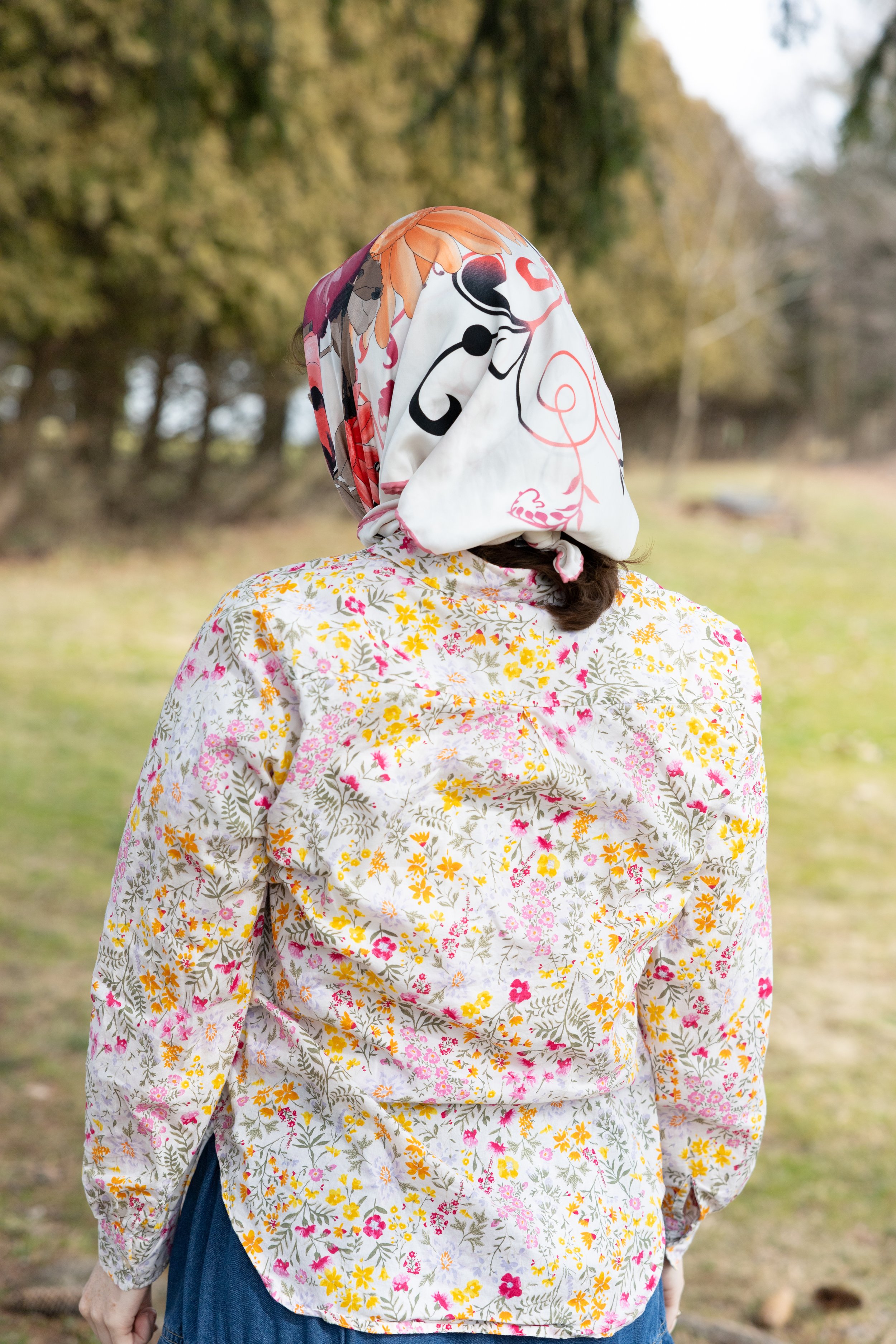

The Rosie (Square)
Fold your scarf diagonally to make a triangle. Lay the point of the wide angle a little ways back from your hairline/forehead.
Bring the other two points to the top of your head–over the wide point–making sure to keep the scarf smooth and flat.
The ends into a tight knot, then tuck the tails under the edge of the scarf. Secure them to your hair with bobby pins, which shouldn’t be visible under the scarf.
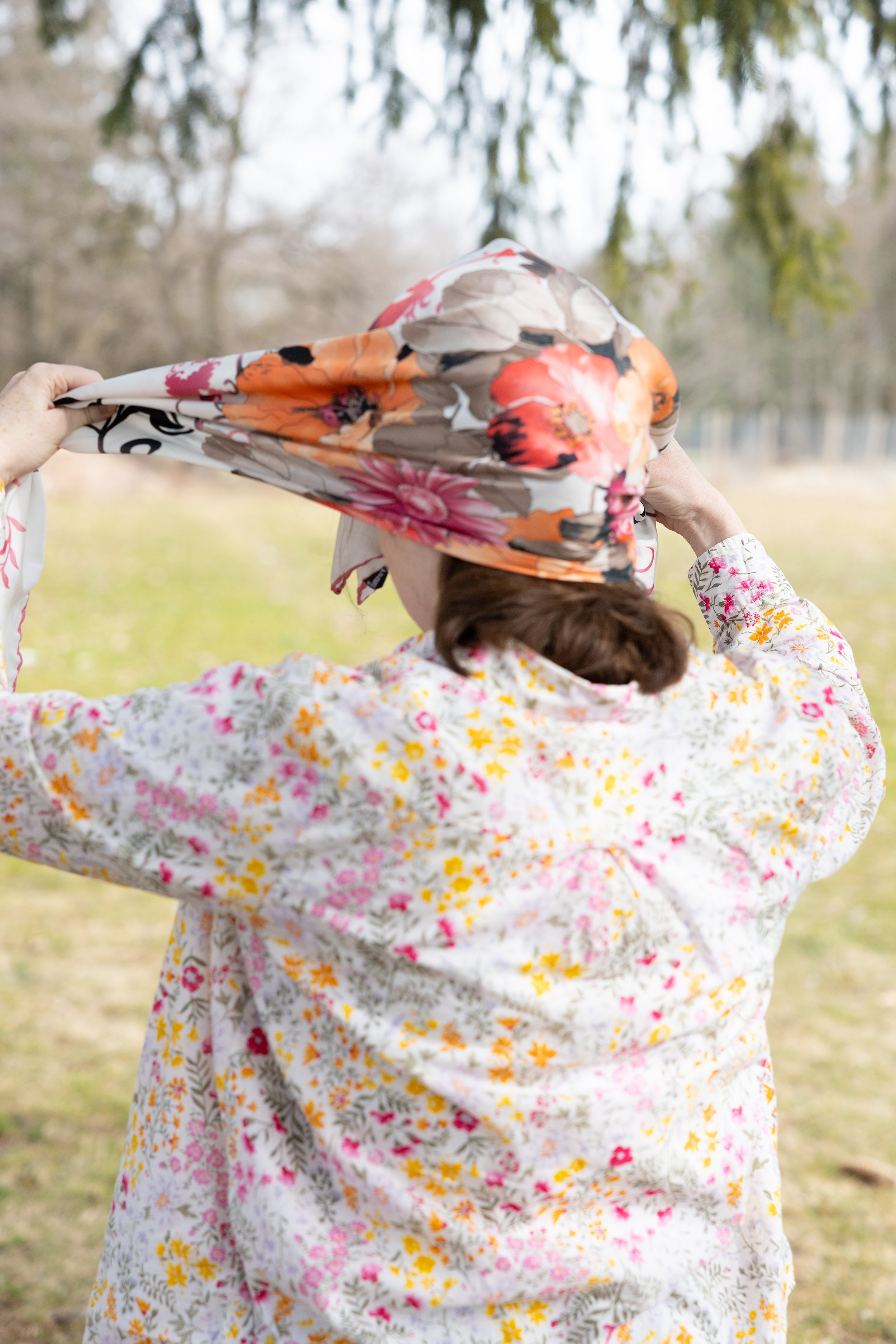
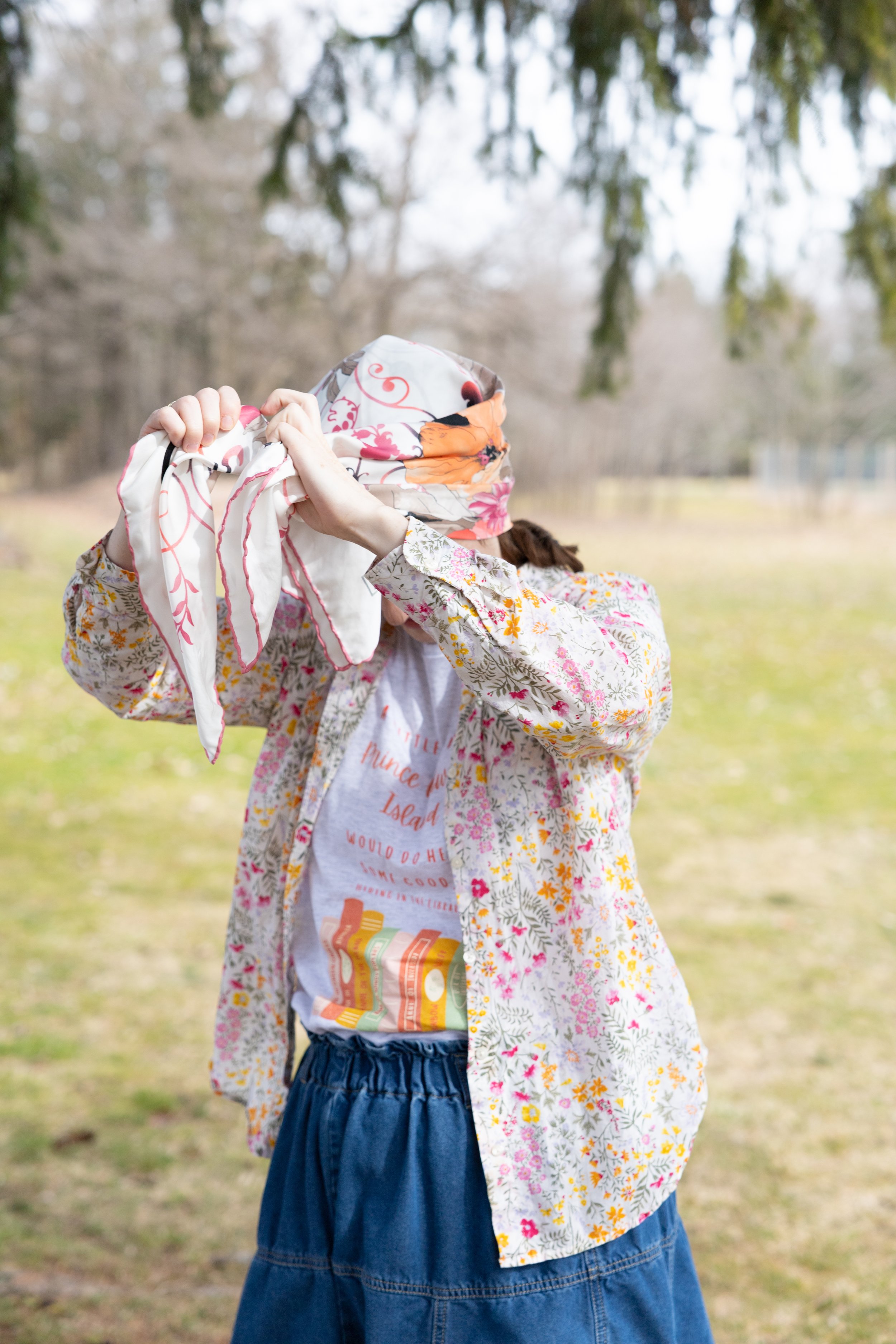
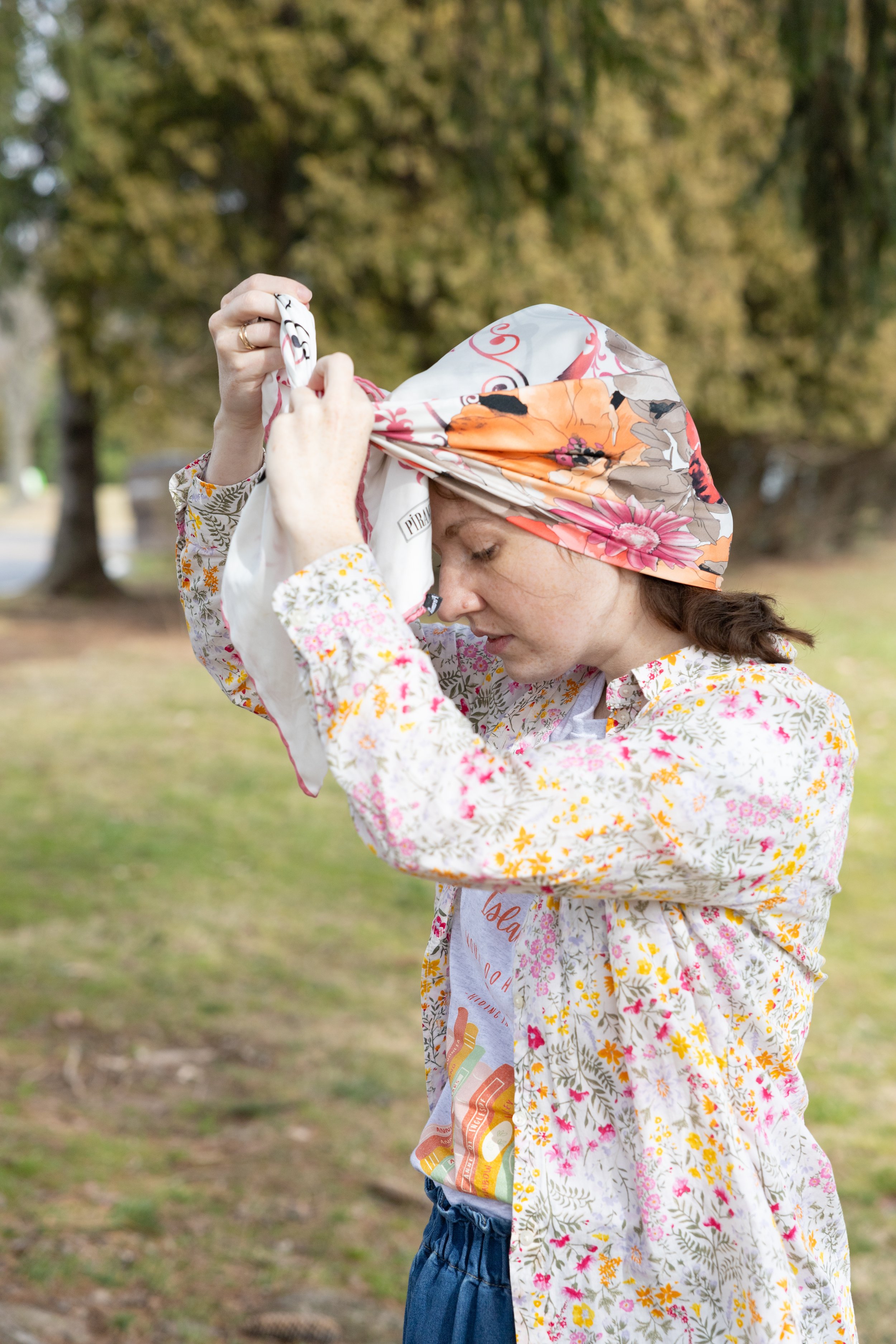
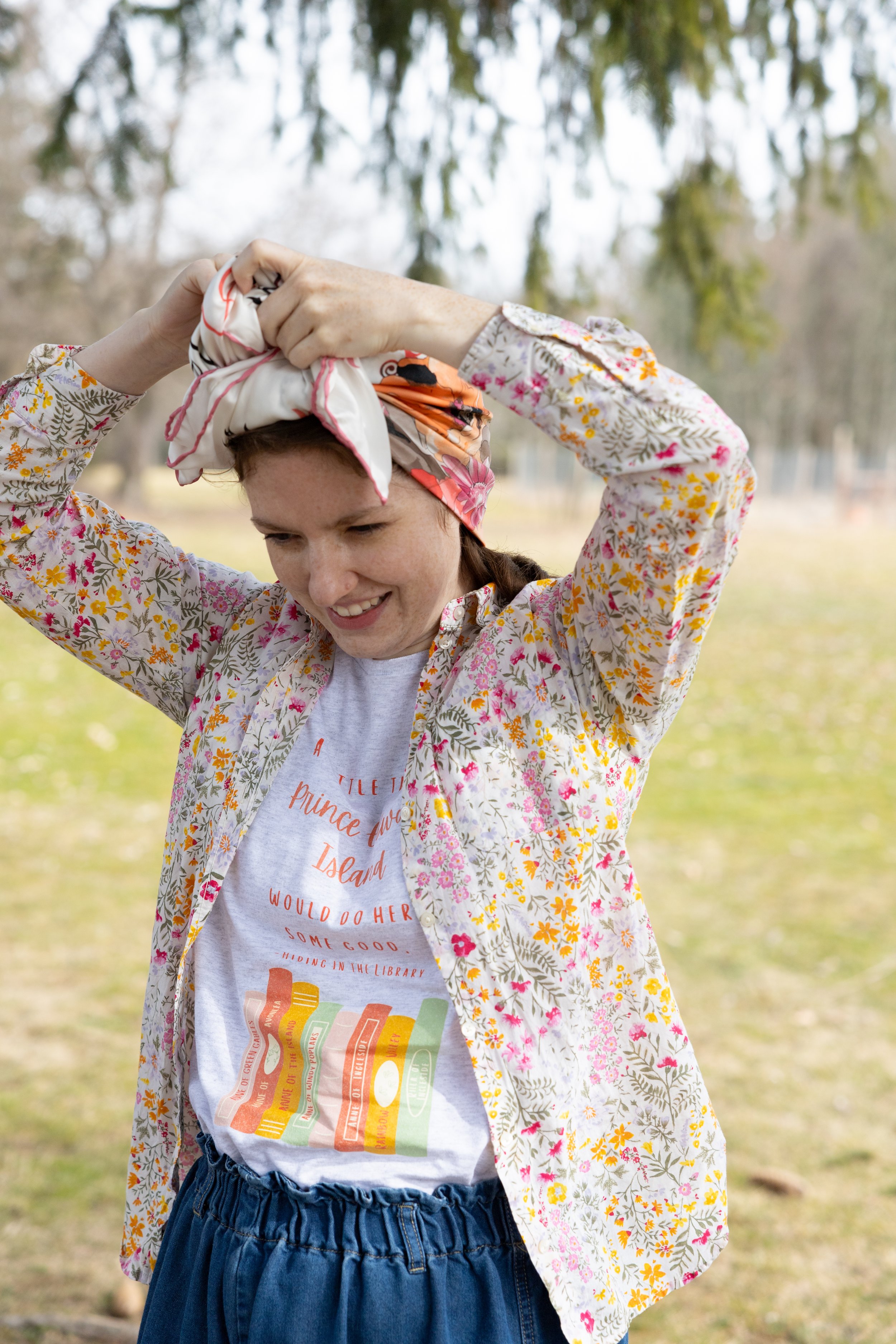
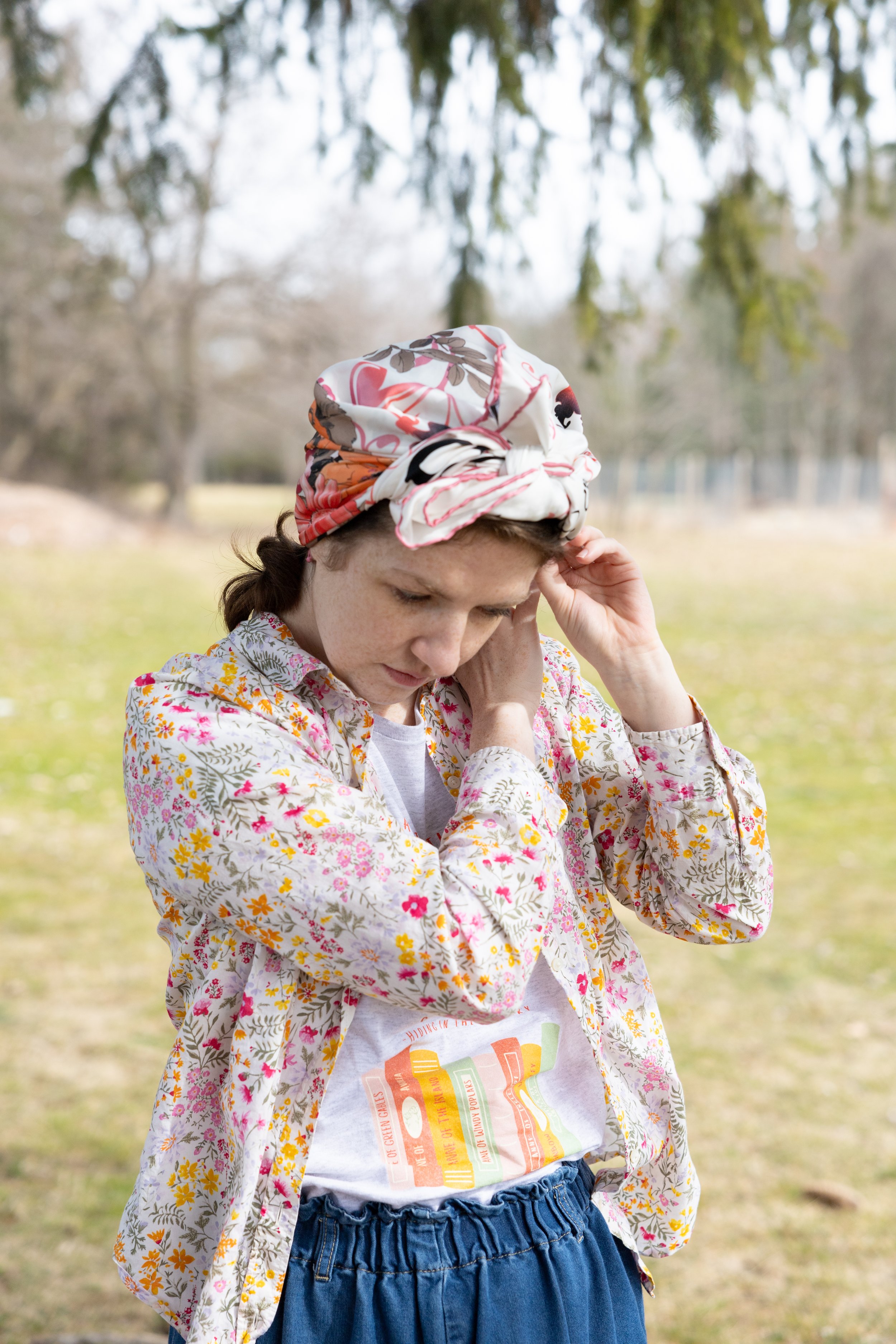
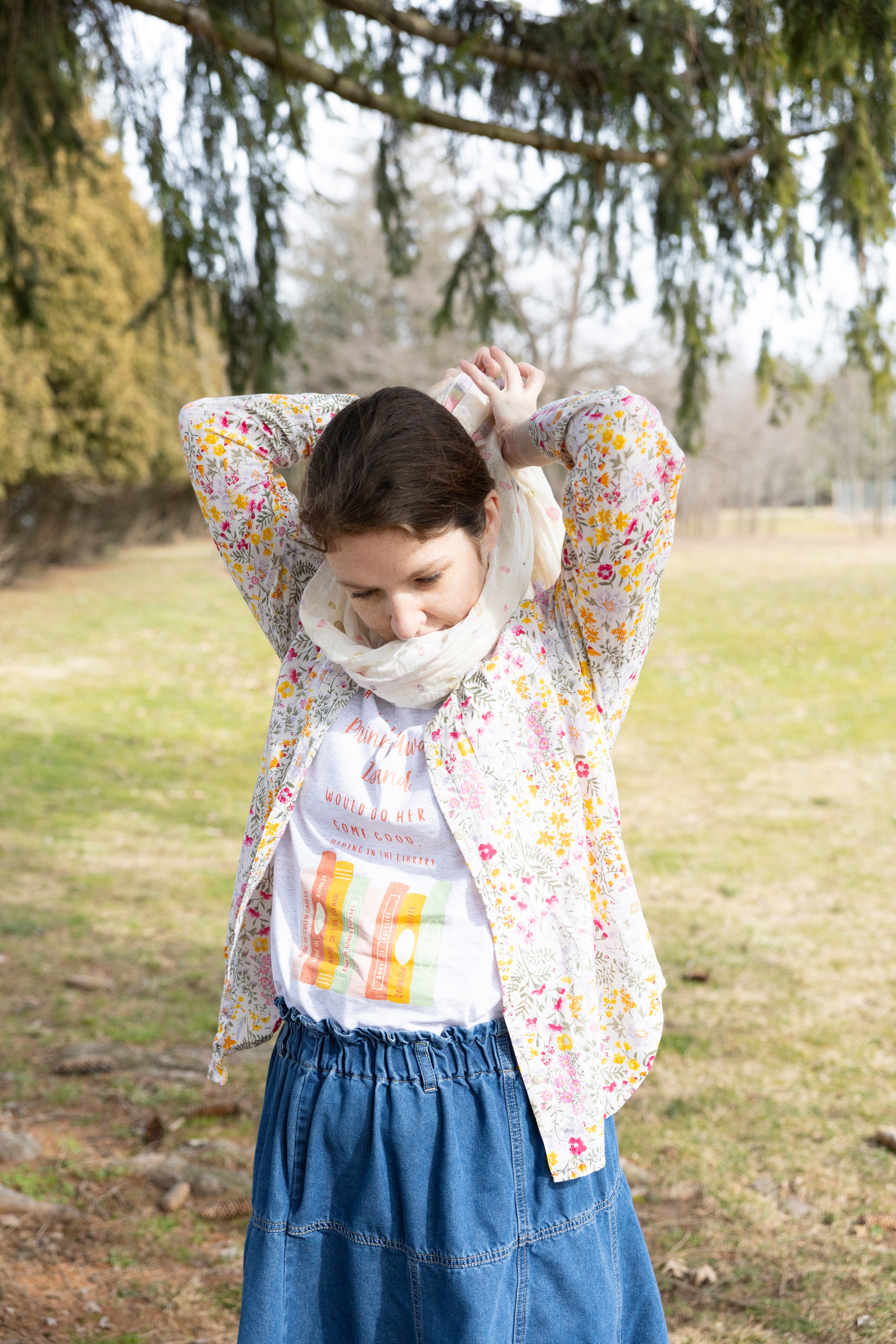
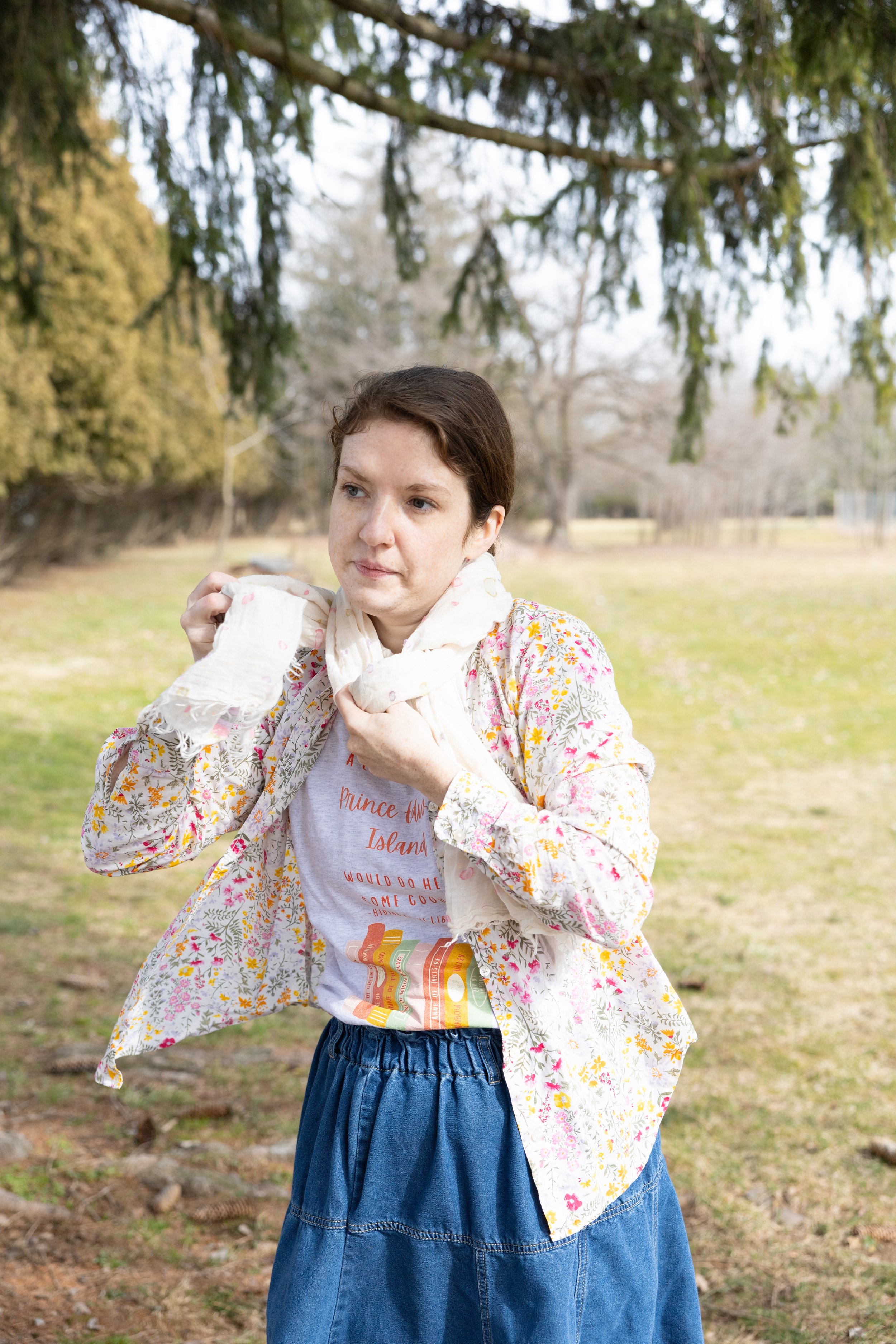
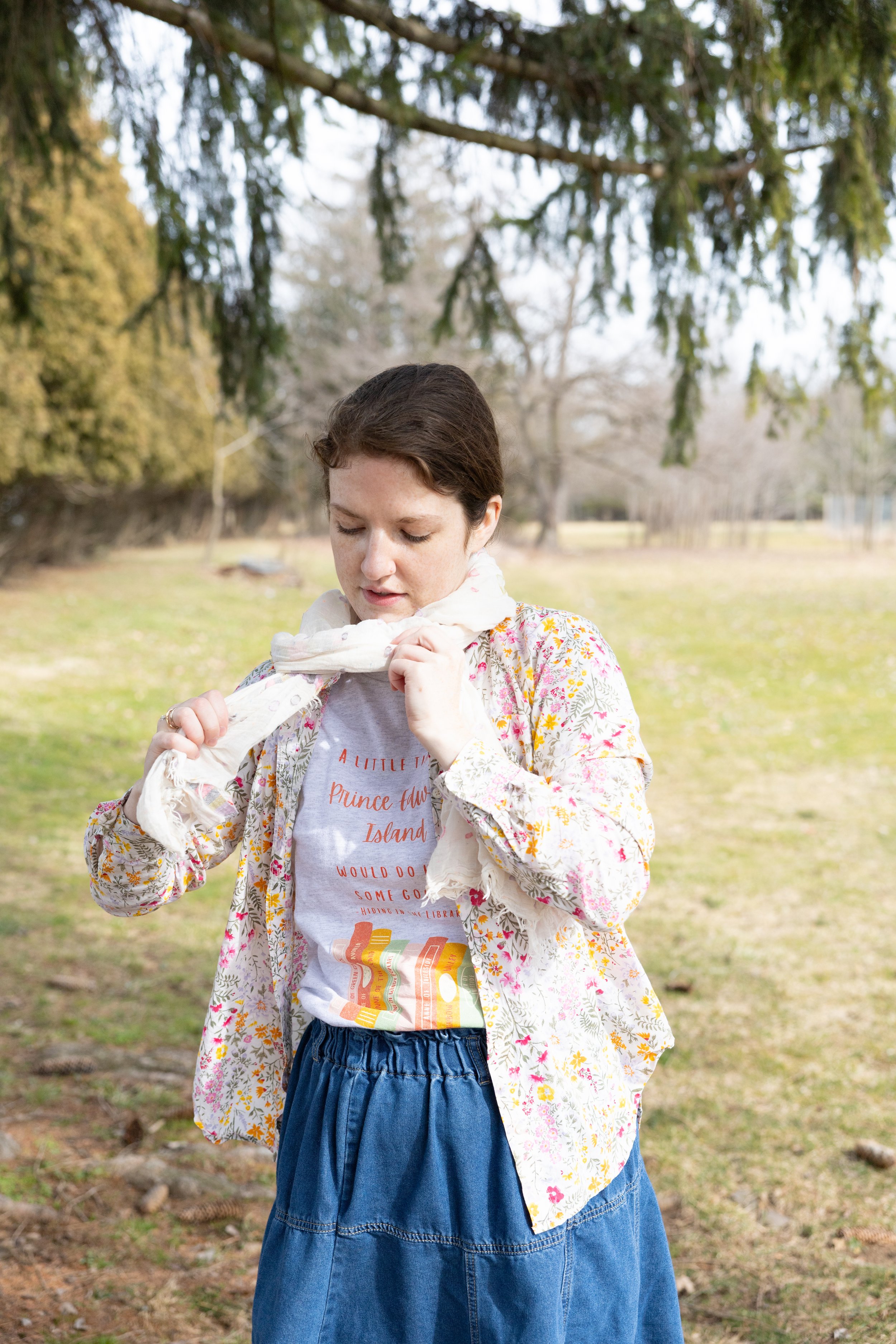
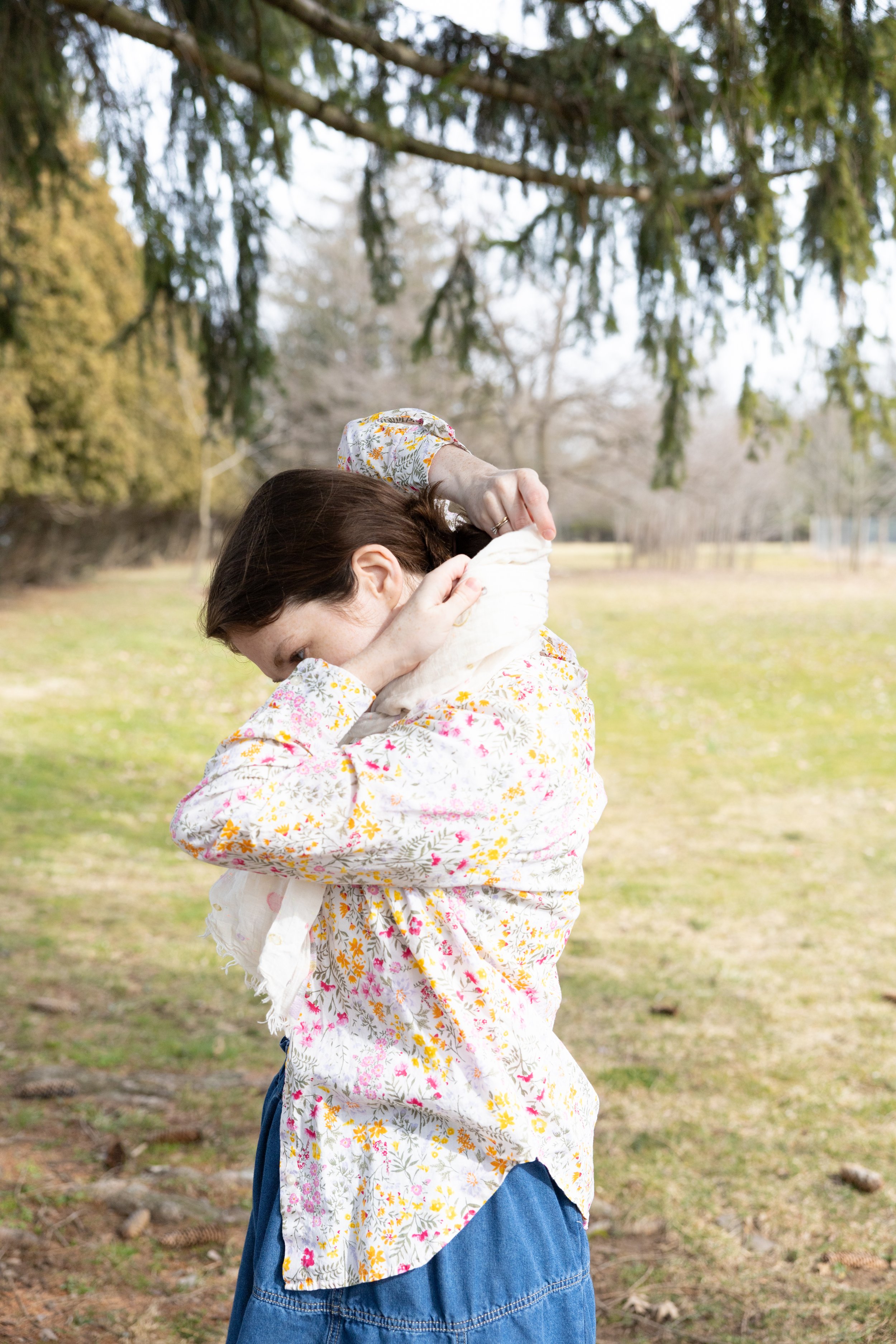
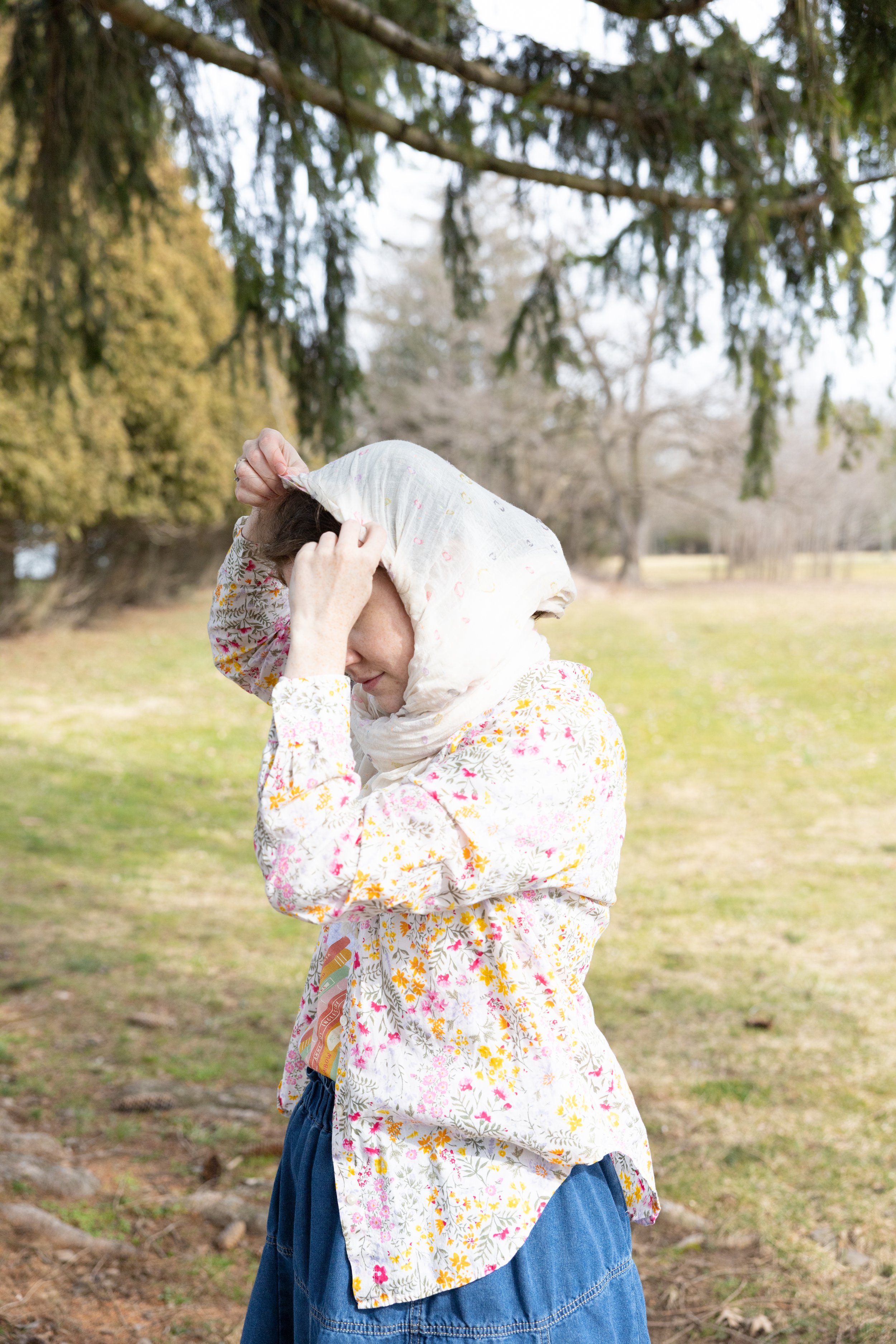
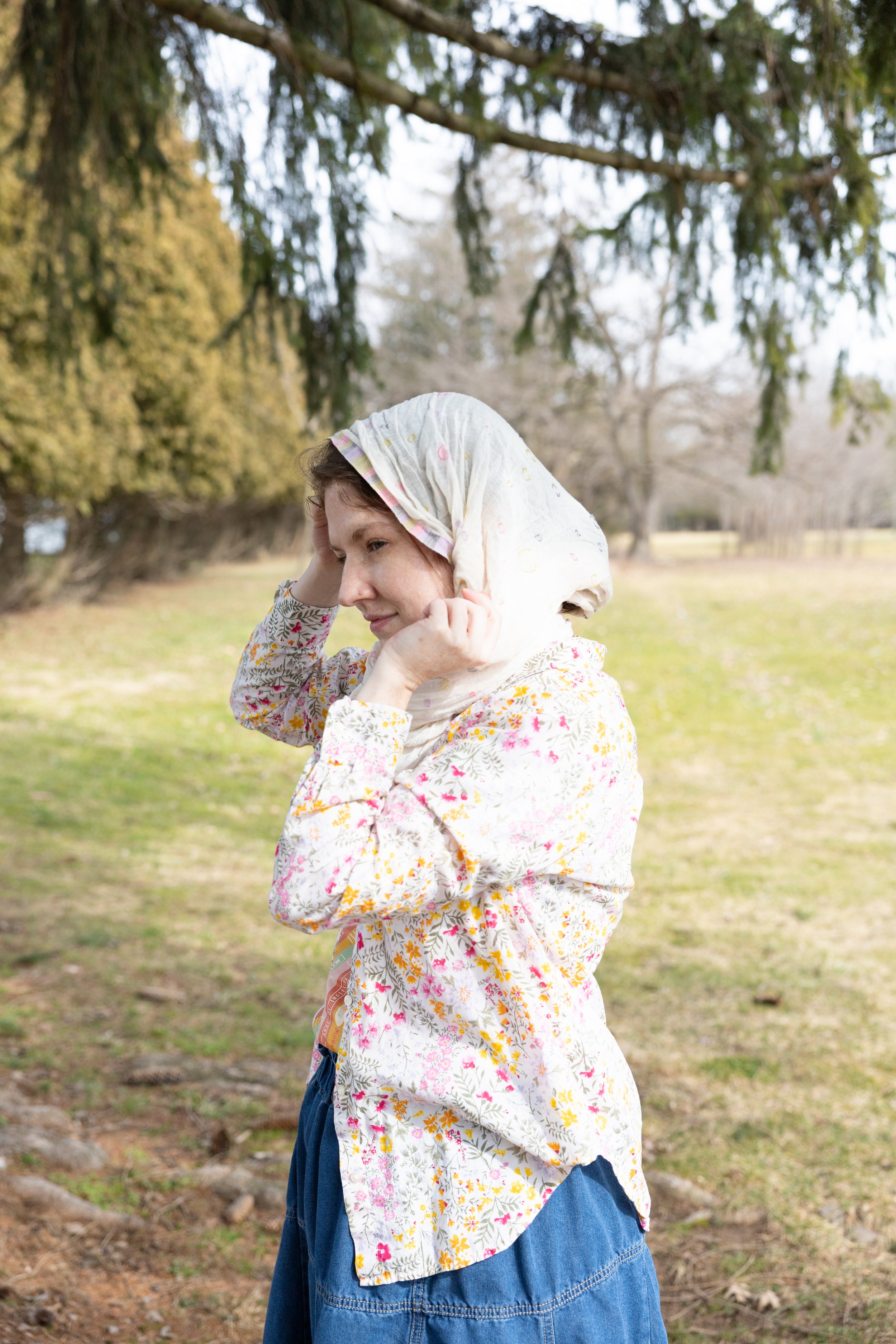
The Trendsetter (Rectangular)
Put the middle of the scarf in front of your neck, wrapping the tails around the back and to the opposite side.
Tuck each end through the front loop of the scarf.
Pull the back part of the loop up and over your head
The Cottagecore (Make your own!)
Watch this quick and easy tutorial! This style works nicely because the ties are hidden under your hair, and they are easier to pin in place because they’re so thin.
Additionally, a simple triangle scarf (that is, NOT a square folded in half) also seems to stay in place very well.
Cut a triangle roughly 35”x14” with a hypotenuse of 22”. Roll the edges in once and sew to make your hem!
There you have it: six methods for effectively covering your head in church! Did I miss any styles? Let us know!
Why We (Actually) Homeschool
A few months ago, I wrote about common homeschooling myths. Now, I want to talk about the homeschooling reality, specifically, why we really homeschool.
by Mindi Popovich-Schneider, Saint Emmelia Ministries Assistant
A few months ago, I wrote about common homeschooling myths. Now, I want to talk about the homeschooling reality, specifically, why we really homeschool.
It’s true that there are a lot of negative reasons–that is, things that we are trying to get away from–but all too often, the positive reasons get overlooked. And that is really a travesty, because these positives are the heart and soul of homeschooling. We’re not running away from other people, diverse opinions, or behaviors that we dislike; we’re actually running towards something. So, here are some positive reasons why we homeschool:
To spend time together: Because we believe that each child is a beautiful being created by God, we genuinely want to spend time with our children and enjoy the things that make them them. We believe that God granted us children as the most important work of our lives. Accordingly, we want to embrace this work as fully as we can, and we can only do that when we are deeply involved in their educations.
To transmit a belief system: This is a myth that does have a kernel of truth in it; it’s just become distorted and popularized as a desire to indoctrinate our kids. In the Garden of Eden, God did not create mindless automatons, but rather reasoning beings who could choose to love Him and know Him. He gave them a solid foundation–clear, explicit rules–and free will to do with that foundation what they would. Just so, we do not want our children to be mindless automatons who never question or think for themselves, but we do want to give them a firm foundation that they may rest upon when it is time for them to exercise their free will. So we keep them protected in a nurturing environment until the foundation is laid and the time for choice has come.
To let kids be kids: In the time that it takes to carefully and intentionally lay a strong foundation for our kids, they get to be kids. All too often, the world forces children to grow up quickly in order to keep up with their peers, whether through inappropriate media, bullying, or other developmentally-unsafe behaviors. Homeschooled kids are allowed to mature and develop at their own pace–not an arrested pace, but simply the timing that is natural to who they are as individual beings. Children can play pretend in the backyard as long as it captures their imagination, or they can start reading Shakespeare the moment his beautiful words catch their hearts without being dragged away from either by their peers or teachers.
To explore anything (and everything): Not only does homeschooling allow children to grow up at their individual pace, but it also allows them to explore different ideas according to their individual interests. When I was a student, I was fascinated by missions work, so my history reading always included biographies of (usually female) missionaries. My husband was enamored of space, so his science reading usually involved at least one book about the cosmos. Now, as adults, I work for a church ministry, and my husband delights in showing our friends’ children how to use the telescope in our living room. Our (wildly different) homeschool educations nurtured these seeds into sweet fruit that we enjoy over and over, in many different ways.
To make room for wonder: All of this exploration gives homeschool families a unique opportunity to approach discovery with intentionality: to learn deeply what a thing is and to marvel at its “whatness”. Whether it is the lives of the saints, the transcendence of a Divine Liturgy, the mystery of a forest, or the joy of a good book, homeschooling gives us the freedom to see what makes things good, and to thank God for them. In my experience, the grind of public school–its busy schedules, standardized testing, and watered-down curriculum–has no interest in wonder, and it is the worse for it.
Taking these reasons together, I would say that the heart of homeschooling is this: a desire to cultivate Beauty in our children’s lives. In fact, I would argue that because of our relationship with God, it is not so much a desire, but an imperative. Because God is the Creator of Beauty, when we teach our children to love Beautiful things and to seek them out, we are teaching them to listen for the things of God and to marvel at His hand in all of Creation.
So while it’s true that we do want to remove unhealthy things from our kids’ lives–nihilism, ugly words and behavior–what’s more important is that we want to fill their lives with good things. We’re not running away or hiding from anything; rather, we are running joyfully towards the Beauty of our Creator.
Why does your family homeschool?

Hiding in the Library: A Year in Books
When I was growing up, I really, really wanted to be a detective. I spent a lot of time (when I wasn’t reading mysteries) inventing mysteries for myself to solve in our backyard (I always cracked the case!). Now as an adult, I feel like I really am a gumshoe, at least in one respect: I am constantly on the case, hunting for books worth sharing with others! Here, I am going to share the results of my sleuthing over the course of the past year, as well as the books that I’m most looking forward to investigating in 2024!
by Mindi Popovich-Schneider, Saint Emmelia Ministries Assistant
When I was growing up, I really, really wanted to be a detective. I spent a lot of time (when I wasn’t reading mysteries) inventing mysteries for myself to solve in our backyard (I always cracked the case!). Now as an adult, I feel like I really am a gumshoe, at least in one respect: I am constantly on the case, hunting for books worth sharing with others! Here, I am going to share the results of my sleuthing over the course of the past year, as well as the books that I’m most looking forward to investigating in 2024!
Here are my recommended books of 2023:
Picture Books
In the Quiet, Noisy Woods by Michael J. Rosen
Through the rompings of two wolf cubs, the reader explores a day in the woods. The beautiful vocabulary and digital art made me fall in love with this sweet tale.
The Littlest Matryoshka by Corinne Demas Bliss
In this story, a little family of matryoshka dolls go on a long journey. This book reminds me of Jan Brett’s work.
The Night is Deep and Wide by Gillian Sze
This board book is excellent for little eyes, due to its high-contrast illustrations in black, white, and red. The writing makes it a wonderful bedtime selection.
Colors of the National Parks by Jenny Miriam
Another board book, this choice is very simple with minimal text. However, the illustrations are beautiful, and it would be a nice choice for a Nature Study unit on the flora and fauna of North America.
Non-Fiction
The Life and Teachings of St. Seraphim of Sarov by N. Puretzki
St. Seraphim has always been special to me because of his love for wild animals. Reading about his relationships with others has inspired me to work on my patience and love for everyone I meet (not just bears!).
Strange New World by Carl Trueman
Although Trueman is Presbyterian–and his reformed theology certainly comes through in the text!–I believe this book is a very important read. Trueman outlines the rise of the phenomenon of “expressive individualism,” our tendency to locate our understanding of the world within ourselves, not within the context of community. This book has helped me identify my own expressive individualist tendencies, which has helped me work on turning my focus outward, towards God and, by extension, those around me.
Classics
My Ántonia by Willa Cather
This book was on my “to be read” list for a long time, and I’m so glad I finally picked it up. The narrator, Jim Burden, recounts his childhood on the plains of Nebraska and particularly his relationship with the oldest daughter of a family of immigrants from Bohemia. American Literature has never been my wheelhouse, but I enjoyed the vivid depictions of frontier life.
Peril at End House by Agatha Christie
While not the only Agatha Christie I read this year, I chose to include Peril at End House on this list because the ending really caught me by surprise! In this mystery, Hercule Poirot (with the help of his trusty sidekick Hastings) races the clock to prevent the death of a young heiress.
Christmas with Anne by L.M. Montgomery (Re-read)
This collection of short stories was the perfect lead-in to Christmas week. Each story focuses on charity, generosity, and forgiveness at Christmastime, but I am certainly inspired to carry those virtues with me through the whole year.
Little House in the Big Woods by Laura Ingalls Wilder (Re-read)
My family reread this book series religiously when I was growing up, but it was delightful to reread the first entry as an adult (and accidental Ingalls apologist–but that’s a story for another time). What excited me most about rereading it was imagining how it could be used in homeschooling, not only for Literature, but for Nature Studies as well!
Adult Fiction
Wonderland Creek by Lynn Austin
After Alice’s boyfriend throws her over for being too obsessed with her books, she travels to Appalachia to deliver books to a rural library there. But, of course, she gets a lot more than she bargained for! Alice is a really delightful character, and it was fun to watch her grow up while maintaining her deep (and relatable) love for books. This book (published by a Protestant company) is suitable for teens.
Young Adult Fiction
East by Edith Patou
I will (almost) always pick up any retelling of “East of the Sun, West of the Moon” (or any of its folkloric descendants), and this one is a modern classic. It follows the original storyline closely, but with a few new motifs and plot twists to keep the reader interested.
The Silent Unseen by Amanda McCrina
At the end of WWII in Eastern Europe, Maria–a Polish teen escaping forced labor in Germany–has to team up with Tomek–a Ukrainian Nationalist–to find her missing brother. This book is a recommendation, but with a caveat: it involves a fair (but realistic) amount of violence and unsavory language. I still recommend it for older teens because the gripping plotline uncovers a little-discussed piece of Orthodox-adjacent history.
Since having a baby, my book selection process is quickly checking out whatever I find most easily on Hoopla, Libby, or CloudLibrary so that I can read while nursing! In 2024, I hope to be more intentional about my selections and finally check off some classics and nonfiction that I’ve been wanting to read for a long time. Here are the books I’m most excited to read:
Non-Fiction
The Joy to Serve by Mat. Juliana Schmemann
The Four Loves by C.S. Lewis
Mere Motherhood by Cindy Rollins
Beatrix Potter: A Life in Nature by Linda Lear
Adult Fiction/Classics
Christy by Catherine Marshall (Re-read)
Kristin Lavransdatter by Sigrid Undset
David Copperfield by Charles Dickens (Already started)
Far From the Madding Crowd by Thomas Hardy (Already started)
Young Adult & Children’s Fiction
Tress of the Emerald Sea by Brandon Sanderson (NOTE: I am not sure how “clean” this book is, but Brandon Sanderson, a Mormon, is known for his fairly safe writing.)
The Book of Dragons by E. Nesbit
There you have it: my 2023 in books! I hope you pick up some of these titles, and if you do, I hope you’ll let me know what you think.
What were your best books of 2023? What books do you have on your list for 2024?
For personalized book recommendations, email Mindi at office@saintemmelia.com

"The Unfading Rose:" Raising Families with a Healthy Relationship to God, Nature, and Dirt

Saint Emmelia Ministries is pleased to give our support to this initiative, born out of our Saint Macrina Lecture on Homesteading.
“The Unfading Rose” is a discussion group for Orthodox Christians interested in homesteading, farming, grappling with technology, and the Benedict Option, who are aspiring to rediscover a balanced life centered on sacraments and nature.
by Ave Maria Farm
What would it look like to raise our families in a life centered on sacramental worship, classical values, art, leisure, agriculture, and the natural rhythms of the earth?
How can we successfully balance our faith and goals with modern entertainment, screens, artificial intelligence, and technologies?
What ancient wisdom can our Church offer us today in our age of over-stimulation, frenzied rush, and rapidly declining morals?
Is it realistic and possible to rediscover authentic leisure and community in our anti-culture society?
What are practical ways to maintain a homestead, unplug from worldliness, and get off the grid?
These and similar questions will be the theme of our monthly meetings. Our hope is that these open discussions generate thought and ideas in an increasingly confusing world. Few generations have faced such challenges in discerning how to be “in the world, not of the world,” and to follow St. Paul’s injunction: “Do not conform to the pattern of this world, but be transformed by the renewing of your mind” (Romans 12:2). Nevertheless, the Holy Spirit continues to preserve the faithful and we are hope-filled that, together, we can walk in Christ’s light.
Fr. Peter Kavanaugh is the priest at St. Benedict Orthodox Church, and started the Ave Maria Farm in northern Texas. He began farming while living at the Holy Monastery of St. Dionysius in Litohoro, Greece, and has ever since pursued his passion to work the soil. Together, he, his wife and four children, and the local community are cultivating a life at their farm, with a small herd of cattle, sheep, goats, chickens, rabbits, and Bonita, the family donkey. They have also built a quaint chapel and three tiny homes on the farm to provide a wholesome living experience for young adults enjoying either a gap year or studying at college, or for those just along for the adventure who want to start their adult life on a solid foundation, experience community, and learn basic farming skills.
We have chosen to call this project the “Unfading Rose.” This has a double meaning. First, it honors and seeks the protection of the Most Holy Theotokos, Mother of Life. Second, it recalls the heart and the beauty of the lifestyle in harmony with Church and Nature. This life, regardless of the times in which we live, never wilts and nor loses its sweet fragrance. May God lead us!
Join in the dialogue! Register here: bit.ly/unfadingrose

In the Shadow of the Monastery
Three years ago I moved to Goldendale from Wenatchee. Many things changed for me then, and one of them was that I was now minutes away from a large women’s monastery. Many of the Orthodox families in the area attend monastery services to be with family, soak up the grace, or simply because they live closer to it than to a regular parish. Although I attend the mission in town, I still visit the monastery often to assist the sisters with their work, and it has been highly beneficial. My and my parents’ plan was to make visiting the monastery part of my education. And I have been learning a lot–it almost feels like a type of home economics course. I’ve discovered how to chop the perfect size of lettuce and how to fold fitted sheets (yes, it’s possible). However, my education and learning is not the only thing that’s flourishing–let’s not forget that this is a monastery!
by Olivia, Fall ‘23 Intern
Three years ago I moved to Goldendale from Wenatchee. Many things changed for me then, and one of them was that I was now minutes away from a large women’s monastery. Many of the Orthodox families in the area attend monastery services to be with family, soak up the grace, or simply because they live closer to it than to a regular parish. Although I attend the mission in town, I still visit the monastery often to assist the sisters with their work, and it has been highly beneficial. My and my parents’ plan was to make visiting the monastery part of my education. And I have been learning a lot–it almost feels like a type of home economics course. I’ve discovered how to chop the perfect size of lettuce and how to fold fitted sheets (yes, it’s possible). However, my education and learning is not the only thing that’s flourishing–let’s not forget that this is a monastery!
As soon as you enter the monastery, you can feel the difference. There’s something about the quiet of the trees and the restful bleating of the goats that just fills your heart with delight; that and the continual prayer from the sisters that makes your soul dance with joy. It feels so different from the disorderly, wild, distracting world we all live in. There are no phones screeching notifications at you, no social media demanding your life, no one to try to impress or to be judged by. I like to call it a grace bubble, a place to take a break from the confusion of the secular world and to let our souls take a breath.
Some people may consider monasteries boring, or they may think that there’s nothing to do. I beg to differ. Every sister has a job, and guests are seldom without one. There is a little rest period after lunch, thank God, but other than that we work from breakfast to vespers. The work is also pleasant in many ways. Not only have I learned fabulous new things and have been assigned fascinating and potentially fun projects (it all depends on attitude!), but I am also bathed in grace as I work. Why? Because every single thing done at a monastery is for Christ, so whatever happens is blessed.
Of course you don’t need to do everything for Christ: our God is not a tyrant, and neither are the sisters. They don’t look over your shoulder as you mop, murmuring “you’re doing that for Christ, right?” Sure, you will get a little bit of the grace merely because the sisters around you are working for Christ's sake, but you won’t get the full benefit if you yourself are unwilling to work or unwilling to be joyful.
I like to work in the kitchen, where the miracles happen. I’m only half joking: the monastery food is crazily good, no matter what they put in front of you. Many moms around here have asked the sisters for their recipes, but what sits on the dinner table at home is nothing compared to the meals at the monastery, even if the cook uses the exact same ingredients. Wondering why? Well, it becomes very clear when you work in the kitchen alongside the sisters. This is the miracle: the room echoes, and all day long, it sounds like it is filled with chirping birds–the sound of the sisters whispering the Jesus Prayer into the food. Grace is an energy; prayer produces grace. So it only makes sense that whatever energy you are producing affects the food you are making. The grace of God, which makes everything beautiful, also has the ability to make food delightful.This is also true about bad energy. If you’ve had a really hard day, and you’re sour and feeling like you are about to detonate with wrath, the food will not be as miraculously delectable as if you had had your mind on Christ. It’s the hidden yet most crucial ingredient to making good food.
I also like to work with the guest house sisters. They do chores, chores, and more chores. To some that might sound like a nightmare, but for me, it is fantastic. We clean the guest house so that staying at the monastery is welcoming; we clean the trapeza so that eating is enjoyable; we chop wood so that winter is cozy. It feels so good to think that you are bringing delight and comfort to another, just by cleaning. One of the sisters told me something that Elder Ephraim had said: “Hospitality and cleanliness are the highest virtues.” It sounded a little strange at first. What about humility or diligence? But when I thought about it, I eventually got what he was saying. What is more humble than getting on your hands and knees and cleaning a toilet? What is more diligent than mopping the same floor day after day? What is more selfless than cleaning an area that you aren’t meant to use anyway, like the guest house? It is dumbfounding what you learn, and what grace you acquire by doing chores.
I realize how insanely fortunate I am to have this ability to escape, truly, whenever I want. I can drive myself to the monastery, even just to stay for a few hours in the morning; it’s only fifteen minutes away. Some of my friends live farther away from monasteries, so they have to pack a week’s load of stuff, go on a long road trip, and get only a taste of the monastery before driving all the way back again. Some people are entirely fine with that. I guess God understood that the ability to visit this monastery whenever I needed would draw me closer to Him, and it has.
Working at the monastery has taught me how to do, and the value of doing, everything for Christ’s sake. I mean, He died for my sake; cleaning and cooking is the least I can do. I don’t believe it is just monastics that benefit from living this life; I think it is the calling of the Christian life in general. If we love Christ, why wouldn’t we want to do everything for him? Monasteries in general are so beneficial, they are havens in this turbulent world. I am growing emotionally and spiritually in the shadow of this monastery, and working there for Christ’s sake has brought so much light into my life.
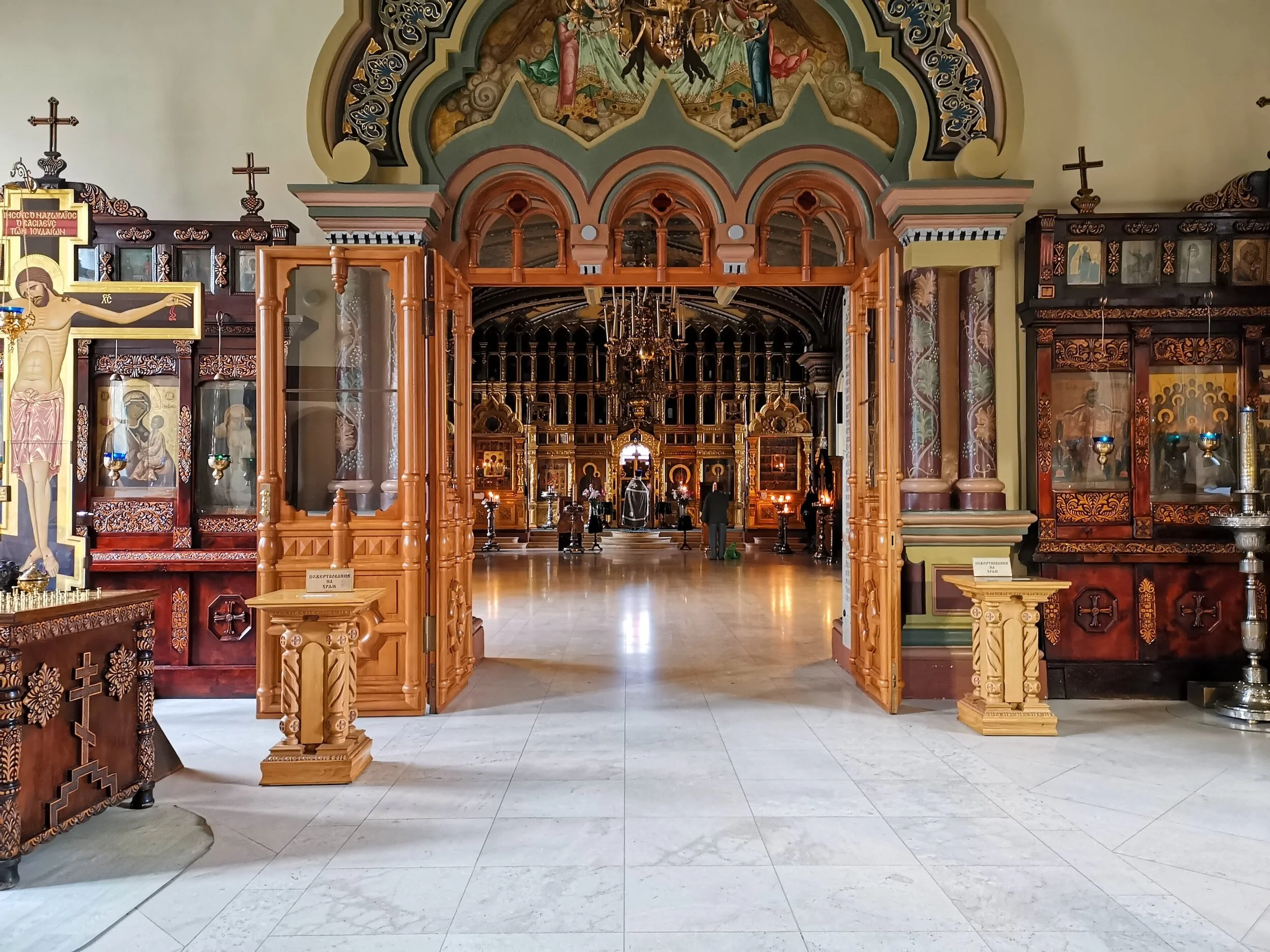
The Church-Related Opportunities of a Homeschooler
Every student–whether public schooled, private schooled, or homeschooled–has routines, priorities, and expectations. Attending a public or private school requires schedules and routines to fit the mold of their calendar and requirements, while homeschooling allows the space and flexibility to focus priorities on God, His Church, and family, while still fulfilling state requirements for homeschooling. Being a homeschooler has allowed me to participate in and experience the life of the Church in ways I otherwise would not have been a part of.
by Anya, Fall ’23 Intern
Every student–whether public schooled, private schooled, or homeschooled–has routines, priorities, and expectations. Attending a public or private school requires schedules and routines to fit the mold of their calendar and requirements, while homeschooling allows the space and flexibility to focus priorities on God, His Church, and family, while still fulfilling state requirements for homeschooling. Being a homeschooler has allowed me to participate in and experience the life of the Church in ways I otherwise would not have been a part of.
As a young teen, I began assisting our church secretary and my father in support of one of our parish ministries. Due to my father’s work schedule, keeping up with the bookkeeping and deposits for our men's ministry weekly collection was becoming increasingly difficult. So I began going into the church office once a week to prepare the funds to be deposited and to keep a ledger for that account. Not only was I able to help my father, but I was able to learn valuable bookkeeping skills. This weekly task gradually turned into helping out with multiple church ministries and administrative tasks, such as making service books, setting up filing systems, keeping inventory, and working for our church gift shop. I gained so much knowledge about office work, organization, and, most importantly, God’s Church. Eventually, I designated one day a week to spend the day at church working on these projects. Homeschooling provided me, and several other kids in my parish, wonderful opportunities and flexibility to volunteer at the church every week.
Our annual International Food Festival is our parish’s biggest fundraiser. Nearly everyone in the parish volunteers to support this event. While all parishioners, including teens, were involved in planning, preparing for, and running the festival, my opportunities were broader because of my flexibility. I have been able to handmake ethnic costumes, learn about the various cultures in our parish, assist with marketing, set up our technology needs, and share information about our faith and Church with visitors.
People often associate church with Sunday mornings only. In addition to Sunday morning liturgies, throughout the year, we celebrate many feasts on weekdays and hold vespers the evening before, along with the weekly molebens and vespers. Being homeschooled, I am blessed to be able to attend all these services to worship and learn about Christ and the Church through them. For example, my family can adjust our routine to attend the Lenten services during Great Lent and Holy Week. We can suspend our typical classes during Holy Week and focus on learning from the scripture and wisdom shared during the many weekly services. Nothing is more important than participating in the life of the church and incorporating it into everyday life.
Another great opportunity homeschoolers have is the ability to include Orthodoxy in their everyday studies. We have chances to make connections to the Church in all subjects. This is far from possible in a public school setting with their fixed, secular curriculums. I am part of an Orthodox homeschool co-op where I have taken classes such as Iconography, Bible & Saints, Hymns & Chants, and The Divine Liturgy, in addition to standard courses that are taught from an Orthodox perspective. All these classes still help me meet the state requirements for homeschooling.
I am very grateful for all the opportunities I have as a homeschooler that I wouldn’t have otherwise if I were schooled elsewhere. Do you want to get involved in the church, but don’t know of any ministries you can help with? No matter your age, chances are there is some way you can support your church. If you don’t think there are any opportunities, start something! Consider asking your priest what your parish's needs are. For example, are there enough girls in your parish to start a “Handmaidens” or “Myrrh-bearers” ministry in which the girls learn how to take care of the candles and clean the icons? Or could you and other young people help prepare for different aspects of Holy Week, like decorating the tomb, filling baskets of flower petals, helping pass out blessed items, etc.? Such a ministry could also incorporate educational and social components. For example, in addition to the activities already suggested, girls can get together for social events and learn a skill from an older woman in the parish or discuss a topic with and get advice from them. In addition to serving in the altar, they can help out in landscaping/outdoor work, or organize outdoor trips with the dads.
I strongly encourage any homeschooler to regularly become a part of their church, as the most important way to dedicate your time and effort is to give it to God. It is unfortunate that those unfamiliar with homeschooling often say that homeschoolers lack opportunities to socialize and be involved in “activities.” I would say that the unique opportunities available to homeschoolers are diverse, social, and focused on that which is most important in our lives. These opportunities help homeschoolers grow as students, citizens, and members of their church community.

Seven Myths about Homeschooling
Despite homeschooling’s meteoric rise in the past few years, many myths about homeschooling persist in mainstream thought. In some ways, perhaps the myths have only grown, as many families were introduced to a very particular, narrow version of schooling at home during the COVID-19 pandemic. In reality, homeschooling is a varied and multi-faceted little universe!
Whether you’re hesitant about homeschooling or are a homeschooler who isn’t sure how to respond to these myths, we hope that the following facts give you new insights to this beautiful journey!
by Mindi Popovich-Schneider, Saint Emmelia Ministries Assistant
Despite homeschooling’s meteoric rise in the past few years, many myths about homeschooling persist in mainstream thought. In some ways, perhaps the myths have only grown, as many families were introduced to a very particular, narrow version of schooling at home during the COVID-19 pandemic. In reality, homeschooling is a varied and multi-faceted little universe!
Whether you’re hesitant about homeschooling or are a homeschooler who isn’t sure how to respond to these myths, we hope that the following facts give you new insights to this beautiful journey!
Homeschoolers cannot succeed in college or in the workforce. By the numbers: Homeschoolers have an average standardized test score of 87th percentile, compared to public schoolers in the 50th percentile. 66.7% of homeschooled students graduate college, 10% higher than public school students. College students who were homeschooled earn higher first-year and fourth-year GPAs when controlling for demographic, pre-college, engagement, and first-term academic factors.
Homeschoolers are all socially awkward. While it is difficult to qualify what “socially awkward” means, 87% of peer-reviewed studies on social, emotional, and psychological development show homeschool students perform statistically significantly better than those in conventional schools. Additionally, homeschool students self-report a high level of comfort interacting with people from all age groups. Ask a librarian, museum docent, etc. their experiences working with homeschool students–they will almost certainly say that homeschoolers tend to be polite, well-behaved, and curious.
Homeschool parents are unqualified to teach their children. Parents’ education level statistically makes no impact on the success rates of their children. There are multiple factors that contribute to this: typically, homeschool parents are driven to provide their children with an excellent education, there are many wonderful curriculum options, and homeschool families know how to make use of the resources available to them!
Families homeschool so that they can brainwash their children. While it is true that many families homeschool so that they can cultivate their values in their children, that is rarely the only goal (and it is a very different goal from “brainwashing”!). In fact, the number one reason 80% of polled families homeschool is to protect their children from unsafe environments and negative peer pressure; for 61% it is to offer their children a higher quality education. Homeschooling is not a defensive reaction; it is a positive, proactive step; not an emergency, but rather a difficult, but treasured calling.
The only people who homeschool are rich, white, religious fundies. Homeschooling is far from homogenous. Not only do families homeschool according to a variety of methods and belief systems (everything from Classical Liberal Arts to Charlotte Mason to Montessori to Waldorf), but homeschooling families across the political and religious spectrums are choosing to homeschool. The vast majority of homeschoolers are lower middle class (which makes sense, considering most homeschool families are single income), and 17-26% of homeschool families are Hispanic, 6-8% are black, and 2-3% are AAPI, while 4-6% identified as other (29-41% of all homeschool families). This falls roughly along the lines of the national race demographics (59.3% white, 18.9% Latino, 12.6% black, 5.9% AAPI, 3.7% other).
Homeschooling hurts public schools. While homeschool families support the public schools via taxes, homeschoolers receive no tax breaks or special government support. When families choose to homeschool their children, they free up resources (especially teacher time and energy!) for other students. In fact, homeschooling saved taxpayers 51 billion in 2021-2022.
Homeschoolers miss out on extracurricular and other opportunities. 98% of homeschoolers participate in an average of 5 extracurricular activities per week. Additionally, not being tied to a traditional school day allows students to take part in internships, apprenticeships, and other skill-strengthening activities. The flexibility of homeschooling gives students an opportunity to explore a range of interests to figure out what they are passionate about.
Like any group of people, homeschoolers are not a monolith: their experiences, interests, and other traits run the gamut of every possible human experience, interest, and trait. The only thing that just about every homeschool family shares is that the recognition that the greatest responsibility for their children’s education rests on their shoulders. And what a joyful responsibility it is!
What are other myths you’ve heard about homeschooling? What truths did we miss? Let us know in the comments!
Resources:
https://brighterly.com/blog/homeschooling-statistics/
https://www.nheri.org/research-facts-on-homeschooling/
https://en.wikipedia.org/wiki/Race_and_ethnicity_in_the_United_States
https://admissionsly.com/homeschooling-statistics/; https://www.nheri.org/research-facts-on-homeschooling/

Reflections from a New Homeschooler, Part 2
I made the unusual switch from public school to homeschool for high school. Typically, many teens decide to do the vise-versa, wanting a “normal high school experience.” There seems to be this common belief that you can’t have a standard and exciting education when you’re homeschooled. I’m here to talk about why I switched and how such stereotypes terrified me at first.
by Caroline, Fall ‘23 Intern
Hello, I’m Caroline!
I made the unusual switch from public school to homeschool for high school. Typically, many teens decide to do the vise-versa, wanting a “normal high school experience.” There seems to be this common belief that you can’t have a standard and exciting education when you’re homeschooled. I’m here to talk about why I switched and how such stereotypes terrified me at first.
In 8th grade, I went to a public school where I was not having the best experience. I tried to convince myself that I was being overdramatic and that everything was fine, when in reality, it wasn’t. I was “in” with the popular group and quietly watched all of the bullying going on behind the scenes. If I dared to speak up, I’d be kicked out, becoming one of the loners. My morals were also completely different from everyone else, as I was one out of three Christians in my class. It was difficult to stand up for my beliefs when no one could agree to disagree.
The material my public school used also had an obvious agenda shoved into it. We couldn’t just learn without being slowly re-educated to fit into their scheme. Additionally, I was not allowed to take the classes that were right for me, all in the name of being “fair” and “equal”. In my English class, we never read full books–only articles summarizing them.
The stereotypes concerning homeschoolers turned me away from the idea of switching to homeschooling at first. My friends often made snarky comments that reinforced this fear into me even more. I was agitated by the thought of having no friends and being lonely. I also was concerned about losing my companions and needing to make new ones. I had no idea how someone would make friends with online schooling; it was a foreign concept to me. In addition, I thought I would have to give up my extracurriculars, like theatre and band. I loved band and acting; there was a sense of community, a shared passion for these activities.
All of these fears were based on inaccurate notions that were pushed on me. In reality, through homeschooling I have made so many amazing and supportive friends that will last for my lifetime. I’ve been able to meet many of my classmates in person and have formed inseparable bonds with them. I would have never been able to construct these friendships if I hadn’t left my old school. Online schooling has also opened up many new opportunities to try new things and work with more people. Since my schedule is flexible, I’ve been able to find new hobbies, such as playing guitar and cultivating sourdough. I’m also able to travel more often and sign up for more programs.
Homeschooling has given me the freedom to sign up for the classes I want, which wasn’t possible in my public school. I love science and math, and I’m finally able to take the harder classes that challenge me. I can also take courses that are more oriented to my interests, such as iconography and meteorology. Furthermore, homeschooling has allowed me to branch off from my previous friendships--which were often false and unhealthy--and form friendships with people who genuinely care. I’m a lot less shy and generally much happier.
Overall, the impact that homeschooling has had on me is indubitable and has brought me closer to God and the Church. I’m very grateful for all the experiences that it has bestowed upon me.

Reflections from a "New" Homeschooler
Two years ago, I made the decision to leave public school to pursue a classical homeschool education. This was a difficult, but ultimately extremely edifying process. I chose the online homeschooling route: taking classes with online Christian academies. I was very unsure of what to expect when I first began this journey, so I hope this article will offer some clarity and encouragement to those exploring homeschooling, specifically the online option. I will elaborate on the reasoning behind my switch to classical homeschooling, the Orthodox homeschool pedagogy, and its effect on my spiritual life.
by Cecilia, Fall ‘23 Intern
Two years ago, I made the decision to leave public school to pursue a classical homeschool education. This was a difficult, but ultimately extremely edifying process. I chose the online homeschooling route: taking classes with online Christian academies. I was very unsure of what to expect when I first began this journey, so I hope this article will offer some clarity and encouragement to those exploring homeschooling, specifically the online option. I will elaborate on the reasoning behind my switch to classical homeschooling, the Orthodox homeschool pedagogy, and its effect on my spiritual life.
Why I started homeschooling
In middle school, I was beginning to experience struggles with my public school’s curriculum, method of teaching, and atmosphere. The direction the school district was heading was alarming–to say the least– and I felt unable to continue being taught in such a secular and progressive manner. The teaching undeniably had an agenda, pushing ideas upon me that I did not agree with as an Orthodox Christian. I was beginning to realize that the aforementioned secular teaching was damaging my spiritual and academic health. I felt a sincere longing for an Orthodox–or at the very least, a Christian–perspective on school subjects, so I decided to completely change my style of schooling. My parents did not force me to make this switch; I decided personally. I am so blessed to have their support through this journey!
Beginning my freshman year in high school, I started online homeschooling, taking classes from two Orthodox schools: Saint Athanasius Academy and Saint Raphael School. I now take classes with Classical Learning Resource Center and Scholé Academy as well. I can earnestly say that this was a life-changing experience, and one I would recommend to anyone struggling with the public school system as I was.
Expectations vs. reality
There are many stereotypes concerning homeschoolers, which may unnerve anyone exploring homeschooling, but let me assure you that most are merely myths! I was extremely worried that I would become the homeschooled kid prototype: awkward, socially unaware, and improperly educated. In reality, I have noticed that homeschoolers are often the opposite of these stereotypes, particularly concerning the notion that they are improperly educated. If anything, homeschoolers explore more subjects and topics than possible in a public school. To address the “socially unaware” misconception, I have found that homeschoolers can pick up a conversation with just about anyone due to their education in so many varying subjects.
In addition to the stereotypes, the prospect of isolation concerned me as well, as I was worried that I would have no community or friendships. In reality, I entered into a much healthier and faithful community when I started homeschooling. I have been able to interact with peers from Saint Emmelia Ministries, my classes, and online school clubs. I have met so many inspiring people and feel very connected, having ample opportunities to socialize, both online and in-person.
Orthodox homeschool pedagogy
The curriculum of my classes has been extremely edifying and nourishing, as we study classical literature and the liberal arts in addition to the standard subjects. In class, we have interactive discussions and debates, leading to more thorough comprehension of subjects. Oftentimes, my public school taught topics in correspondence to what would be on the standardized assessments, which led to my simply memorizing things for a test. On the contrary, in my classical online classes, I have found myself genuinely soaking in knowledge and being able to retain information.
The teachers in these online classical academies educate their students in a manner that allows for the expressing of opinions and points of view. They teach them how to think, not what to think; there is no agenda.
Additionally, homeschooling (particularly through online classes) allows for a smoother transition from high school to college, if one should choose this path after graduating. The schedule I now have is effectively a college schedule, with classes generally running twice a week. Homeschooling calls one to learn time management and take accountability of one’s own homework schedule, which are both vital skills in college.
Spiritual life
The flexibility of my schedule has allowed me to be more actively involved in the Church’s feast days and lenten services, which was something very difficult to do when I was public-schooled. Moreover, my teachers’ and classmates’ zeal for the faith has been very inspiring and formative. I am so blessed to receive an Orthodox Christian foundation in my learning! In every class, we start and end with a prayer, which may seem insignificant, but makes a substantial difference in our learning. It allows our minds to acknowledge and concentrate on the reason behind learning: to grow in the knowledge of God’s creation, beauty, and greatness. Orthodox online academies also offer Catechism classes, which have increased my knowledge of the Saints, Church history, and Orthodox theology.
The atmosphere of an Orthodox homeschool classroom is very spiritually nourishing, as the students are taught to glorify God in all things; this has prompted me to genuinely see God in every subject.
Switching from public school to online classical homeschooling has been a transformative experience. Learning and discussing every subject with Orthodox Christianity at its base has truly reshaped my perspective on the world, the arts, and my faith.

Why Do We Homeschool? Part 2
In the Prologue of Ochrid, St. Nikolai tells a story of a monk talking to St. Arsenius about reading the Holy Scriptures. If you want to read the whole story, you can find it in the reflections for May 8th. The exhortation given by St. Arsenius to the monk is to “just read.”
The centrality of our educational philosophy parallels the ethos of this same idea. While the exchange centered on the power of scriptures despite our lack of understanding, it has a similar mechanical process to the way we learn in general. We put in the work, and the results will come.
by Cornelia Oprea
My child, just read!
In the Prologue of Ochrid, St. Nikolai tells a story of a monk talking to St. Arsenius about reading the Holy Scriptures. If you want to read the whole story, you can find it in the reflections for May 8th. The exhortation given by St. Arsenius to the monk is to “just read.”
The centrality of our educational philosophy parallels the ethos of this same idea. While the exchange centered on the power of scriptures despite our lack of understanding, it has a similar mechanical process to the way we learn in general. We put in the work, and the results will come.
“Commit thy works unto the LORD, and thy thoughts shall be established.” (Proverbs 16:3)
Reading well-written books works as the seeds in the Parable of the Sower. They are the seeds we sow with a proleptic view of our children as grown servants of God. As such, their academic performance is not dependent on a benchmark imposed by a restrictive set of skills arbitrarily delineated, but a thorough guidance to a way of thinking and behaving that is aligned with the will of God.
Our homeschooling is not tied to a room at home, or a set of materials per se. We take our books with us no matter where we are, and we explore libraries or bookstores that we discover along the way. Our boys equally learn from museums, interactions with people we encounter along the way, hikes where we explore God’s creation. These habits we maintain whether we are home or traveling.
One of the most beautiful parts of the path we are on is that we can learn through discovery. And what could be more beautiful to discover than Orthodox communities across the United States. As part of our logistical travel planning, we look up churches that we can attend. I send out a quick email to the priest letting him know who we are and when we would like to attend. More importantly, we let him know if we are prepared to receive communion or not. Most of the time, we have a few options to choose from, and we tend to pick parishes that have services in English.
This has been the most humbling part of our adventures: while in different jurisdictions, with many or few parishioners, multiple priests or traveling priests, every single parish we have visited, every community we have encountered, received us with open arms and showed us beautiful hospitality.
Lessons learned, for now
Besides the inevitable lesson of learning to trust God, the biggest lesson we have learned is that our sins follow us no matter where we are.
We struggle with our prayer rule at home, we do so on the road as well. We struggle fasting, we do so on the road also.
But as we move towards salvation with any struggle, any fall is just an opportunity to rise and try again. So I will share with you a few safeguards we have put in to help with said falling.
God loves order, and so do I
Most that know me know that I live by my handy-dandy notebook, with my lists and schedules. And here we are, uprooted from routine, never knowing from one day to another what will follow. For a while, I had to fight the temptation to give in. Traveling can be chaotic. At home, we have our prayer corner and the habit of starting and ending the day congregating by our icon corner. Traveling, our established routines get removed, and we are faced with forcing the will. Thank God for technology! A friend taught me to set an alarm. So, we do. If my husband is traveling by himself, we facetime and say our prayers together, which also helps him stay grounded.
Fasting on the road is another challenge. Living on a steady diet of gas station food, while appealing on vacations, loses its appeal when you spend a significant amount of time on the road. We do not have an eiconomia from fasting, and while it took us a while to understand why not, the solution was simple. We prepare our meals and instead of grabbing whatever from wherever, we eat our hummus sandwiches and survive to say “thank God for another beautiful day!”
Overall, the solution to a balance between the chaos of the unknown and the order of obedience is flexibility. I still plan our days in 30-minute intervals, and while our home routine allows me to have a printed schedule with color coded intervals, on the road, I can adjust those 30 minutes to allow us to stop and enjoy the view and God’s creation. When you reach the peak after an intense hike, and you stop and look into the vastness of the horizon, the beauty of His love overwhelms you not just in a spiritual sense, but in a palpable, physical sense. Such a sense of joy I have only felt in one other instance: in those rare moments when you are not just attending, but where you live the liturgy in the presence of our brothers and sisters in Christ and of all the Saints.
Abraham never went back to Ur
As Abraham never once looked back on all the comforts of living in the greatest city of his time, we hope to allow our children to never look back at their childhood without a sense of having grown up in a family of sinners that traveled to adjust themselves to a continual search for Christ.
To Him be the Glory!