


5 Saint Emmelia Resources You Might Not Know About
Since you’re reading this, you probably know something about our work at Saint Emmelia Ministries, whether it’s our conferences, online discussion groups, or the Saint Macrina Lecture Series. But here are five more resources you might not know about!
by Mindi Popovich-Schneider, Saint Emmelia Ministries Assistant
Since you’re reading this, you probably know something about our work at Saint Emmelia Ministries, whether it’s our conferences, online discussion groups, or the Saint Macrina Lecture Series. But here are five more resources you might not know about!
Our Spiritual Advisors. This board is made up of one priest from each Antiochian archdiocese, as well as a ROCOR and OCA priest (don’t worry, we’re working on the rest of the jurisdictions too). These wonderful priests are knowledgable about homeschooling and are available to help you connect with families and resources in your archdiocese/area.
Hymn Study. I see a LOT of parents asking how to make Ambleside Online’s music study fit better with our faith. Of course, we’ve got you covered! This offers a list of suggested hymns (sheet music included) to study throughout the course of the school year.
An Orthodox Morning Basket. Another question I see a lot, especially from families who are new to Orthodoxy, is how to incorporate the Faith into the school day. Using the Charlotte Mason concept of “the morning basket,” this guide offers many different suggestions so that you can choose what fits your family’s specific needs!
Scholarships/Grants. By God’s grace and the generosity of donors, we’re so blessed to be able to offer scholarships. The Saint Basil Scholarship is specifically for clergy families to use at St. Raphael School or Classical Learning Resource Center (St. Athanasius already has one set up from the same funding source). The Saint Theosebia Scholarship is open to any homeschool family for any education-related need. The Homeschool Co-Op Grant supports any Orthodox co-op and can be used for a wide variety of needs. Finally, the St. Gregory Merit Scholarship is awarded to one high school senior each year, though all applicants receive a certificate and commencement tassel.
Book Recommendations. Our book lists are extensive and constantly being updated! Make sure to check them out to get ideas for your or your kids’ next read!
We have so much more to offer than this, including some things that will be launched very soon! (Hint: it has to do with co-ops!) But we want to hear from you: what resources do YOU need the most?
The Six Areas of Early Literacy
Something you might not know about me (or maybe you already do know this, and you’re about to be like, “please, Mindi, enough already!”) is that I used to be a Children’s Librarian. One major aspect of my job was planning storytimes, which meant thinking a lot about pre-literacy skills and teaching parents how to help their children hone these skills. So today, I’m going to talk about the six areas of early literacy and ways that you can strengthen your child’s skills in these areas, specifically by engaging with our Faith!
by Mindi Popovich-Schneider, Saint Emmelia Ministries Assistant
Something you might not know about me (or maybe you already do know this, and you’re about to be like, “please, Mindi, enough already!”) is that I used to be a Children’s Librarian. One major aspect of my job was planning storytimes, which meant thinking a lot about pre-literacy skills and teaching parents how to help their children hone these skills. So today, I’m going to talk about the six areas of early literacy and ways that you can strengthen your child’s skills in these areas, specifically by engaging with our Faith!
The first area is vocabulary. Children ages newborn to four should hear between 17,000-21,000 words per day. Research shows that children who hear substantially fewer words than this tend to struggle in the first few years of school. Now, since we’re all hanging out on the Saint Emmelia Ministries website, I would hazard a guess that not a lot of us put much stock into public education’s metrics for success. Still, I think the message is clear: words matter! Reading (naturally!), narrating what you’re doing, and asking open-ended questions and modeling a response–all these things can increase the number of words your child hears per day.
Fortunately, being Orthodox puts us at an advantage: take your child to any service, and they will hear between 25% and 40% of those words. Add in morning, evening, and mealtime prayers, and you’re zooming towards that goal! On top of all of that, you’re automatically introducing them to lovely, delightful words that most kids don’t have the opportunity to encounter.
Singing is incredibly important for developing literacy skills. When we sing, we draw out our syllables naturally. Children then can hear the individual sounds and understand that words are broken up into smaller parts. This understanding is called “phonological awareness,” which later helps children sound out words while reading.
Here again, because music is such an important part of our faith, Orthodoxy comes in handy! Sing hymns with your kids throughout the day, and they’ll DEFINITELY be hearing all those phonemes (“aaaaaaaaa-leeeeeeeeee-luuuuuuuuuu-iaaaaaaaa”)!When you’re out and about–talking walks, going to the grocery store, etc.–you probably talk to your little ones about what you see (personally, puppy doggies and “cycs”–motorcycles–are a BIG topic of discussion any time we leave the house!). Do you ever pause and talk to your kids about signs or logos? Well, that is one incredibly easy way to help develop print awareness, the understanding that letters and numbers have meaning. When reading books with your children, point out specific words, especially if those words are in a font that stands out from the others. Books with very few words are also great for developing this skill because it makes it easier for kids to connect an isolated symbol with its meaning.
When you’re looking at icons, be sure to point out the writing. Explain that the writing is the saint’s name. Show them the text on the scrolls and explain that it’s something that particular saint said.
Move over, geometry: shapes are important for reading too! After all, what are letters but shapes combined in different ways? Shape-sorting games are a great foundation for learning to write letters. As you play, talk about the similarities and differences in shapes. When you’re out and about, identify the different shapes you see. All of this helps build letter knowledge, the ability to distinguish between and identify letters.
Thank goodness that Orthodoxy is so tactile! As you look at all the objects around you in your home or at church, talk about the shapes they are made up of. Use your child’s fingers to trace the length of a candle or the roundness of the antidoron.
If your family is anything like mine, you’ve probably had to read one or two books over and over and over and over. While you might be reciting Goodnight, Moon in your sleep, this repetition is actually incredibly important for kids because it strengthens their narrative skills, or the ability to understand stories. When a child hears a story over and over, they begin to recall what happens next, unconsciously absorbing an ordered sequence of events.
Playing pretend–even something as basic as pretending that a blanket is a priest’s robe–can help strengthen narrative skills because it helps kids think symbolically. Playing “Liturgy” can also help kids strengthen their understanding of sequence. As your kids gain more speech, have them narrate to you what you’re doing as you prepare to say prayers (or as you watch liturgy from the Narthex!)
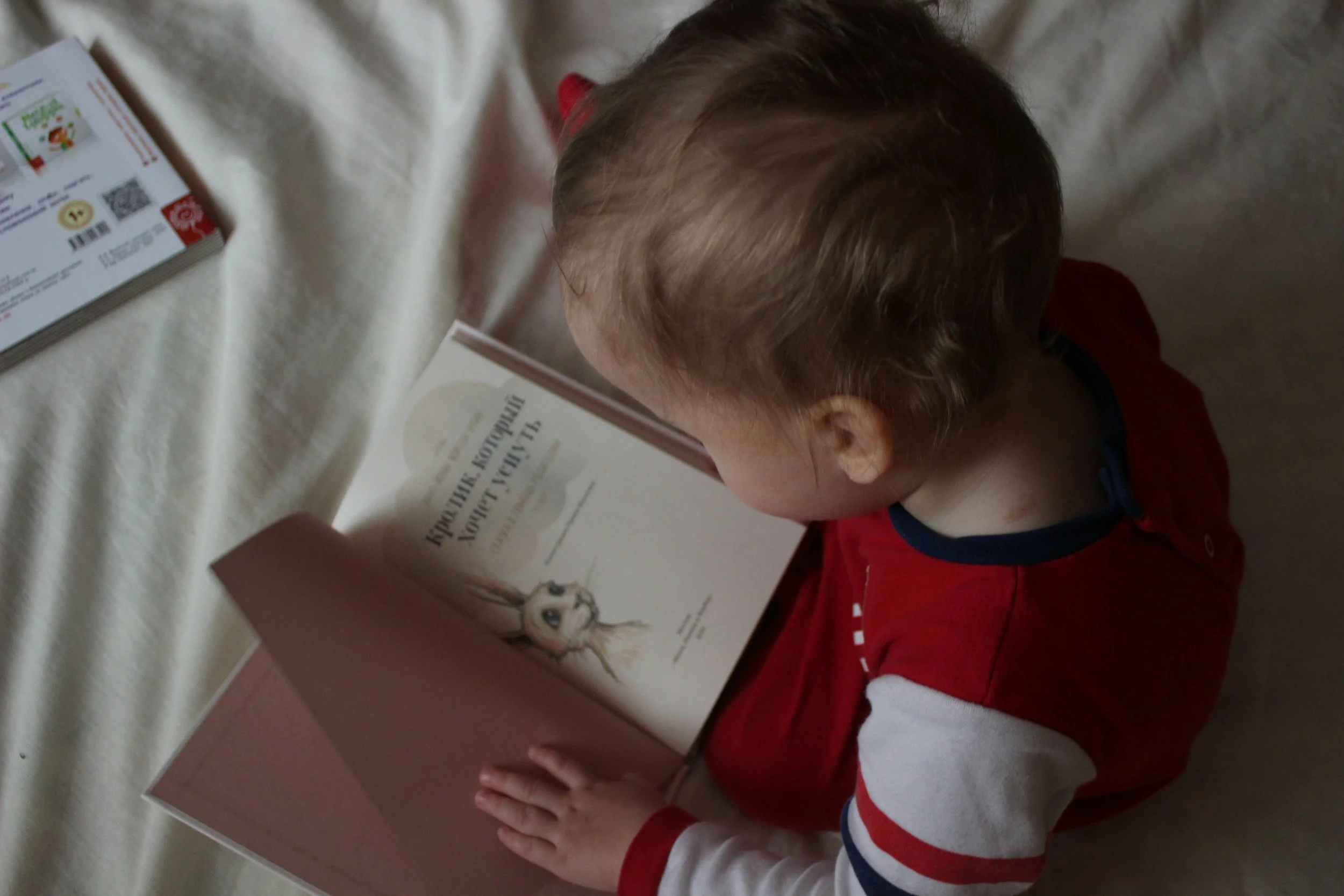
The best literacy area (in my opinion) is print motivation, or a child’s interest in and enjoyment of books. For very young children, this means allowing them to explore books in their own way: going backwards and forwards as they wish, lingering over pictures, skipping pages or reading them over and over, and even chewing on pages! At any age, being snuggled up together creates an association between reading and feeling loved.
Reading books about Orthodoxy can be motivating because they have an immediate connection to your child’s life. When kids recognize something in a book–perhaps a priest’s robe or a specific icon–they are more likely to want to engage with the book and find out what is going on in the pictures.
One of my biggest takeaways from my time in libraries is that almost everything we do contributes to early literacy in one way or another. You can make these activities extra rich by engaging with your kids through questions and making connections to the six different areas of literacy. And of course, as with everything in life, the best place for growth is in the beauty and love of the Church!
Why We (Actually) Homeschool
A few months ago, I wrote about common homeschooling myths. Now, I want to talk about the homeschooling reality, specifically, why we really homeschool.
by Mindi Popovich-Schneider, Saint Emmelia Ministries Assistant
A few months ago, I wrote about common homeschooling myths. Now, I want to talk about the homeschooling reality, specifically, why we really homeschool.
It’s true that there are a lot of negative reasons–that is, things that we are trying to get away from–but all too often, the positive reasons get overlooked. And that is really a travesty, because these positives are the heart and soul of homeschooling. We’re not running away from other people, diverse opinions, or behaviors that we dislike; we’re actually running towards something. So, here are some positive reasons why we homeschool:
To spend time together: Because we believe that each child is a beautiful being created by God, we genuinely want to spend time with our children and enjoy the things that make them them. We believe that God granted us children as the most important work of our lives. Accordingly, we want to embrace this work as fully as we can, and we can only do that when we are deeply involved in their educations.
To transmit a belief system: This is a myth that does have a kernel of truth in it; it’s just become distorted and popularized as a desire to indoctrinate our kids. In the Garden of Eden, God did not create mindless automatons, but rather reasoning beings who could choose to love Him and know Him. He gave them a solid foundation–clear, explicit rules–and free will to do with that foundation what they would. Just so, we do not want our children to be mindless automatons who never question or think for themselves, but we do want to give them a firm foundation that they may rest upon when it is time for them to exercise their free will. So we keep them protected in a nurturing environment until the foundation is laid and the time for choice has come.
To let kids be kids: In the time that it takes to carefully and intentionally lay a strong foundation for our kids, they get to be kids. All too often, the world forces children to grow up quickly in order to keep up with their peers, whether through inappropriate media, bullying, or other developmentally-unsafe behaviors. Homeschooled kids are allowed to mature and develop at their own pace–not an arrested pace, but simply the timing that is natural to who they are as individual beings. Children can play pretend in the backyard as long as it captures their imagination, or they can start reading Shakespeare the moment his beautiful words catch their hearts without being dragged away from either by their peers or teachers.
To explore anything (and everything): Not only does homeschooling allow children to grow up at their individual pace, but it also allows them to explore different ideas according to their individual interests. When I was a student, I was fascinated by missions work, so my history reading always included biographies of (usually female) missionaries. My husband was enamored of space, so his science reading usually involved at least one book about the cosmos. Now, as adults, I work for a church ministry, and my husband delights in showing our friends’ children how to use the telescope in our living room. Our (wildly different) homeschool educations nurtured these seeds into sweet fruit that we enjoy over and over, in many different ways.
To make room for wonder: All of this exploration gives homeschool families a unique opportunity to approach discovery with intentionality: to learn deeply what a thing is and to marvel at its “whatness”. Whether it is the lives of the saints, the transcendence of a Divine Liturgy, the mystery of a forest, or the joy of a good book, homeschooling gives us the freedom to see what makes things good, and to thank God for them. In my experience, the grind of public school–its busy schedules, standardized testing, and watered-down curriculum–has no interest in wonder, and it is the worse for it.
Taking these reasons together, I would say that the heart of homeschooling is this: a desire to cultivate Beauty in our children’s lives. In fact, I would argue that because of our relationship with God, it is not so much a desire, but an imperative. Because God is the Creator of Beauty, when we teach our children to love Beautiful things and to seek them out, we are teaching them to listen for the things of God and to marvel at His hand in all of Creation.
So while it’s true that we do want to remove unhealthy things from our kids’ lives–nihilism, ugly words and behavior–what’s more important is that we want to fill their lives with good things. We’re not running away or hiding from anything; rather, we are running joyfully towards the Beauty of our Creator.
Why does your family homeschool?

Seven Myths about Homeschooling
Despite homeschooling’s meteoric rise in the past few years, many myths about homeschooling persist in mainstream thought. In some ways, perhaps the myths have only grown, as many families were introduced to a very particular, narrow version of schooling at home during the COVID-19 pandemic. In reality, homeschooling is a varied and multi-faceted little universe!
Whether you’re hesitant about homeschooling or are a homeschooler who isn’t sure how to respond to these myths, we hope that the following facts give you new insights to this beautiful journey!
by Mindi Popovich-Schneider, Saint Emmelia Ministries Assistant
Despite homeschooling’s meteoric rise in the past few years, many myths about homeschooling persist in mainstream thought. In some ways, perhaps the myths have only grown, as many families were introduced to a very particular, narrow version of schooling at home during the COVID-19 pandemic. In reality, homeschooling is a varied and multi-faceted little universe!
Whether you’re hesitant about homeschooling or are a homeschooler who isn’t sure how to respond to these myths, we hope that the following facts give you new insights to this beautiful journey!
Homeschoolers cannot succeed in college or in the workforce. By the numbers: Homeschoolers have an average standardized test score of 87th percentile, compared to public schoolers in the 50th percentile. 66.7% of homeschooled students graduate college, 10% higher than public school students. College students who were homeschooled earn higher first-year and fourth-year GPAs when controlling for demographic, pre-college, engagement, and first-term academic factors.
Homeschoolers are all socially awkward. While it is difficult to qualify what “socially awkward” means, 87% of peer-reviewed studies on social, emotional, and psychological development show homeschool students perform statistically significantly better than those in conventional schools. Additionally, homeschool students self-report a high level of comfort interacting with people from all age groups. Ask a librarian, museum docent, etc. their experiences working with homeschool students–they will almost certainly say that homeschoolers tend to be polite, well-behaved, and curious.
Homeschool parents are unqualified to teach their children. Parents’ education level statistically makes no impact on the success rates of their children. There are multiple factors that contribute to this: typically, homeschool parents are driven to provide their children with an excellent education, there are many wonderful curriculum options, and homeschool families know how to make use of the resources available to them!
Families homeschool so that they can brainwash their children. While it is true that many families homeschool so that they can cultivate their values in their children, that is rarely the only goal (and it is a very different goal from “brainwashing”!). In fact, the number one reason 80% of polled families homeschool is to protect their children from unsafe environments and negative peer pressure; for 61% it is to offer their children a higher quality education. Homeschooling is not a defensive reaction; it is a positive, proactive step; not an emergency, but rather a difficult, but treasured calling.
The only people who homeschool are rich, white, religious fundies. Homeschooling is far from homogenous. Not only do families homeschool according to a variety of methods and belief systems (everything from Classical Liberal Arts to Charlotte Mason to Montessori to Waldorf), but homeschooling families across the political and religious spectrums are choosing to homeschool. The vast majority of homeschoolers are lower middle class (which makes sense, considering most homeschool families are single income), and 17-26% of homeschool families are Hispanic, 6-8% are black, and 2-3% are AAPI, while 4-6% identified as other (29-41% of all homeschool families). This falls roughly along the lines of the national race demographics (59.3% white, 18.9% Latino, 12.6% black, 5.9% AAPI, 3.7% other).
Homeschooling hurts public schools. While homeschool families support the public schools via taxes, homeschoolers receive no tax breaks or special government support. When families choose to homeschool their children, they free up resources (especially teacher time and energy!) for other students. In fact, homeschooling saved taxpayers 51 billion in 2021-2022.
Homeschoolers miss out on extracurricular and other opportunities. 98% of homeschoolers participate in an average of 5 extracurricular activities per week. Additionally, not being tied to a traditional school day allows students to take part in internships, apprenticeships, and other skill-strengthening activities. The flexibility of homeschooling gives students an opportunity to explore a range of interests to figure out what they are passionate about.
Like any group of people, homeschoolers are not a monolith: their experiences, interests, and other traits run the gamut of every possible human experience, interest, and trait. The only thing that just about every homeschool family shares is that the recognition that the greatest responsibility for their children’s education rests on their shoulders. And what a joyful responsibility it is!
What are other myths you’ve heard about homeschooling? What truths did we miss? Let us know in the comments!
Resources:
https://brighterly.com/blog/homeschooling-statistics/
https://www.nheri.org/research-facts-on-homeschooling/
https://en.wikipedia.org/wiki/Race_and_ethnicity_in_the_United_States
https://admissionsly.com/homeschooling-statistics/; https://www.nheri.org/research-facts-on-homeschooling/
Why Are Many Orthodox Families Turning Towards Homeschooling?
Why are many Orthodox families turning towards homeschooling their children?
As the Director of an online school for homeschooling families, I talk with many parents of homeschoolers, and I also work directly with their children, so I have a unique window into the lives of these families.
It’s important to recognize that families across the nation and the world choose homeschooling for a multitude of reasons.
by Adam Lockridge
Note: this post was originally published on oca.net.
Why are many Orthodox families turning towards homeschooling their children?
As the Director of an online school for homeschooling families, I talk with many parents of homeschoolers, and I also work directly with their children, so I have a unique window into the lives of these families.
It’s important to recognize that families across the nation and the world choose homeschooling for a multitude of reasons.
Military families that regularly move may desire more consistency in their children’s schooling, and homeschooling offers an attractive way to stabilize their educational program.
Parents with children who have special needs often find that school districts simply can’t or won’t accommodate their unique needs.
Children who are gifted in a particular way–musically, academically, artistically, or athletically–may need a more flexible educational schedule in order to advance to their highest potential.
Some schools are unsafe of feel threatening to the child. Students who can’t escape a threatening situation at school, such as bullying, may find escape by learning in the peace and quiet of their own home.
Religious families–and this is an increasingly common reason–often feel that the public schools have broken their trust by training their children in ways that overtly contradict the core values of the family.
There are probably some homeschool families who reject the idea of institutionalized schooling altogether, but I’ve never heard that cited as a reason to homeschool. The common denominator in the homeschooling movement, as I see it, seems to be a highly responsible, independent, do-it-yourself attitude. Abuses exists, as they do in schools. The overwhelming majority of families, however, seek customization, choice, and quality which can only be obtained by setting upon the task themselves. Most do not see this arrangement as ideal, but it is often the only acceptable choice that families have available.
As an Orthodox school, you probably see many families who are choosing homeschooling for religious reasons. Can you tell me more about what motivates them in particular?
I do hear from many Orthodox families who feel that public schools are no longer a viable option. Although I can’t speak for all of them, I do observe patterns.
From the perspective of many religious families, public schools have become functionally atheistic. While parents may not use this language to describe their dilemma, I think the phrase gives a name to a specific and widespread concern. Schools may not openly advocate for atheism as a philosophy (although many do exactly that), but it is undeniable that the adults who spend the most time with our children–teachers, coaches, and other school faculty–engage in a systematic omission by neglecting the everyday spiritual and moral needs of children. Under the banner of inclusiveness and pluralism, this unbreakable code of silence in moral and spiritual matters amounts to child neglect in the core facets of their being.
Children learn by imitation. In public schools, students daily observe and imitate adults who are required by the state to act as if God does not exist. Public school teachers may “love” children with a kind of natural affection, but functionally they are forced to neglect them. Teachers and faculty must refrain from prayer, eliminate all displays of religious piety, and strictly avoid advocating moral or spiritual principles. This is particularly unacceptable in the humanities, such as history and literature, but this functional atheism extends into science, art, music, and even athletics.
Children spend vast amounts of time at school. Longer school hours, demanding extracurricular activities, huge homework loads, and the looming threat of competitive college admissions, have conspired to pressure parents to relinquish opportunities to meet the spiritual and moral needs of their own children.
The overextension on the part of schools, combined with pervasive functional atheism, forces many religious families, including Orthodox Christians, to opt out of the system entirely.
What do parents need to homeschool their children?
The resources available for homeschooling are vast, and parents will find no lack of options for creating a plan that works for their kids. Free online resources abound, and many high quality products–online courses, curricula, and books–can be purchased at a tiny fraction of the price of private school.
The largest obstacle for most families is making choices within the vast arena of options. Connecting with other families who are homeschooling through friendships, churches, and co-ops can be an important source of experience and encouragement.
Finally, it is worth noting that parents do not need to be experts on any given subject to successfully homeschool. Any skillful and experienced teacher will tell you that the most important skill in teaching is relational rather than intellectual. Getting to know your child and intentionally cultivating a good relationship with him or her is the only required discipline of a homeschool parent. Fortunately, on the job training will happen naturally with the attentive and engaged adult.
Are kids isolated when they aren’t in public school?
I speak with homeschooling students every day, and I am constantly amazed at their ability to engage in thoughtful discussions and interact with one another and adults. I’ve taught in school environments, and by and large the students were far less mature and socially adjusted.
One reason for this, I believe, is that homeschool students often spend significantly more time with a wider variety of relationships. They learn not only how to be peers, but also how to interact with children of other ages; they constantly speak one-on-one with adults (impossible for teachers with twenty, or thirty, or even more students); and they face fewer pressures to conform to passing fads and fashions.
Isolation can happen in a crowd probably more easily than in a smaller group of family and friends. In this respect I would say that social isolation could possibly be a bigger problem in the crowded public schools than in the more personal and intimate society of family and friends found in homeschools across the country.
Are homeschooling students successful?
The most well-documented fact, and the one most often ignored, is that homeschooling students perform significantly better than their public school peers in academics, including standardized testing. But performance and perceived performance are not the same thing. Some schools and even employers look with skepticism on a homeschool diploma. As homeschooling becomes more widely accepted and understood, the risk of being denied opportunities as a result of homeschooling has faded, and now homeschooled students are sometimes preferred to their public school counterparts.
But academic metrics miss the most important motivator for many homeschooling families. Families who choose to homeschool almost always have a different measure of success than economic incentives such as college admissions and career advancement. Success for these families would include practical concerns such as getting a good job, but they would also consider less objective but equally important emotional, moral, and spiritual measures of success. On this level, it is not even possible to compare the success of public school and homeschooling as they differ in their aims.
Are there any drawbacks or common pitfalls of homeschooling?
The most common drawback, which is true of any counter-cultural do-it-yourself option, is an inevitable periodic crisis of confidence that homeschool parents face–mothers in particular. Many of us who were raised in a different educational system face worries that we will fail. This desire to succeed is a healthy concern, but it needs to be managed by frequent intentional reminders of the motivation for homeschooling and a balanced perspective on expected outcomes. This long view of homeschooling is difficult to maintain, but it is absolutely essential.
Another drawback is the financial sacrifice. Most homeschooling families must be or become single-income families, as one parent must stay at home and teach the children. States offer huge incentives to enroll in public schools by funding tuition through taxes, so families are also leaving on the table a monetary value of sometimes $10,000 or even $15,000 per year in schooling expenses. This economic loss could total hundreds of thousands of dollars over the life of the family, and this is a price many families are unable or unwilling to pay.
One common mistake I see homeschooling families make is modeling their homeschool on the curriculum of the public school system. The public school is structured to treat all students the same, which means that variety and customization are impossible in most cases. It is the “fast-food” schooling option. Homeschool families have an opportunity to create a beautiful, homemade, and fully customized curriculum, but they often resort to trying to replicate what is being done in the local public schools. Families who do this are still likely better off than their peers in public schools, but this pitfall is a lost opportunity for more.
What is the most common fear of families who are considering homeschooling as an option?
The fear of failure. When it comes to children, none of us feel like we can afford to fail.
I try to remind parents that the joy of homeschooling comes through learning alongside the students. The best teachers are the ones who always want to know more about the topic or improve their own skill. As a parent, your kids will learn by watching you. Be curious. Be attentive. Show reverence for classic literature and revel in the beauty of the natural world. If you do so in sincerity of heart and not in a spirit of control or manipulation, your love of learning will be contagious, and your kids will begin to feel that inner compulsion to learn all that they can about God’s glorious world. This makes learning not only easy, but it becomes a natural by-product of a healthy sense of wonder and a confidence that understanding is the true reward of sustained independent learning.