Exodus Lesson Plan: Art Study
by Kristin Edwards
The Antiochian Archdiocese theme for 2025-2026 youth activities is The Book of Exodus. We’ve developed a series of lesson plans that explores that theme through a different discipline.
In this lesson, we will be looking at various visual depictions of Moses, both in the setting of a sacred space and outside of the church building. We will begin with one of the earliest extant images and move forward chronologically. Watch as the images change visually and in purpose. This lesson is inspired by the Charlotte Mason picture study method. These images should be sufficient for a month or more, using one at a time that can be repeatedly referred to over the course of several days to several weeks. For each image, use the following steps:
Print off a high quality reproduction.
Give to the student to silently examine for at least two minutes. (Ask the children to be as detailed as possible in their observations. Try to memorize the image, so you’re able to see it in your mind’s eye).
Turn over the reproduction and ask your child to make as many observations as possible without looking at the image. With multiple children, children can take turns making one observation at a time. Adults should participate, too!
Each image has a short informative paragraph (below) that you may want to share with your child as part of your observation discussion. Make sure to ask about what the image might remind your children of. Ask about any connections that they can make to something else they have studied, read, heard, or seen. How does it connect to the biblical story depicted? What details are included and/or excluded? What might be the reasons?
Hang the reproduction up in a visible spot to look at repeatedly for the remainder of the month or quarter or semester. You might notice something new every time you look at it!
Image 1: Moses found in the Nile River. From the Dura Europos synagogue. (ca. 244-255), now reinstalled in Damascus Museum
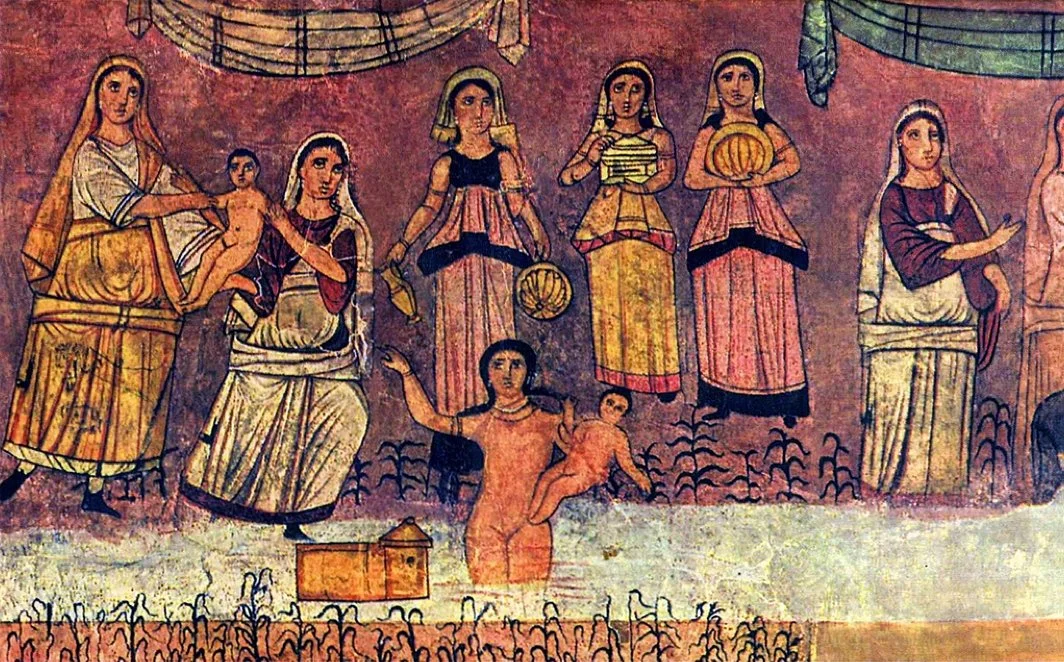
This fresco is part of a series, which covers the interior walls of the Dura Europos Synagogue. The city of Dura Europos (modern-day Syria) was hidden and well-preserved for almost two thousand years under a blanket of sand. Beautiful images cover the walls and make up an entire narrative of the life of Moses. On the lower register at the eye-level of a child, additional frescoes delight the viewer. Dura Europos also was home to an early Christian “house church” baptistry whose walls were covered in images. (These are also worth checking out!) The discovery of this buried city in the 1920s was paramount to the study of sacred images and their use in worship. The narrative scenes demonstrate that visual decoration in sacred spaces was used much earlier than scholars (and iconoclasts) had originally thought. People were to gaze at the images during prayer, as well as learn and memorize the narrative. Notice how the image of Moses shows the movement of Moses from the basket in the water to the bank. There is also a striking resemblance between the traditional imagery of Aphrodite and the form of the Egyptian princess, making a clear statement about the (sacred) nature of these images. The curtains above divided scenes, but also were symbolically significant in the ancient world as delineators of sacred space.
Image 2: Moses and the Burning Bush. St. Catherine’s Monastery Mosaic. (6th Century), Mt. Siani, Egypt.
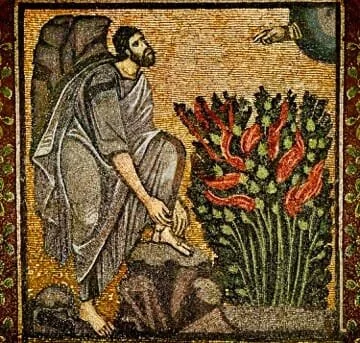
This mosaic of Moses removing his sandals at the burning bush is found at St. Catherine’s Monastery. It is above the eastern apse of the monastery’s Great Basilica. Moses and the burning bush is a prominent theme of the monastery’s visual program for obvious reasons – the monastery is located on the holy ground at the base of Mt. Sinai itself. This image is also an early one, meant to be a part of liturgical life. Like many of the other icons and mosaics at the monastery, the Muslim occupation of the region during iconoclasm preserved it from destruction. Its survival left an example of early Christian iconography for later generations. Notice the thousands of tesserae of many colors that were used to create the image. The folds of Moses’s garments are magnificently executed. The tongues of fire in the burning bush are, indeed, strikingly similar to tongues of fire that we see in images of Pentecost. Why? What are you reminded of when you see this image? How is this similar to the sacred images / icons in our own churches?
Image 3: Moses Parting the Red Sea. Illumination in the Paris Psalter. (ca. 950-970), in the Bibliothèque Nationale de France, Paris.
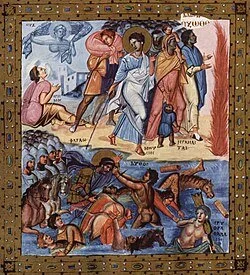
Versus a large-scale church decoration, this image is part of an illuminated manuscript called the Paris Psalter. It takes sacred images outside the church building and puts them in private hands. This psalter was made during the Macedonian Renaissance after iconoclasm had ended and is considered one of the most lavish examples of Byzantine illumination. The psalter does not have an inscription to indicate the exact circumstances of its commissioning, giving it an air of mystery. However, because of some visual clues (like King David depicted in emperor’s clothes in one of the illuminations) and the sumptuous materials used in its making (calf-skin parchment, expensive minerals, and abundant gold leaf), it is widely accepted that it was a psalter commissioned by a Byzantine emperor. There are 14 miniatures in the psalter, two of which are images of Moses illustrating the Old Testament Canticles. Instead of the decorations being for “public consumption” as in the previous two images, these were for the private devotions of the reader. Still sacred in nature, the illuminated manuscript decoration brought images to a more personal level, albeit in this case for imperial private use. In image 3, the pillar of fire stands on the right side as Moses leads the Israelites out from personifications of night and the desert. In the bottom register, there is a personification of the deep, who pulls Pharaoh down into the water. If you and your children enjoy this image, look up the other miniature of Moses receiving the tablets of the law! In fact, all 14 miniatures are fabulous.
Image 4: Giotto di Bondone. Moses Brings Forth Water out of a Rock. (ca. 1304-1306) Fresco embedded in a decorative band as part of a large scale church decoration, Scrovegni Chapel, Italy.
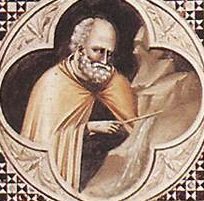
This small border fresco was painted by Giotto in the 14th century as part of a large-scale decoration cycle. It is nestled inside a border image that delineates much larger frescoes with the story of Christ’s life. The chapel decoration overall is a particularly striking example of Giotto’s revolutionary style that was a (oftentimes shocking) departure from Byzantine painting tradition. You can look at the other images from the chapel with your child if desired. Here Moses brings water from a rock, a sacred act. However, notice the more realistic expression and the softer lines that Giotto was known for. Moses is given a more “lifelike” appearance, drawing attention to his humanity. He has soft hair and wrinkles and an emotional expression on his face. And yet, the mountain still has something of an unrealistic appearance, reminding the viewer of otherworldliness or sacred space. Though inside a sacred space again, the image is less a window to the divine and more an artistic expression of the humanity of his subject. Giotto’s style and methods of painting only become more and more popular in the Renaissance, Catholic West in following years. Though not for prayer in the Orthodox sense, its beauty is still reflective of God’s beauty in the world, possibly bringing some nuance to an understanding of what it is to be human.
Image 5: Rembrandt van Rijn. Moses Smashing the Tablets of the Law (ca. 1659), in the Gemäldegalerie, Berlin.

This Rembrandt painting of Moses’s descent from the mountain is a stark contrast to earlier, sacred images for use during prayer. After the Protestant Reformation, churches did not typically commission artwork, and art moved even more into the sphere of personal use. Most of Rembrant’s paintings were commissioned by individuals. By Rembrandt’s time at the height of the Dutch Baroque period painting’s purpose had shifted from sacred devotional use or use in worship to a focus on an artistic evocation of emotion and feeling. This painting illustrates that fact by its mere size. It is large: five feet tall and four feet wide. Moses is positioned directly in front of the viewer where one can quite intensely feel movement downward. He is angry or in pain, likely about to smash the tablets of the law. Everything is realistically portrayed, including the Hebrew lettering on the tablets of the law. What else can you and your children notice about this painting? What else might Moses be feeling and how might this be represented?
Check back soon for more lesson plans!