


Hiding in the Library: Orthodox Books for Children and Teens
There are so many books out in the world, and not all of them are edifying. What we put into our brains matters. If we put junk into our brains it will affect our souls and our thoughts, but if we put edifying knowledge and pure thoughts into our brains, it will be beneficial for us. Our faith calls us to keep a pure mind and heart, for what goes in comes out. Sometimes it is hard to find good books and it is even harder to find good Christian and Orthodox books for teens and children to read. So here are some I have enjoyed!
by Sevastiane, Summer ‘24 Intern
There are so many books out in the world, and not all of them are edifying. What we put into our brains matters. If we put junk into our brains it will affect our souls and our thoughts, but if we put edifying knowledge and pure thoughts into our brains, it will be beneficial for us. Our faith calls us to keep a pure mind and heart, for what goes in comes out. Sometimes it is hard to find good books and it is even harder to find good Christian and Orthodox books for teens and children to read. So here are some I have enjoyed!
Letters to Saint Lydia by Melinda Johnson: I would recommend this book for somewhat older teens. It follows a non-Orthodox girl and her journey to finding the faith through her letters to her patron, Saint Lydia. Lydia’s family converts to Orthodoxy without her and she doesn’t know what she wants to do, so she writes to Saint Lydia. This book is very relatable since it is set in modern times and covers a lot of difficult topics teens face today. I loved this book very much and I recommend it to everyone I know. Ten out of ten for sure!
Voyage to the Rock By Father Matthew Penney: For those of you who like mystery books, this one is great. It is like any other mystery book you would find in the bookstore, but the main characters are Orthodox! This one is great as a read-aloud or for tweens who want to read it themselves. It follows Martin, a priest’s kid, who has to move to Newfoundland, Canada to help his family build a parish. There he finds an old cross. Is it the cross from the voyage of Saint Brendan the Navigator? With his sister and his new friend Ashley, Martin tries to figure out the mystery of the cross, all while the evil Sullivan O’Connell hunts them down. This one is an enjoyable read.
Saint Spyridon’s Shoes by Christine Rogers: This book is good for any age. This book takes place in Corfu, where Spyros fishes on the beach and longs to attend school like his friend, Nico. He then meets an old man on the beach and befriends him. This is a story about their friendship. The friendship turns out to be a lot more important than Spyros realizes. This book is short and sweet and a great one for everyone to read!
Who is God? Who am I? Who Are You? by Dee Pennock: This is one of my favorite books to read. This book also covers a lot of difficult topics for teens about living in the world. It has tons of good quotes and talks about free will and how to love our neighbor. This book covers all the hard topics but formats them in a fun and interesting way to read. The illustrations might look funny, but this book is truly one of the best for teens!
Icon by Georgia Briggs: I cannot stress enough the importance of this book for teens. I love this book with all my heart. Sometimes living in the world as an Orthodox Christian can be hard. Christ says to live in this world but not of this world, and sometimes we can get mixed up and start to morph to the expectations and pressure from our friends and non-Christian family and the secular world. We can start to think that it is more important for us to have money and lots of clothing and to keep up to date with the latest trends. This book is a great example for remembering our faith in the modern world. . Icon is about a young Euphrosyne, whose family is killed, so she has to move in with her grandparents. It is set in a future where being Christian is illegal, and people have to change their names and their whole identity. This book is about one girl fighting for what she believes in and putting her trust in Christ in times of struggle. Euphrosyne is a character you can both relate to and try to imitate. This book is a good reminder of what our time on earth is really for.
My Elder, Joseph the Heschycast by Elder Ephraim of Arizona: Saint Joseph is one of my favorite saints and this book is his thorough life story. It is thicker than the books mentioned above, and it is not fiction, but his life story is amazing. At the start of the story, he struggles with the same problems we all have, like anger, but he overcomes them and achieves a state of complete grace and prayer from the heart. Elder Joseph also had a very close relationship with the Theotokos, and he would pray to her all the time, for any need. Saint Joseph was able to see demons and physically had to fight them for them to disappear. I really love this book and think it is a great book for early teens.
Precious Vessels of the Holy Spirit by Protecting Veil Press: The contemporary elders of Greece are all newer saints or people believed to be saints but awaiting canonization. This book covers many of their lives. It has a short biography about each of them, as well as the counsel or advice that they gave. I love this book because it has so many saints, many of which are newer saints. Their advice is priceless and you can learn a lot from reading this book. This book is more for teens, and adults can read it too!
While these are just some of the many Orthodox books out there, all of these books are fantastic reads, and there is something for everyone, from mystery to biography. I loved reading these books, and I hope you will too. I hope you can learn from reading these books!
The Six Areas of Early Literacy
Something you might not know about me (or maybe you already do know this, and you’re about to be like, “please, Mindi, enough already!”) is that I used to be a Children’s Librarian. One major aspect of my job was planning storytimes, which meant thinking a lot about pre-literacy skills and teaching parents how to help their children hone these skills. So today, I’m going to talk about the six areas of early literacy and ways that you can strengthen your child’s skills in these areas, specifically by engaging with our Faith!
by Mindi Popovich-Schneider, Saint Emmelia Ministries Assistant
Something you might not know about me (or maybe you already do know this, and you’re about to be like, “please, Mindi, enough already!”) is that I used to be a Children’s Librarian. One major aspect of my job was planning storytimes, which meant thinking a lot about pre-literacy skills and teaching parents how to help their children hone these skills. So today, I’m going to talk about the six areas of early literacy and ways that you can strengthen your child’s skills in these areas, specifically by engaging with our Faith!
The first area is vocabulary. Children ages newborn to four should hear between 17,000-21,000 words per day. Research shows that children who hear substantially fewer words than this tend to struggle in the first few years of school. Now, since we’re all hanging out on the Saint Emmelia Ministries website, I would hazard a guess that not a lot of us put much stock into public education’s metrics for success. Still, I think the message is clear: words matter! Reading (naturally!), narrating what you’re doing, and asking open-ended questions and modeling a response–all these things can increase the number of words your child hears per day.
Fortunately, being Orthodox puts us at an advantage: take your child to any service, and they will hear between 25% and 40% of those words. Add in morning, evening, and mealtime prayers, and you’re zooming towards that goal! On top of all of that, you’re automatically introducing them to lovely, delightful words that most kids don’t have the opportunity to encounter.
Singing is incredibly important for developing literacy skills. When we sing, we draw out our syllables naturally. Children then can hear the individual sounds and understand that words are broken up into smaller parts. This understanding is called “phonological awareness,” which later helps children sound out words while reading.
Here again, because music is such an important part of our faith, Orthodoxy comes in handy! Sing hymns with your kids throughout the day, and they’ll DEFINITELY be hearing all those phonemes (“aaaaaaaaa-leeeeeeeeee-luuuuuuuuuu-iaaaaaaaa”)!When you’re out and about–talking walks, going to the grocery store, etc.–you probably talk to your little ones about what you see (personally, puppy doggies and “cycs”–motorcycles–are a BIG topic of discussion any time we leave the house!). Do you ever pause and talk to your kids about signs or logos? Well, that is one incredibly easy way to help develop print awareness, the understanding that letters and numbers have meaning. When reading books with your children, point out specific words, especially if those words are in a font that stands out from the others. Books with very few words are also great for developing this skill because it makes it easier for kids to connect an isolated symbol with its meaning.
When you’re looking at icons, be sure to point out the writing. Explain that the writing is the saint’s name. Show them the text on the scrolls and explain that it’s something that particular saint said.
Move over, geometry: shapes are important for reading too! After all, what are letters but shapes combined in different ways? Shape-sorting games are a great foundation for learning to write letters. As you play, talk about the similarities and differences in shapes. When you’re out and about, identify the different shapes you see. All of this helps build letter knowledge, the ability to distinguish between and identify letters.
Thank goodness that Orthodoxy is so tactile! As you look at all the objects around you in your home or at church, talk about the shapes they are made up of. Use your child’s fingers to trace the length of a candle or the roundness of the antidoron.
If your family is anything like mine, you’ve probably had to read one or two books over and over and over and over. While you might be reciting Goodnight, Moon in your sleep, this repetition is actually incredibly important for kids because it strengthens their narrative skills, or the ability to understand stories. When a child hears a story over and over, they begin to recall what happens next, unconsciously absorbing an ordered sequence of events.
Playing pretend–even something as basic as pretending that a blanket is a priest’s robe–can help strengthen narrative skills because it helps kids think symbolically. Playing “Liturgy” can also help kids strengthen their understanding of sequence. As your kids gain more speech, have them narrate to you what you’re doing as you prepare to say prayers (or as you watch liturgy from the Narthex!)
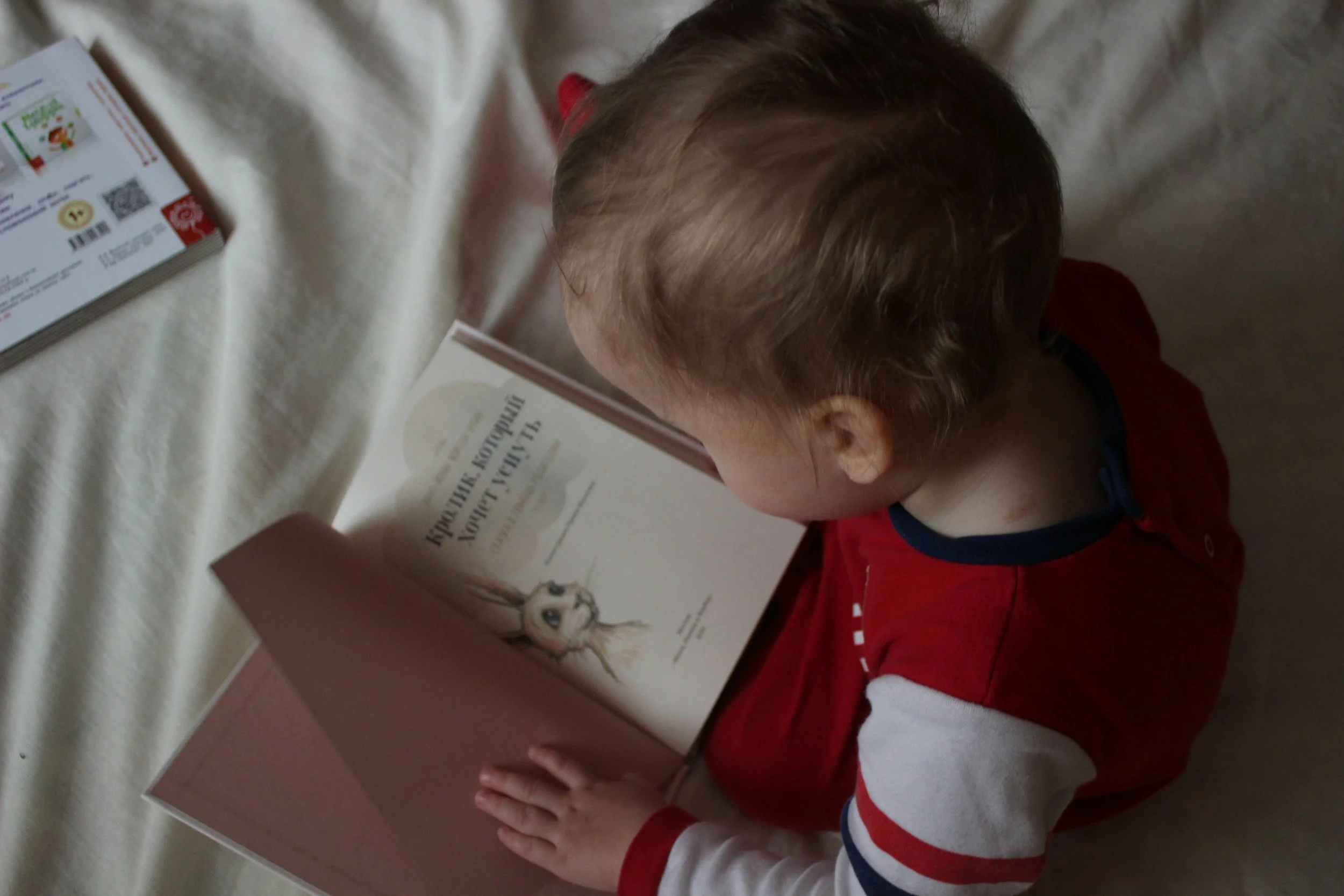
The best literacy area (in my opinion) is print motivation, or a child’s interest in and enjoyment of books. For very young children, this means allowing them to explore books in their own way: going backwards and forwards as they wish, lingering over pictures, skipping pages or reading them over and over, and even chewing on pages! At any age, being snuggled up together creates an association between reading and feeling loved.
Reading books about Orthodoxy can be motivating because they have an immediate connection to your child’s life. When kids recognize something in a book–perhaps a priest’s robe or a specific icon–they are more likely to want to engage with the book and find out what is going on in the pictures.
One of my biggest takeaways from my time in libraries is that almost everything we do contributes to early literacy in one way or another. You can make these activities extra rich by engaging with your kids through questions and making connections to the six different areas of literacy. And of course, as with everything in life, the best place for growth is in the beauty and love of the Church!