Now that we have placed the city of Corinth in its context, let’s get to know the people of Corinth and the other early Christians who supported the Church there. We will look at each of these figures and their lives, as well as how they give meaning to the lessons Paul was trying to teach the Corinthians.
Background information:
In his two letters, Paul mentions a number of early Christians, many of whom are mentioned in the Acts of the Apostles or in Paul’s early letters. Start learning about them by reading the Bible verses listed. The links offer more biographical information.
Sosthenes (1 Cor 1:1): Listed along with Paul in the greeting of the letter. Because the rest of the epistle is written in the first-person singular, it does not seem that Sosthenes was involved with writing the letter. However, at the time, he was with Paul in Ephesus. (See also Acts 18:17)
Chloe (1 Cor 1:11): A wealthy woman of Corinth. These servants of Chloe most likely met with Paul in Ephesus, bringing him news of the Church, while on business for their mistress.
Apollos and Peter (1 Cor 1:12, 1 Cor 3:6, 1 Cor 9:5-6): First mentioned in the context of the factionalism breaking out among the Church in Corinth. Because Paul was the founder of the Church in Corinth, some declared their loyalty to him. Others felt that Paul was not well-educated enough, and placed their loyalty behind Apollos. Still others declared themselves followers of Peter, as he was one of the original twelve apostles. Paul admonishes them to be united–followers of Christ above all. Later, he compares himself to Peter (Cephas), demonstrating through his own work how the Corinthians must exercise restraint in the freedoms Christ has given them.
Crispus and Gaius (1 Cor 1:14): Two Corinthians whom Paul baptized. He states that he is glad he baptized so few, so that he did not contribute to the factionalism breaking out. (See also Acts 18:18 [Crispus], Acts 19:29, Romans 16:23, 3 John 1 [Gaius])
Timothy (1 Cor 4:17, 2 Cor 1:1, 2 Cor 1:19): Travelled with Paul. He had, at some point, left Paul to go to Macedonia, from where he would presumably travel to Corinth to help the Church. By the beginning of the second letter, Timothy and Paul were reunited in Philippi.
Barnabas (1 Cor 9:5-6): Mentioned as an example of the differences between apostles. Paul worked as a tentmaker to support himself, refusing to take money from the Church. Barnabas apparently operated similarly. Paul uses these examples to build the case that the apostles and teachers use restraint, despite having freedom in Christ to act in different ways.
Stephanas (1 Cor 16:15-17), Fortunatus, and Achaicus (1 Cor 16:17): Three of the 70 Apostles. Stephanas is described as the first baptized in “Achaia,” the province where Corinth was located. Paul offers him and his household up as models for serving the Church. The three men visited Paul in Corinthians, and presumably returned with his letter to the Church.
Silvanus (2 Cor 1:19): Mentioned along with Timothy and Paul himself as one of the three main teachers and apostles to the Corinthians. By mentioning Timothy and Silvanus, Paul highlights the truth of God’s promises–not only has Paul taught it, but so have these other two apostles.
Titus (2 Cor 7:6-7): Another of the 70 Apostles. Paul, while away from Corinth, experienced “tribulation,” “fears,” and “quarrels.” However, Titus brought him news from Corinth, providing “relief.”
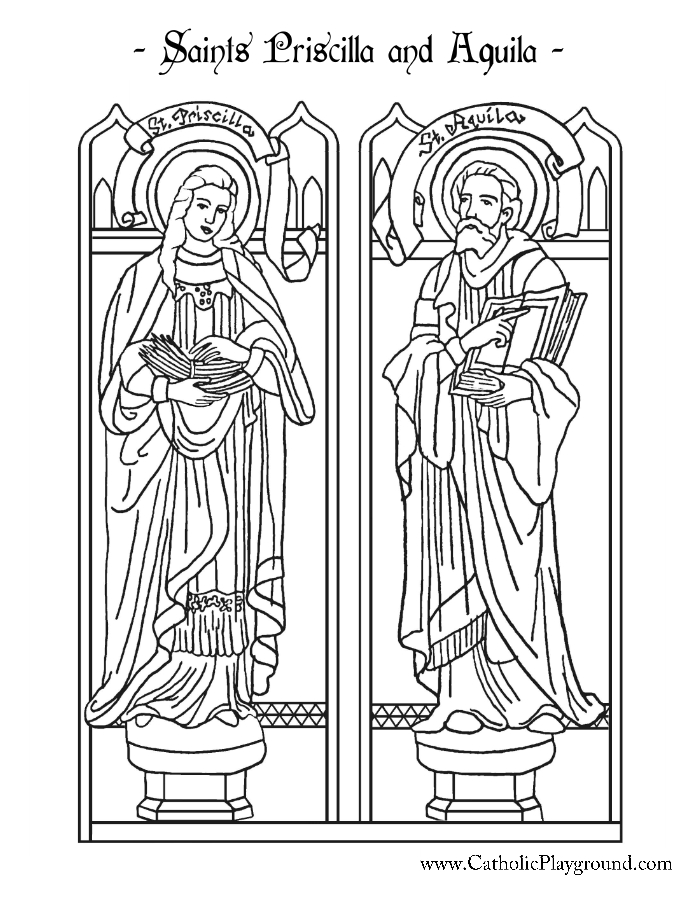
Aquila and Priscilla (1 Cor 16:19): A married couple whom Paul lived with during his stay in Corinth. Aquila and Paul together worked as tentmakers, and when Paul set out for Syria, the two accompanied him. The Church at Ephesus gathered in their house. (See also Acts 18:2-3, 18, 26)
Erastus and Quartus (Romans 16:23): Two of the 70 Apostles, mentioned along with Gaius. When Paul wrote his letter to the Romans, he was residing in Corinth. In his closing, he sends greetings from these three apostles.
Activity:
Choose 2-3 saints to read more about their lives (NOT Apollos, Peter, Timothy, Barnabas, Silas, or Titus–that is, apostles to Corinth, who were not from there).
What do you notice about their lives?
How does knowing their lives help us understand the impact of Paul’s letters and teachings?
Look up their icons
Print off the attached cards and practice matching them up.
Questions for consideration:
What does it say about the early Church that Paul could casually “name drop” so many of the Apostles–many of whom had not yet personally visited Corinth?
Activities for younger siblings:
Read 1 Corinthians 1 and 16. Write a letter to a friend from Church, modeling Paul’s opening and closing
Look up the icons of two or three of the saints and read about them. Ask them for their prayers!
Color this picture of Ss. Aquila and Priscilla.
Sources:
Farley, Lawrence. First and Second Corinthians: Straight from the Heart. Chesterton, IN: Ancient Faith Publishing. 2005.